Best Countries for Hiring Developers in South America (2026)

TL;DR :-
Explore the best countries for hiring developers in South America based on talent depth, cost structure, and ecosystem maturity.
Evaluate India vs Latin America and find out their advantages and differences.
Apply a decision framework covering EOR models, talent validation, and strategic alignment with your product roadmap.
You need high-quality developers. Fast. But you also need cost control, time zone alignment, and predictable delivery. South America looks attractive. Yet every country promises talent, English fluency, and lower rates.
The real challenge is not finding developers. It is choosing the right ecosystem. Some markets offer scale. Others offer stability. A few offer deep technical maturity.
If you are evaluating the best countries for hiring developers in South America in 2026, this guide breaks down scale, cost, risk, compliance, and strategic fit — so you can make a decision that supports long-term product velocity.
Scaling Fast but Losing Control Over Cost and Delivery Quality?
Rapid hiring without process discipline creates compliance risks and sprint delays. Soft Suave combines cost clarity, legal safety, and engineering rigor for predictable outcomes.
Fix ScalingThe “Big Three”: Brazil, Colombia, and Argentina
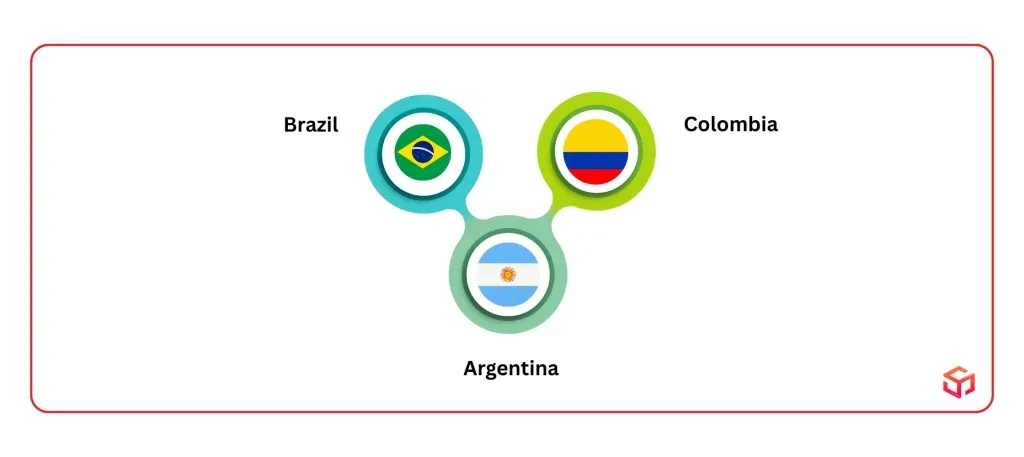
These three countries dominate South America’s tech hiring landscape due to scale, ecosystem maturity, and international exposure. Each offers a different balance of cost, talent depth, and operational risk.
Brazil
Brazil has the largest developer population in South America. Major hubs like São Paulo anchor a strong fintech and enterprise software ecosystem. The internal market drives innovation and reduces dependency on foreign contracts.
Brazil’s advantages:
Large talent pool
Brazil has hundreds of thousands of software engineers across Java, .NET, Node.js, and cloud-native stacks, making large-scale team expansion feasible without severe talent shortages.Enterprise ecosystem maturity
Strong exposure to banking, telecom, and retail systems creates engineers comfortable with high-availability architectures and complex system integrations.Strong GitHub activity
Brazilian developers show consistent open-source contributions, signaling technical engagement beyond service-only work.
Considerations:
Higher salary bands than in Peru or Colombia.
English proficiency varies by region.
Mandatory 13th-month salary increases total employment cost.
Brazil is ideal for scale and enterprise-grade engineering teams.
Argentina
Argentina is known for technical depth and strong English proficiency. Buenos Aires remains a major tech hub. Argentine engineers often work directly with US startups and SaaS firms.
Argentina’s strengths:
Competitive rates
Currency volatility makes hourly rates attractive compared to regional peers, especially for USD-based contracts.High English proficiency
Among the strongest English skills in Latin America, which reduces communication friction in Agile delivery.Strong academic foundation
A respected engineering education system produces developers comfortable with algorithms and architecture-level problem solving.
Risks to monitor:
Inflation-driven salary renegotiations.
Currency instability is affecting long-term cost predictability.
Argentina suits product-led companies that value communication and engineering depth.
Colombia
Colombia is one of the fastest-growing tech ecosystems in the region. Bogotá and Medellín have seen rapid startup growth supported by government-backed innovation programs.
Colombia’s advantages:
Balanced cost-to-quality ratio
Developer rates remain competitive while technical standards continue improving across frontend, backend, and DevOps skill sets.Government tech investment
Public-private initiatives support digital transformation and software export growth.Improving English proficiency
Continuous investment in language training strengthens collaboration with US companies.
Colombia is a strong option for companies seeking growth-stage nearshore teams without Brazil-level cost exposure.
Need Elite Engineers Without Slowing Your Product Roadmap?
Our full-stack developers integrate seamlessly into your architecture, follow Agile best practices, and deliver measurable sprint velocity aligned with your product goals.
Meet Our ExpertsQuality Specialists: Uruguay and Chile
These countries may not offer massive talent pools, but they deliver stability, regulatory clarity, and strong professional standards. They work well for precision hiring rather than aggressive scaling.
Uruguay
Uruguay is politically stable and business-friendly. The developer pool is smaller but highly professional. Engineers here often work on enterprise SaaS and fintech platforms.
Key strengths:
Regulatory predictability
Transparent labor laws reduce compliance ambiguity and lower legal risk for foreign companies.High contract stability
Lower corruption perception compared to regional averages increases operational confidence.Strong remote culture
Teams are accustomed to international clients and distributed Agile workflows.
Uruguay fits companies seeking low legal friction and stable long-term collaboration.
Chile
Chile consistently ranks high in economic stability and business transparency. Developers here show strong exposure to mining-tech, SaaS, and cloud solutions.
Chile’s advantages:
High English proficiency
Communication quality often surpasses regional averages, improving sprint clarity and stakeholder alignment.Business-friendly regulations
Easier incorporation processes and investor-friendly policies.Technical specialization
Cloud-native development and DevOps adoption are relatively strong.
Chile is well-suited for specialized cloud, data, and DevOps-focused engagements.
Emerging Markets: Peru and The Nearshore Advantage
Emerging markets offer cost advantages and growing talent pools. Combined with geographic proximity to North America, they create strong nearshore collaboration models worth evaluating.
Peru is steadily expanding its software engineering base.
Peru’s advantages:
Competitive developer rates
Lower hourly costs compared to Brazil and Chile while maintaining and improving quality standards.Growing education pipeline
Increasing STEM enrollment contributes to expanding junior and mid-level developer supply.Less market saturation
Lower competition for top engineers compared to Argentina or Brazil.
Nearshore advantage:
Real-time time zone overlap with US teams.
Reduced communication latency compared to Asian offshore models.
Easier travel and cultural alignment.
Faster Agile sprint cycles due to synchronous collaboration.
For many US companies, this operational proximity is as important as cost savings.
Struggling With Developer Quality Variance Across South America and India?
Unpredictable skill levels delay releases and inflate costs. Soft Suave delivers rigorously vetted Indian engineers, structured governance, and transparent reporting to protect your roadmap.
Secure StabilityIndia Vs Latin America: Which is best to hire developers?
Global hiring decisions often come down to India versus Latin America. Both regions offer strong engineering ecosystems but serve different operational strategies.
India’s advantages:
Massive talent pool: Millions of developers across diverse technology stacks, enabling rapid scaling of large engineering teams.
Mature offshore delivery models: Decades of experience in IT services, managed services, and enterprise modernization projects.
Cost efficiency at scale: Lower baseline salaries, especially for large offshore development centers.
Latin America’s advantages:
Nearshore time zone alignment: Real-time collaboration with US teams reduces project delays.
Strong English proficiency in Argentina and Chile: Improves product discussions and sprint ceremonies.
Cultural compatibility: Agile ceremonies and stakeholder communication often feel more aligned with US business culture.
Choosing between India and Latin America depends on delivery intensity, collaboration needs, and scaling speed. An offshore development center in India does not automatically guarantee lower total cost, reduced overhead, or better outcomes compared to a nearshore setup in South America.
India is suitable for large-scale offshore delivery models, long-term managed services, and cost-optimized enterprise modernization programs. It works well when structured processes, layered team hierarchies, and 24/7 development cycles are strategic priorities.
The success of this model depends less on geography and more on delivery maturity – including sprint discipline, architectural oversight, and transparent reporting frameworks. Companies that partner with experienced offshore development teams such as Soft Suave often focus on predictable velocity, clear communication pipelines, and measurable engineering KPIs rather than just hourly cost.
Latin America is better suited for high-collaboration product engineering, Agile sprint environments, and real-time stakeholder interaction. It performs strongly in startup ecosystems, SaaS product development, and innovation-driven roadmaps where rapid iteration and time zone alignment directly impact velocity.
The decision should align with your architecture complexity, budget strategy, and operational oversight capacity.
Financial Reality: Base Rates vs. Total Cost of Employment
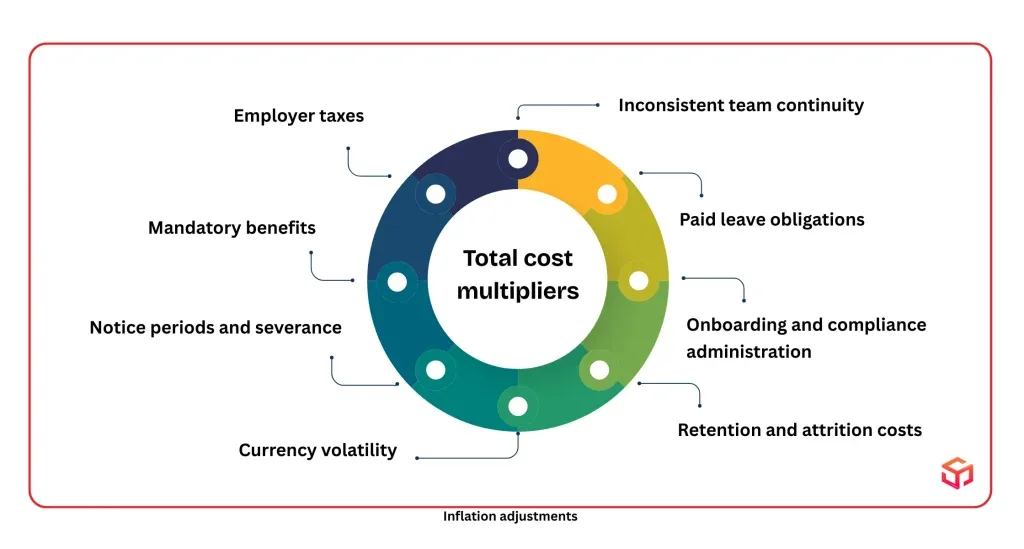
Developer salary is only part of the equation. The real cost includes statutory benefits, payroll taxes, and compliance obligations that vary across countries.
Base salary factors:
Senior developer hourly rate in South America typically starts from $35, and increases depending on the country and specialization.
Argentina and Peru often sit at the lower end.
Chile and Brazil trend higher.
Total cost multipliers:
Employer taxes: Payroll contributions can increase total cost by 20% to 60%, depending on country-specific labor laws.
Mandatory benefits: Brazil includes a 13th-month salary requirement, significantly impacting annual cost projections.
Notice periods and severance: Termination policies differ and may add unexpected liabilities.
Currency volatility: Exchange rate fluctuations, especially in Argentina, can impact long-term budgeting and force frequent contract adjustments when salaries are benchmarked against USD.
Inflation adjustments: High inflation environments may require periodic compensation revisions, increasing annual payroll costs beyond initial projections.
Paid leave obligations: Statutory vacation days, public holidays, and sick leave policies vary by country and directly affect billable productivity and workforce availability.
Onboarding and compliance administration: Background checks, employment contracts, payroll setup, and legal consultation add operational overhead, particularly when hiring without local infrastructure.
Retention and attrition costs: Competitive markets like Brazil and Argentina may require retention bonuses, skill premiums, or counteroffers to maintain senior engineering talent.
Before budgeting, review a structured developer rate card to benchmark realistic cost expectations across skill levels and engagement models.
Understanding total cost prevents financial miscalculations that derail scaling plans.
Not Sure If the Talent Will Match Your Technical Standards?
Test our developers for 40 hours at zero cost. Evaluate code quality, communication, and architectural thinking before making any commitment.
Start TrialCompliance & EOR: Navigating Legal Fragmentation
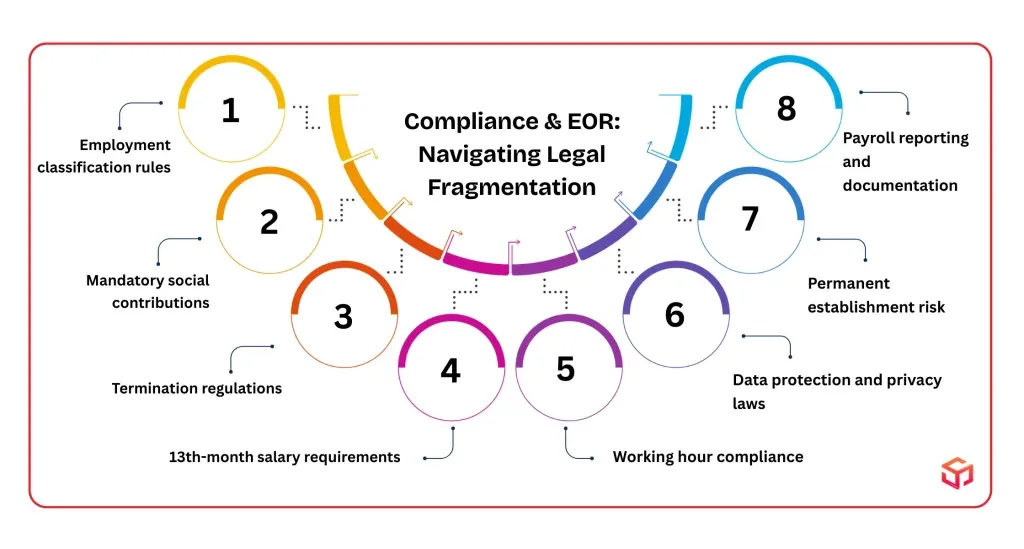
Each South American country has distinct labor regulations. Setting up a local entity is complex and time-consuming for foreign firms.
Compliance challenges include:
Employment classification rules: Misclassifying contractors as independent workers instead of employees can trigger fines, back taxes, and retroactive benefit obligations.
Mandatory social contributions: Healthcare, pension funds, unemployment insurance, and other statutory benefits vary by jurisdiction and significantly impact employer payroll obligations.
Termination regulations: Notice periods, severance calculations, and dismissal justification requirements differ across countries and may create unexpected financial exposure.
13th-month salary requirements: Countries like Brazil mandate an additional annual salary payment, which must be factored into total compensation modeling.
Working hour compliance: Overtime pay, maximum weekly hours, and holiday pay rules are strictly regulated and can increase payroll liabilities if mismanaged.
Data protection and privacy laws: Local data protection regulations may require secure handling of employee records and cross-border compliance safeguards.
Permanent establishment risk: Operating without a local entity may expose foreign companies to corporate tax liabilities if authorities determine an ongoing commercial presence.
Payroll reporting and documentation: Monthly filings, tax declarations, and government reporting obligations require precise administrative processes to avoid compliance penalties.
Employer of Record (EOR) solutions simplify entry by:
Handling payroll and compliance.
Managing statutory benefits.
Reducing legal exposure.
An EOR model enables fast hiring without incorporating a local subsidiary, especially useful during pilot hiring phases.
Vetting Talent: Education and Technical Validation
Country selection is only the first step. Talent validation determines delivery quality.
South America produces strong STEM graduates, particularly in Argentina and Brazil. However, vetting must go beyond resume screening.
Effective validation includes:
Live coding assessments: Test algorithmic thinking, debugging skills, and real-time problem solving under pressure to evaluate practical coding ability beyond theoretical knowledge.
Architecture interviews: Assess system design capability, microservices structuring, database optimization, and scalability planning for cloud-native and distributed environments.
GitHub and open-source review: Analyze contribution history, code quality, documentation habits, and collaboration patterns to measure real-world engineering engagement.
Domain alignment checks: Verify prior experience in fintech, SaaS, healthcare, AI, or enterprise modernization to ensure contextual relevance to your product roadmap.
Code review simulation: Evaluate how candidates review existing code, suggest refactoring improvements, and apply clean architecture principles in collaborative environments.
DevOps and deployment exposure: Assess familiarity with CI/CD pipelines, containerization, infrastructure-as-code, and cloud platforms such as AWS or Azure.
Security awareness evaluation: Test understanding of secure coding practices, data protection standards, and common vulnerabilities like OWASP Top 10 risks.
Communication and Agile fluency: Measure clarity in technical explanation, sprint participation readiness, and ability to collaborate within Scrum or Kanban frameworks.
Data from Stack Overflow surveys and GitHub activity trends confirm rising developer engagement across Latin America.
Strong validation processes convert regional potential into predictable delivery outcomes.
Conclusion: Aligning Your Stack with the Right Hub
Hiring in South America is not a cost decision. It is a velocity decision. The right country strengthens your engineering throughput, reduces communication drag, and stabilizes long-term scaling. The wrong choice creates hidden friction across compliance, cost control, and sprint execution.
Brazil delivers enterprise-scale engineering. Argentina drives communication clarity and architectural depth. Colombia balances growth and affordability. Uruguay and Chile provide regulatory confidence. Peru offers emerging cost leverage.
Your architecture, delivery, and risk tolerance should guide the decision. Map your roadmap. Define your scaling horizon. Then choose the hub that accelerates execution – not just the one with the lowest rate.
FAQs
What is the average hourly rate for a senior developer in South America?
Senior developer rates typically start from $35 per hour, depending on country, specialization, and engagement model. Argentina and Peru trend lower, while Brazil and Chile sit toward the higher end of the range.
Which South American country has the best English proficiency for tech teams?
Argentina consistently ranks highest for English proficiency in the region, followed closely by Chile and Uruguay. Strong English skills reduce communication friction and improve Agile collaboration with US-based product and engineering teams.
How do I handle local labor laws without setting up an office in South America?
You can use an Employer of Record (EOR) model. An EOR manages payroll, statutory benefits, tax compliance, and employment contracts, allowing you to hire legally without creating a local legal entity.
Why is Brazil considered a leader in technical depth?
Brazil has the largest developer population in South America, strong enterprise exposure in fintech and telecom, and active participation in open-source communities, making it a leader in large-scale and complex system development.

Ramesh Vayavuru is the Founder & CEO of Soft Suave Technologies, with 15+ years of experience delivering innovative IT solutions.
Related Blogs