Best Staff Augmentation Providers for AI Developers in 2026: Vetted & Reviewed

TL;DR :-
Understand how AI staff augmentation differs from traditional IT staffing and the skills providers should evaluate before hiring.
Explore key AI roles, compare leading AI staffing providers, and identify which options fit different business needs.
Discover why India leads AI staff augmentation and learn practical criteria for evaluating AI talent partners.
Finding experienced AI developers is becoming harder every year. The need for AI professionals keeps increasing, yet engineers who possess practical experience in LLMs, MLOps, and production AI systems are still difficult to locate.
As a result, AI-focused staff augmentation has become one of the fastest-growing hiring models in 2026. Instead of spending months recruiting internally, businesses can access pre-vetted AI engineers who are ready to contribute immediately.
However, not every provider specializes in AI talent. Understanding the differences between AI staffing and traditional IT staffing, along with AI-specific hiring requirements, is critical before choosing a partner.
In order to streamline the evaluation process, we assessed and vetted top staff augmentation providers using the criteria that organizations typically use when assessing AI talent partners.
These criteria are based on the questions, concerns, and evaluation priorities we have repeatedly encountered during AI hiring and vendor selection discussions. We explain them in more detail later in this guide.
What Makes AI Staff Augmentation Different from Regular IT Staffing
Hiring AI talent requires a very different evaluation process than traditional software hiring. AI projects involve specialized skills, infrastructure expertise, and model deployment knowledge that general staffing providers often struggle to assess accurately.
Understanding these differences helps companies avoid costly hiring mistakes.
AI-specific vetting: LLM, MLOps, Data Engineering skills
AI hiring is far more complex than traditional software hiring. New models, frameworks, and AI tools emerge constantly, making technical skills difficult to assess through resumes alone. Companies need engineers who can adapt, learn quickly, and solve evolving challenges.
This is why specialized vetting is essential. Strong AI engineers need more than coding skills. They must understand AI models, data pipelines, deployment workflows, and production environments to build scalable solutions that deliver measurable business value. Here are some more reasons why AI-specific vetting is important
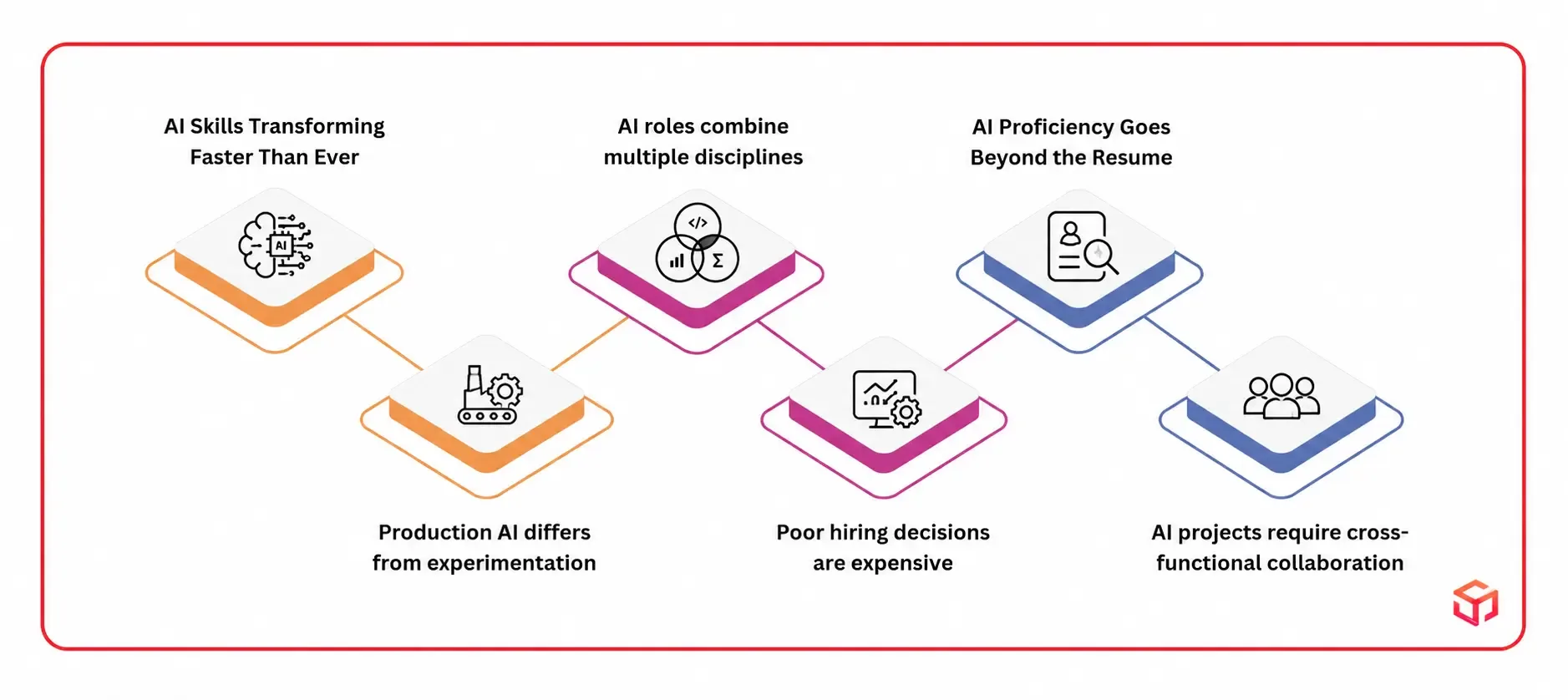
AI Skills Transforming Faster Than Ever: New models, frameworks, and deployment techniques emerge frequently, making continuous learning and adaptability critical for long-term success.
AI roles combine multiple disciplines: Modern AI engineers often require expertise across software development, machine learning, cloud infrastructure, and data engineering.
AI Proficiency Goes Beyond the Resume: Many candidates list AI tools on resumes, but hands-on implementation experience is often difficult to verify.
Production AI differs from experimentation: Building prototypes is easier than deploying reliable AI systems that perform consistently at scale.
Poor hiring decisions are expensive: Incorrect AI hires can delay projects, increase costs, and slow business adoption of AI initiatives.
AI projects require cross-functional collaboration: Successful implementations depend on engineers working effectively with data, product, infrastructure, and business teams.
These are some of the critical AI skills providers should evaluate.
Large Language Models (LLMs): Ability to work with GPT, Claude, Gemini, and open-source language models effectively.
Prompt Engineering: Designing prompts that improve response quality, reliability, accuracy, and task-specific performance.
Retrieval-Augmented Generation (RAG): Building systems that combine enterprise knowledge with language model capabilities.
Data Engineering: Managing data pipelines, transformations, quality controls, and infrastructure supporting AI systems.
MLOps and Deployment: Deploying, monitoring, scaling, and maintaining AI models in production environments.
Vector Databases and Embeddings: Understanding semantic search, knowledge retrieval, embeddings, and vector storage systems.
AI Infrastructure: Working with cloud platforms, GPUs, model serving, and inference optimization techniques.
Model Evaluation and Monitoring: Measuring performance, detecting drift, and ensuring long-term reliability of AI solutions.
These skills are critical because modern AI projects depend on far more than model development.
Engineers must manage data, infrastructure, deployment, and ongoing optimization to ensure AI solutions perform reliably in production environments and deliver measurable business value.
Why general IT staffing firms fall short for AI roles
Conventional staffing agencies were established to recruit software developers, QA engineers, and infrastructure experts.
AI hiring introduces a different set of technical, operational, and business requirements that many general staffing providers are not equipped to evaluate.
Common challenges include:
1. Rapidly Evolving AI Skills are Difficult to Assess
AI technologies evolve far faster than traditional software stacks. New models, frameworks, and tools emerge every few months, making resume-based screening unreliable. Many staffing firms lack the expertise to evaluate LLM experience, prompt engineering, model optimization, RAG architectures, and other specialized AI capabilities.
2. Modern AI Roles Are Highly Specialized and Cross-Functional
AI positions rarely fit into a single job category. An AI engineer may require expertise in software development, machine learning, cloud infrastructure, data engineering, and business workflows. Traditional staffing models are optimized for narrow roles and often struggle to assess hybrid skill sets accurately.
3. Limited Understanding of AI Infrastructure and MLOps
Building an AI prototype is only the beginning. Successful AI projects need knowledge in several key areas: GPUs, vector databases, model serving, cloud AI platforms, monitoring, version control, deployment automation, and managing the AI lifecycle. These critical skills are frequently overlooked during conventional technical screening.
4. Difficulty Evaluating Data Engineering Capabilities
The effectiveness of AI systems relies entirely on the quality of the data that supports them. Reliable data pipelines, data quality management, feature engineering, and inference infrastructure directly impact model performance. General staffing providers often underestimate the importance of these foundational skills when sourcing AI talent.
5. Focus on Individual Roles Instead of Complete AI Teams
Successful AI initiatives depend on collaboration between AI engineers, MLOps engineers, data engineers, product managers, and domain experts. Conventional staffing agencies usually prioritize filling specific roles instead of comprehending how these positions collaborate to achieve business results.
These limitations often result in longer hiring cycles, weaker candidate matches, delayed AI initiatives, and higher recruitment costs.
The best staff augmentation providers for AI developers understand these complexities and can identify talent capable of building, deploying, and scaling production-ready AI solutions.
Struggling to Find Proven AI Talent?
Hiring delays and weak AI expertise can stall projects. Soft Suave provides vetted AI engineers who accelerate delivery, reduce risk, and improve outcomes.
Hire AI ExpertsKey AI Roles to Understand Before Choosing a Provider
AI projects require a mix of specialized skills, not just AI developers. Understanding these key roles helps you identify the expertise your project needs and choose a provider capable of supplying the right talent.
Based on our experience helping organizations build AI teams, these are the roles organizations most commonly need to build, deploy, and scale AI successfully.
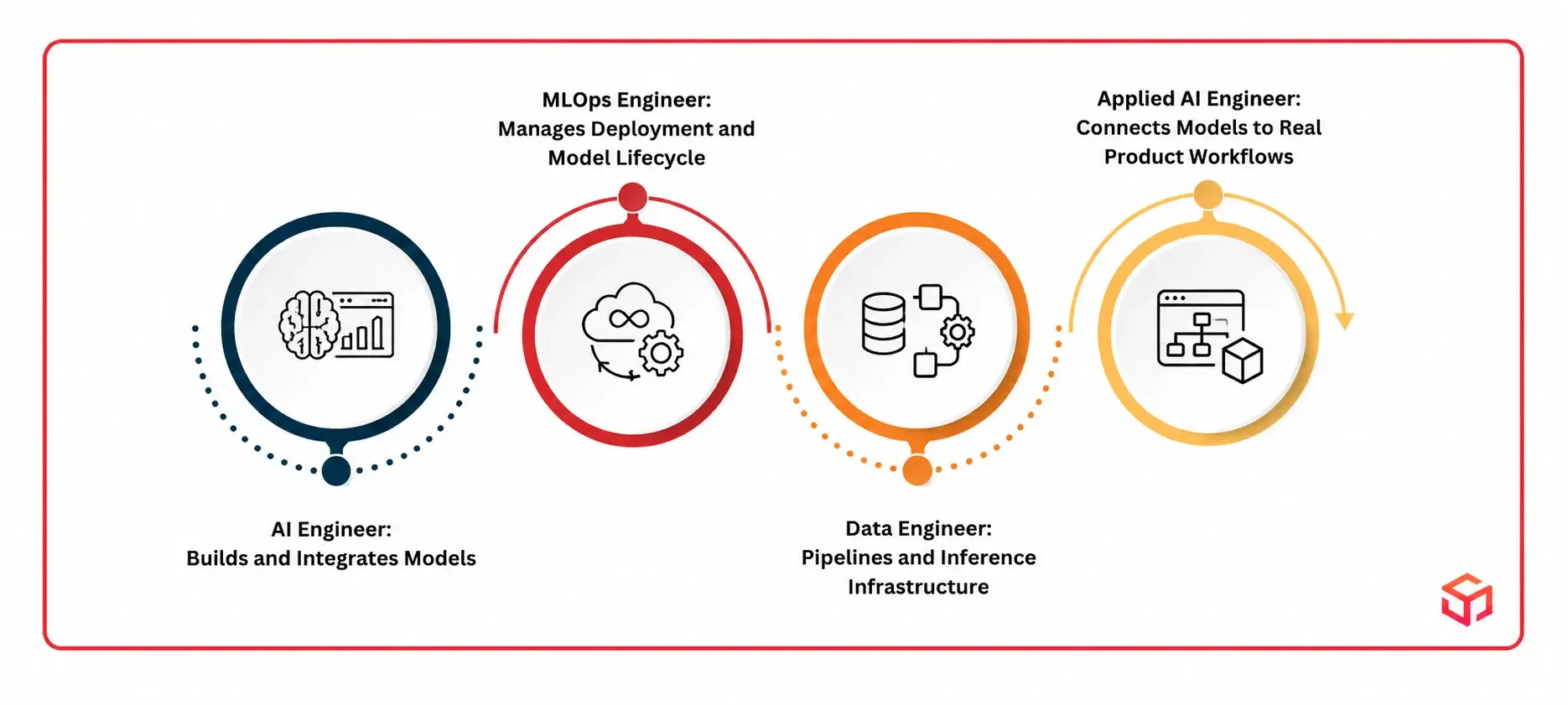
H3: AI Engineer: Builds and Integrates Models
AI Engineers are responsible for developing and integrating AI capabilities into applications and business systems. They work with large language models, prompt engineering, model fine-tuning, and AI APIs to create intelligent features. Their primary focus is transforming AI concepts into practical solutions that deliver measurable value to end users.
MLOps Engineer: manages deployment and model lifecycle
MLOps Engineers ensure AI models operate reliably in production environments. They manage deployment pipelines, monitoring, version control, scalability, and performance optimization. Their role is critical for maintaining model accuracy, reducing operational risks, and ensuring AI systems continue delivering consistent results after deployment.
Data Engineer: Pipelines and Inference Infrastructure
Data Engineers build and maintain the data infrastructure that powers AI systems. They manage data collection, transformation, storage, and pipeline reliability. By ensuring high-quality, accessible data, they help improve model performance and provide the foundation required for scalable and efficient AI operations.
Applied AI Engineer: Connects Models to Real Product Workflows
Applied AI Engineers focus on integrating AI into real-world business processes and applications. They connect AI models with existing systems, workflows, and user experiences. Their expertise helps organizations move beyond experimentation and implement AI solutions that improve efficiency, automation, and decision-making across operations.
Why India Has Become the Default for AI Staff Augmentation
Global companies increasingly look to India when building AI teams. The combination of talent availability, engineering maturity, cost efficiency, and AI education has positioned India as the leading destination for AI staff augmentation engagements.
India’s AI talent pool: scale and depth no other region matches
India has emerged as a global hub for AI talent, combining workforce scale, technical expertise, and growing contributions to AI research and innovation.
Several factors continue to strengthen the country’s position as a preferred destination for AI staff augmentation.
1. Large Engineering Workforce
Organizations can access specialists across machine learning, data engineering, MLOps, cloud engineering, and AI product development without facing severe talent shortages. IBEF states that the country has more than 5.4 million software developers and continues to produce a significant number of STEM graduates every year.
2. Global AI Recognition
India’s growing influence in artificial intelligence extends beyond workforce size. The Stanford AI Index 2026, as reported by the Indian Express, ranks the country second globally for AI authorship and innovation output.
3. Enterprise AI Exposure
Many engineers gain experience through global enterprises, product companies, startups, and Global Capability Centers operating throughout India.
4. Broad Technology Coverage
AI professionals often possess complementary skills in cloud platforms, DevOps, software engineering, and distributed systems.
5. Growing AI Education Ecosystem
Universities, certification programs, and professional training initiatives continue expanding AI and machine learning expertise across the workforce.
This depth allows organizations to scale AI initiatives faster than many competing regions.
AI Hiring Taking Too Long?
Every vacant AI role slows innovation and growth. Soft Suave connects you with experienced engineers quickly, helping projects move forward confidently.
Build FasterCost advantage: AI engineers start from $15/hr in India vs. $50/hr in the US
Cost remains one of the primary reasons organizations choose India for AI staff augmentation. While experienced AI engineers in the United States often start at around $50 per hour and can increase significantly based on specialization, organizations can often access comparable AI talent in India starting from $15 per hour.
The benefit, however, goes further than just the hourly rates. Building an internal AI team often involves substantial recruitment expenses, lengthy hiring cycles, onboarding costs, employee benefits, and retention challenges. These factors can significantly increase the total cost of acquiring and maintaining AI talent.
India’s mature technology ecosystem helps organizations reduce many of these overheads. Businesses gain access to pre-vetted AI engineers, MLOps specialists, and data engineers without investing months in recruitment and technical screening. This enables faster project initiation while keeping hiring costs under control.
The cost advantage becomes even more significant when organizations need to scale teams. Instead of competing for a limited pool of local AI specialists, businesses can quickly expand their engineering capacity through experienced augmentation partners.
More importantly, lower costs do not necessarily mean lower quality. India’s large engineering workforce, growing AI expertise, and extensive experience serving global organizations allow companies to access skilled AI professionals while maintaining budget efficiency. This combination of affordability, scalability, and technical capability continues to make India a preferred destination for AI staff augmentation.
While cost efficiency is an important factor, the ideal hiring location ultimately depends on your project requirements, collaboration needs, compliance considerations, and long-term business goals.
When India Is Often the Better Choice
You need to scale AI teams quickly without lengthy recruitment cycles.
Cost efficiency is an important factor alongside technical expertise.
Your project requires a mix of AI engineers, MLOps specialists, data engineers, and software developers.
You need access to a large talent pool with experience supporting global clients.
Your organization already operates with distributed or remote teams.
When the US Is Often the Better Choice
Real-time collaboration across the same time zone is critical to daily operations.
The project requires frequent in-person meetings or close onsite engagement.
You need highly specialized domain expertise in regulated industries where local market knowledge is essential.
Internal policies, compliance requirements, or client contracts require talent to be located within the United States.
Executive stakeholders prefer direct access to local teams for strategic planning and governance.
Time zone coverage and async collaboration maturity
Successful AI projects depend on close collaboration between internal teams and external engineers.
India’s extensive experience in serving international clients has contributed to the establishment of advanced remote delivery practices that facilitate distributed AI development across various time zones.
Several factors contribute to this advantage:
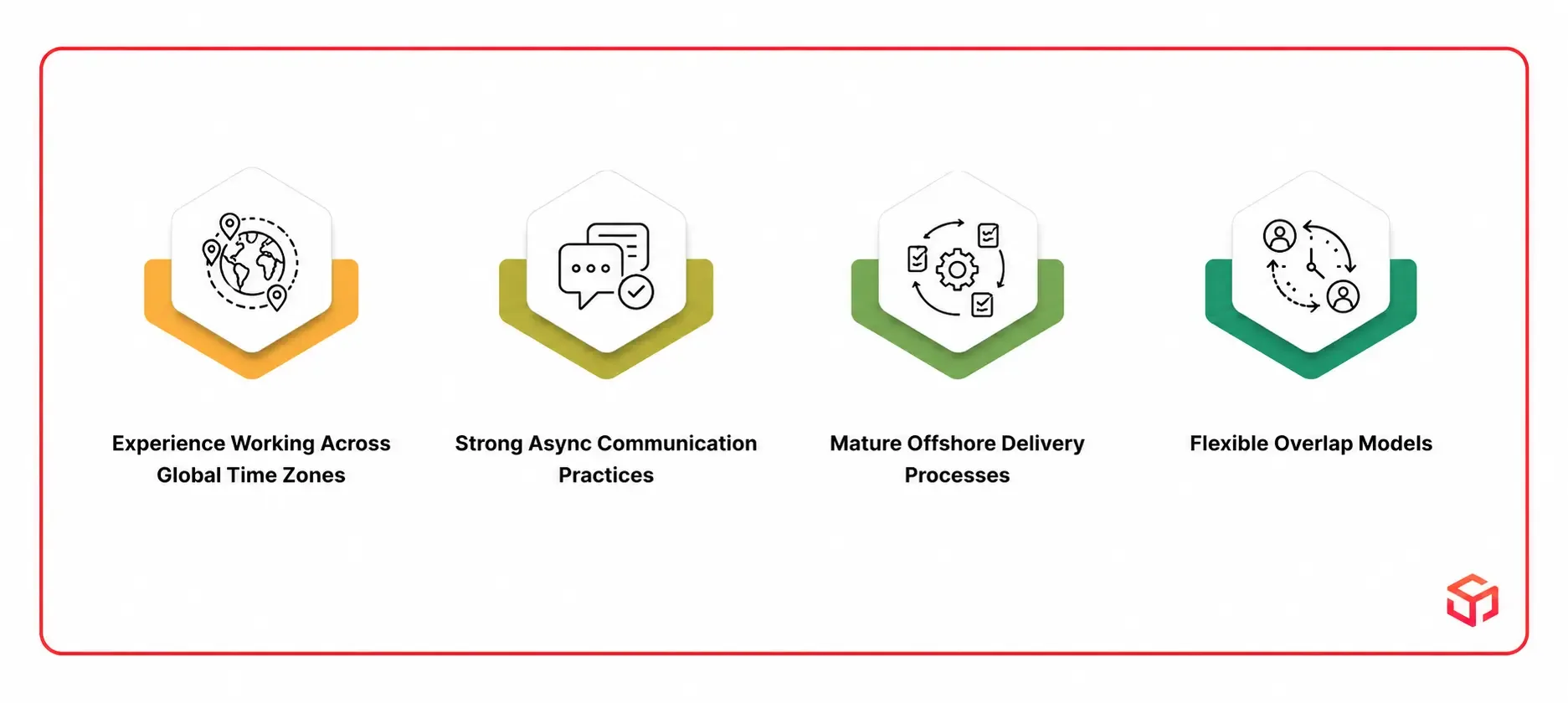
Experience Working Across Global Time Zones
Indian engineering teams routinely collaborate with clients across North America, Europe, Australia, and the Middle East, enabling smooth communication and project coordination despite geographic distance.
Strong Async Communication Practices
Teams are familiar with using documentation, project management tools, and structured reporting to maintain visibility and momentum even when stakeholders are working in different time zones.
Mature Offshore Delivery Processes
Years of experience supporting global software and AI initiatives have helped Indian providers develop reliable frameworks for sprint execution, stakeholder communication, and remote project governance.
Flexible Overlap Models
Organizations can establish several hours of working-day overlap for meetings, reviews, and planning sessions while still benefiting from extended development cycles and faster project progress.
This combination of global delivery experience, structured communication, and flexible collaboration models enables organizations to scale AI teams without sacrificing visibility, productivity, or delivery quality.
Top Staff Augmentation Providers for AI Developers (2026)
Choosing the right provider depends on your project complexity, growth stage, hiring timeline, and AI specialization requirements. Some firms excel at enterprise-scale delivery, while others focus on startups, GenAI innovation, or flexible team augmentation models.
To help narrow your options, here are some of the best staff augmentation providers for AI developers, categorized by the types of organizations they are best suited to support.
These providers were selected based on their AI capabilities, engineering expertise, talent pool strength, delivery experience, client feedback, industry reputation, and ability to support organizations at different stages of growth.
Providers best suited for startups and growing product teams
Startups and growth-stage companies often need flexibility, speed, and direct collaboration. The following providers are frequently chosen by organizations looking to accelerate AI product development without building large internal hiring functions.
1. Soft Suave

Soft Suave is an India-based IT staff augmentation provider that helps startups, scale-ups, and enterprise product teams with AI developer support
The company supports organizations developing AI applications, workflow automation platforms, intelligent business systems, and modern software products. The talent network consists of AI engineers, MLOps experts, data engineers, cloud engineers, and full-stack developers.
A key differentiator is Soft Suave’s focus on talent quality and speed. The company follows a rigorous vetting process designed to identify the top 1% of Indian engineering talent, ensuring clients gain access to highly skilled professionals with strong technical and communication capabilities.
Businesses can typically onboard developers within 48 hours, helping reduce hiring delays and accelerate project delivery.
Soft Suave also offers a 40-hour free trial, allowing organizations to evaluate technical expertise, collaboration style, and team fit before making a long-term commitment.
Combined with a simple four-step hiring process, direct access to engineers, flexible engagement models, and transparent collaboration, Soft Suave provides a practical and scalable solution for growing AI teams.
Scale AI Teams With Confidence
Access AI engineers, MLOps specialists, and data experts through one trusted partner. Deliver projects faster while maintaining quality and flexibility.
Start Scaling2. Arc

Arc is a remote talent platform that helps organizations hire remote developers, engineers, and AI specialists without the complexity of traditional recruitment processes.
The platform is designed to simplify remote hiring for both employers and candidates, making it a popular choice for startups and growing companies seeking specialized technical talent.
One of Arc’s key strengths is its focus on remote-first hiring. With a distributed team spanning multiple countries, the company has built processes specifically for sourcing, evaluating, and managing remote engineering talent.
Organizations can access AI developers, engineers, consultants, contractors, and freelancers across a wide range of technologies and engagement models.
Arc also emphasizes talent quality, positioning itself as a source for highly vetted remote professionals, including AI developers in India. Its flexible hiring approach allows businesses to scale teams quickly without committing to lengthy recruitment cycles or full-time hiring processes.
The platform is particularly well-suited for startups, scale-ups, and product-focused organizations that need rapid access to specialized AI expertise while maintaining flexibility in how they build and manage their engineering teams.
3. Bacancy

Bacancy Technology is a one of the IT staff augmentation companies in India that provides AI engineers, machine learning specialists, and dedicated development teams for startups, SMBs, and enterprise organizations.
With more than 14 years of industry experience, the company has built expertise across a wide range of AI use cases and industries.
One of Bacancy’s strengths is its focus on certified AI talent. Its engineers hold certifications across leading platforms and technologies, including AWS, Google Cloud, Microsoft Azure, and TensorFlow. This enables organizations to access professionals with experience in building, deploying, and managing AI solutions across modern cloud environments.
Businesses can choose from multiple engagement models, including dedicated AI developers, hourly hiring, and project-based development, depending on their requirements.
The company also offers rapid onboarding, allowing organizations to hire vetted AI developers within 48 hours. Combined with flexible hiring options and broad AI expertise, Bacancy is a strong choice for businesses looking to scale AI initiatives efficiently.
Providers best suited for enterprise scale
Large organizations often require mature delivery processes, compliance controls, and the ability to scale teams quickly. The following providers are commonly considered for enterprise AI staffing initiatives.
1. BairesDev

BairesDev is a US-based software engineering company that provides AI staff augmentation, dedicated teams, and software outsourcing services through its nearshore talent network across Latin America.
The company is particularly well-suited for enterprise organizations that need experienced AI engineers while maintaining close time-zone alignment with North American teams.
One of BairesDev’s key differentiators is its talent screening process. The company states that it hires the top 1% of more than two million applicants and provides access to numerous senior developers.
Its AI staffing model focuses on engineers with real-world deployment experience rather than purely academic or experimental backgrounds.
BairesDev also emphasizes AI-augmented development practices, with engineers using modern AI coding tools to improve development speed, code quality, and delivery consistency.
In addition to supplying talent, the company manages recruitment, onboarding, infrastructure, and administrative processes, allowing organizations to scale engineering teams with less operational overhead.
2. Andela

Andela is a global talent marketplace that helps organizations build distributed engineering teams across multiple regions. The company provides access to AI engineers, machine learning specialists, data scientists, and software developers, making it a strong option for businesses looking to scale AI initiatives without being limited to a specific geography.
One of Andela’s strengths is its structured approach to AI talent specialization. Its network includes engineers focused on AI application development, enterprise AI integration, and production AI operations.
These specialists help organizations build AI-powered features, integrate AI capabilities into existing systems, and manage AI platforms at scale.
To maintain talent quality, Andela combines technical screening with ongoing upskilling programs, ensuring engineers stay current with evolving AI technologies, platforms, and development practices. This focus on continuous learning helps clients access talent that is familiar with modern AI frameworks and deployment environments.
Andela also offers flexible engagement models and trial periods, allowing companies to evaluate engineers before committing to long-term engagements. This makes it particularly attractive for organizations that need rapid team expansion while minimizing hiring risk.
Test AI Talent Before You Commit
Soft Suave delivers healthcare Evaluate technical expertise, communication, and team fit through Soft Suave’s 40-hour free trial before making any long-term hiring decision. experienced in HIPAA workflows, secure integrations, and faster release cycles without sacrificing compliance, scalability, or operational stability during product expansions.
Try Risk-Free3. Toptal

Toptal is a global talent network known for connecting organizations with highly experienced AI developers, machine learning engineers, AI consultants, and technical leaders.
The platform is often chosen by companies that need specialized expertise for complex AI initiatives rather than large-scale team augmentation.
One of Toptal’s key differentiators is its rigorous screening process. The company states that fewer than 3% of applicants are accepted into its network, with candidates evaluated for technical expertise, problem-solving ability, communication skills, and domain experience.
This selective approach makes Toptal particularly attractive for businesses seeking senior-level AI talent.
Toptal supports a wide range of engagement models, from short-term consulting assignments to long-term engineering support.
Companies can typically begin working with matched AI professionals within 48 hours, helping accelerate hiring timelines for urgent projects.
Another notable advantage is its talent matching process, where experienced specialists work closely with clients to understand technical requirements and team dynamics before recommending candidates.
The platform also offers a trial period, allowing organizations to evaluate talent fit before making a long-term commitment. This combination of speed, flexibility, and highly vetted expertise makes Toptal a popular choice for businesses seeking specialized AI talent on demand.
Providers with niche GenAI / LLM specialisation
Some providers focus specifically on advanced AI capabilities such as generative AI, large language models, intelligent automation, and enterprise AI transformation.
1. 10Pearls

10Pearls is an AI-native digital development company that helps organizations accelerate AI adoption through consulting, engineering, and enterprise transformation services.
With more than 20 years of experience delivering enterprise-grade software solutions, 10Pearls combines strategic AI consulting with hands-on engineering execution. Its expertise spans generative AI, conversational AI, intelligent automation, and digital transformation initiatives across multiple industries.
The company also provides access to high-quality technical talent through both offshore and nearshore staff augmentation models.
A key differentiator is its agile delivery approach, which focuses on reducing development backlogs, accelerating product teams, and shortening time-to-market. 10Pearls also emphasizes rapid validation of AI initiatives, helping organizations move from concept to proof-of-value within 90 days.
This combination of AI expertise, enterprise delivery experience, and flexible engagement options makes 10Pearls a strong choice for organizations pursuing large-scale AI modernization and transformation programs.
2. DataArt

DataArt is a global technology consulting and engineering company that helps organizations move AI initiatives from experimentation to production.
The company supports machine learning, data analytics, intelligent automation, and enterprise AI programs, making it a strong option for businesses seeking both strategic guidance and technical execution.
Its industry-specific expertise allows organizations to access AI solutions tailored to unique business challenges and operational requirements.
DataArt has also earned numerous industry recognitions in data engineering and artificial intelligence, reflecting its commitment to innovation and technical excellence.
Beyond AI development, the company helps businesses improve scalability, optimize technology investments, and manage changing market demands through flexible engineering resources and consulting services.
This combination of AI expertise, enterprise delivery experience, and business-focused problem-solving makes DataArt a strong choice for organizations looking to implement and scale AI solutions with long-term strategic value.
3. Leewayhertz

LeewayHertz is an AI-focused software development company that specializes in helping enterprises integrate artificial intelligence directly into their business operations.
With more than 15 years of experience, the company supports organizations looking to move beyond AI experimentation and implement solutions that deliver measurable operational and business impact.
Its services cover the full AI lifecycle, including AI strategy consulting, custom AI application development, multi-agent systems, generative AI solutions, and end-to-end AI integration. This makes LeewayHertz particularly attractive for organizations seeking specialized expertise in GenAI and large language model (LLM) implementations.
The company offers multiple engagement models, including project-based development, team extension, and dedicated development teams, providing flexibility for businesses at different stages of AI adoption.
For enterprises looking to integrate AI into workflows, automate business processes, or build advanced AI-powered applications, LeewayHertz stands out as a strong provider with deep expertise in modern AI technologies and enterprise-grade delivery.
How to Evaluate Any AI Staff Augmentation Provider
Selecting an AI staffing partner involves more than simply reviewing advertising claims or assessing hourly rates.
Through our experience supporting 200+ organizations with AI hiring and team augmentation, we have observed that certain evaluation criteria consistently influence provider selection.
The factors below reflect the questions, concerns, and decision-making priorities that frequently emerge when organizations compare AI staff augmentation partners. These same criteria were also considered when selecting the providers featured in this guide.
Together, they provide a practical framework for identifying providers capable of delivering production-ready AI talent and supporting long-term project success.
1. AI-Specific Technical Screening
Ask how candidates are evaluated. A qualified provider should assess knowledge of LLMs, machine learning workflows, data engineering, AI architecture, and production deployment practices rather than relying solely on coding interviews.
2. Production Deployment Experience
Building an AI prototype is relatively easy. Implementing AI systems on a large scale necessitates expertise in monitoring, governance, infrastructure management, performance enhancement, and operational dependability.
3. Talent Availability and Time-to-Hire
The best providers maintain access to pre-vetted talent pools. Inquire about the timeline for bringing qualified AI engineers on board and the onboarding procedures that must be completed before work starts.
4. Security and IP Protection
AI projects often involve proprietary business data, internal processes, and sensitive information. Review security controls, access management procedures, compliance standards, and intellectual property protections before engagement.
5. Communication and Delivery Model
Successful AI initiatives require close collaboration. Understand how engineers communicate, participate in Agile ceremonies, report progress, and coordinate with internal stakeholders.
6. Team Scalability
Project requirements rarely remain static. Evaluate whether the provider can scale resources up or down as business needs evolve without disrupting delivery timelines.
7. AI Case Studies and References
Past performance often predicts future success. Request examples of AI implementations, deployment challenges solved, measurable outcomes achieved, and client references where possible.
8. Replacement and Continuity Policies
Unexpected turnover can slow critical projects. Strong providers maintain structured replacement processes that minimize disruption and preserve delivery continuity.
9. Cost Transparency
Avoid providers that offer unclear pricing structures. Transparent engagement models help organizations forecast costs accurately while avoiding unexpected budget overruns later.
10. Engineering Governance
The strongest AI staffing partners provide more than talent. They support code reviews, technical oversight, sprint accountability, quality standards, and engineering best practices that improve project outcomes.
Conclusion
The recruitment of AI specialists has become much more focused compared to conventional software hiring. Success depends on finding engineers who understand not only AI models but also deployment pipelines, infrastructure, governance, and real-world business workflows.
The providers listed in this guide serve different needs, from enterprise-scale transformation initiatives to startup-focused product development.
The most important step is choosing a partner that understands the complexity of AI delivery rather than treating AI roles like standard software positions.
Organizations that invest in the right talent today will move faster, deploy smarter solutions, and create stronger competitive advantages tomorrow.
As AI adoption accelerates across every industry, access to proven AI expertise may become one of the most valuable strategic assets a business can acquire.
FAQs
What is AI staff augmentation?
AI staff augmentation is a hiring model where organizations temporarily or permanently extend their engineering teams with AI specialists. These professionals may include AI engineers, MLOps engineers, data engineers, and machine learning experts who work directly within existing teams.
How is AI staff augmentation different from outsourcing an AI project?
With staff augmentation, the client retains control over product strategy, priorities, and delivery management while external engineers join the internal team. In outsourcing, the service provider typically assumes responsibility for project execution and delivery outcomes.
How quickly can I get an AI developer through staff augmentation?
The majority of providers can connect you with skilled AI engineers in a timeframe of one to three weeks. Timelines depend on role complexity, experience requirements, and provider talent availability. Companies with pre-vetted AI talent pools can often accelerate onboarding significantly.
What does AI staff augmentation typically cost?
Costs vary based on location, specialization, and seniority. AI engineers in North America generally command higher rates than those in India, Eastern Europe, or Latin America. MLOps, GenAI, and LLM specialists typically carry premium pricing compared to general software engineers.
Which provider is best for LLM / generative AI developers?
The best option is influenced by your objectives, financial resources, and organizational setup. Providers such as Toptal, Andela, BairesDev, and Soft Suave are commonly considered for organizations seeking experienced LLM and generative AI talent.

Ramesh Vayavuru is the Founder & CEO of Soft Suave Technologies, with 15+ years of experience delivering innovative IT solutions.
Related Blogs