Fiverr vs Upwork vs Freelancer vs Soft Suave: Which Is Best to Hire Developers?

TL;DR :-
Compare Fiverr, Upwork, Freelancer, and Soft Suave across hiring speed, cost structure, quality control, and delivery ownership.
Understand when each model fits short-term tasks, mid-term contracts, or roadmap-driven product development.
Use a practical decision checklist to choose the right hiring structure for stability, scalability, and risk management.
Hiring the wrong developer can delay your product by months. Missed deadlines, unstable code, and endless revisions are common when the hiring model doesn’t match the project complexity.
Marketplaces promise speed. Agencies promise stability. But the real question is different: who owns delivery?
If you are comparing Fiverr, Upwork, Freelancer, and Soft Suave, you are not just choosing talent. You are choosing risk distribution, accountability structure, and engineering governance.
Before you commit to budget and roadmap timelines, understand how these models truly work and which one aligns with your technical expectations.
Marketplace Confusion Slowing You Down?
Freelance churn, weak vetting, and missed deadlines drain momentum. Soft Suave delivers governance-backed developers who stabilize sprints, protect architecture, and accelerate product releases confidently.
Stabilize NowWhat these options really are
Before comparing features and fees, it’s important to understand the structural difference between freelance marketplaces and managed development partners. Each model distributes responsibility differently. Let’s break them down one by one.
Fiverr

Fiverr operates as a gig-based marketplace. Freelancers create predefined service packages – Basic, Standard, and Premium tiers. Buyers select and purchase directly.
The platform charges approximately 20% from sellers and around 5.5% from buyers, according to industry comparisons. Fiverr works best for clearly defined, small tasks.
For example:
Landing page bug fixes
UI adjustments
Simple API integrations
Minor WordPress tweaks
Speed is its main strength. You can hire within hours. However, complex backend architecture or multi-sprint application builds rarely fit well inside predefined gig scopes.
Delivery ownership stays with the buyer. You define requirements. You validate code. You manage quality control.
Upwork

Upwork follows a proposal-based hiring model. Clients post a job. Freelancers submit bids. You review profiles and conduct interviews.
Upwork hosts over 18 million freelancers globally. It supports both short-term and long-term contracts.
The platform typically charges freelancers around 10% service fees, along with client-side charges.
Upwork is flexible. It supports hourly billing, milestone payments, and long-term engagement contracts.
For developers, it allows custom project scoping instead of fixed gig packages. But the responsibility framework remains clear:
You manage screening.
You evaluate technical capability.
You oversee sprint execution.
Upwork provides infrastructure – not engineering governance.
Freelancer

Freelancer.com uses a competitive bidding system. Clients post projects. Developers submit price proposals. There is also a contest-based model for design and creative tasks.
Platform fees are typically around 10%, with minimum thresholds depending on project size.
Freelancers work well for budget-sensitive hiring. The bidding format encourages price competition.
However, quality variance is higher due to open-market competition. Technical vetting is entirely the client’s responsibility. There is no built-in architectural review process or QA framework.
Soft Suave Technologies

Soft Suave operates under a managed engineering model, not a freelance marketplace structure. This is a fundamentally different hiring category.
Instead of listing independent freelancers, Soft Suave provides structured offshore development teams with governance, QA validation, and sprint-level accountability.
The focus is not on hourly bidding. The focus is on outcome-driven delivery.
You still choose your developers. But the vendor manages onboarding, performance tracking, backup resources, and delivery continuity.
This model distributes risk differently. It reduces management overhead and stabilizes long-term engineering velocity.
Tired Of Managing Freelancers Constantly?
Interview cycles, rework, and constant supervision consume leadership capacity. Soft Suave provides outcome-driven engineering teams so you focus on growth, not daily delivery issues.
End Issues TodayFour-Way Comparison Table: Fiverr vs Upwork vs Freelancer vs Soft Suave
Choosing a hiring platform is not about brand popularity. It’s about aligning speed, quality control, cost structure, and delivery ownership. Let’s compare them across critical engineering decision factors.
Comparison Factor | Fiverr | Upwork | Freelancer | Soft Suave |
Best For | Micro-tasks, fixed scope work | 1–3 month contracts, feature extensions | Budget-driven hiring | Product builds, scaling teams, and staff augmentation |
Typical Use Case | Bug fixes, UI tweaks, small integrations | Mid-term development projects | Cost-sensitive projects | Roadmap-driven engineering |
Hiring Speed | Immediate via gig purchase | 2–7 days (proposal + interviews) | Depends on the bidding cycle | Structured shortlisting before onboarding |
Onboarding Depth | Minimal | Interview-based | Proposal-based | Technical alignment before sprint start |
Quality Vetting | Rating-based selection | Client-led screening | Bid comparison | Internal technical screening + QA governance |
Architecture Validation | Not structured | Depends on client expertise | Not structured | Built-in engineering review |
Pricing Model | Fixed gig pricing | Hourly / milestone billing | Competitive bidding | Defined engagement scope, Time and material, or managed services |
Cost Predictability | Clear upfront, limited flexibility | Scope creep may increase cost | Lower initial cost, quality risk | Controlled sprint budgeting |
Hidden Costs Risk | Scope expansion | Hourly overrun | Rework from quality variance | Lower via the governance model |
Management Effort | Fully client-managed | Client-led oversight | Client-managed | Vendor-managed governance |
Leadership capacity required | High | High | Very High | Lower management overhead |
Replacement Process | Restart the hiring process | Re-interview cycle | Re-post project | Bench-backed replacement |
Continuity Stability | Low | Medium | Medium-Low | High |
Communication Model | Gig-based messaging | Contract tools | Platform messaging | Structured reporting + sprint reviews |
Accountability Level | Task-level | Milestone-based | Agreement-based | SLA-backed accountability |
IP Protection | Platform terms | Contract-based | Contract-dependent | NDA-backed structured compliance |
Enterprise Readiness | Low | Medium | Medium | High |
Scaling Capability | Not optimized for teams | Multiple independent contracts | High integration risk | Pod-based scaling model |
Coordination Complexity | High | High | Very High | Managed internally |
Contract & Compliance Support | Basic platform terms | Standard contracts | Standard contracts | Vendor-managed agreements |
Delivery Ownership | Task completion | Hours or milestones | Contract output | Outcome-driven delivery |
Long-Term Stability | Low | Medium | Medium-Low | High |
Scale Without Delivery Risk Today
From React to Node, Python to DevOps, our experts integrate seamlessly into your stack, ensuring sprint velocity, QA stability, and roadmap execution without integration bottlenecks.
Scale SmartWhen Fiverr is the best choice (and when it’s not)
Fiverr is powerful in specific contexts. But using it for complex development can introduce structural risks. Let’s define when it works and when it doesn’t.
Best-fit scenarios
Fiverr is suitable when:
Scope is fixed and documented: Clear acceptance criteria reduce revision cycles and prevent scope creep.
The task is small and isolated: Ideal for UI tweaks, plugin updates, and single-feature improvements.
Speed matters more than long-term integration: Fast turnaround is often achievable within days.
Watch-outs
Fiverr becomes risky when:
Backend architecture is involved: Complex system design rarely fits gig constraints.
Multiple sprints are required: Gig boundaries limit long-term roadmap planning.
Security-sensitive data is handled: Structured compliance frameworks are limited.
When Upwork is the best choice (and when it’s not)
Upwork provides flexibility and scale. But it requires internal technical leadership to function effectively. Here’s when it works best.
Best-fit scenarios
Upwork works well when:
You have a technical lead internally: Strong oversight ensures sprint quality and architecture alignment.
Project duration is 1–3 months: Feature development fits milestone billing structures.
You prefer direct freelancer relationships: Control remains fully client-driven.
Watch-outs
Upwork becomes challenging when:
Scaling to multiple developers: Coordinating independent contracts increases integration risk.
No QA framework exists: Code validation responsibility stays internal.
Founder bandwidth is limited: Interviewing and management consume time.
When Freelancer is the best choice (and when it’s not)
Freelancer offers competitive pricing through open bidding. But price-based hiring requires careful evaluation.
Best-fit scenarios
Freelancer works best when:
Budget sensitivity is high: Competitive bids can reduce upfront cost.
Scope is straightforward: Clear deliverables reduce quality variance.
Rapid experimentation is needed: Contest models support creative testing.
Watch-outs
Freelancer may not suit:
Enterprise-grade projects: Architecture validation is not built-in.
Long-term roadmap builds: Continuity risk increases with churn.
Security-critical applications: Compliance governance depends on client contracts.
A Managed Development Alternative to Freelance Marketplaces (Soft Suave)
When engineering stability matters, managed models reduce instability. Instead of managing freelancers individually, you gain structured delivery support.
How Soft Suave works
Soft Suave follows a governance-led engineering framework designed for delivery stability. Instead of transactional hiring, the model focuses on structured onboarding, sprint accountability, and long-term roadmap alignment.
1. Shortlisting: Developers are shortlisted based on technology stack expertise, domain exposure, architectural understanding, and sprint complexity. Matching is not profile-based alone; it considers business objectives, scalability requirements, and integration dependencies.
2. Onboarding: The onboarding process includes structured knowledge transfer, repository access setup, CI/CD alignment, environment configuration, and sprint planning discussions. This reduces ramp-up time and ensures developers contribute meaningfully from the first iteration.
3. Governance: Delivery operates through disciplined Agile sprint cycles that include backlog grooming, daily stand-ups, QA validation, code reviews, and performance tracking. Clear reporting mechanisms ensure transparency, accountability, and predictable engineering velocity.
Many founders who begin with freelance marketplaces eventually wish to hire dedicated developers when scaling demands continuity, deeper ownership, and reduced management overhead.
Engagement models
Engagement flexibility supports different scaling needs.
Dedicated Developer: A Dedicated Developer model allows you to extend your internal engineering team with a focused resource aligned to your tech stack and sprint goals. You retain direct task control while benefiting from vendor-backed support, ensuring stability without hiring full-time in-house staff.
Dedicated Team: A Dedicated Team includes multiple roles such as frontend, backend, DevOps, and QA engineers working together on your product roadmap. This model supports end-to-end application development with shared sprint ownership, structured reporting, and consistent delivery across development cycles.
Pod Model: The Pod Model provides a cross-functional engineering unit that includes developers, QA specialists, and governance oversight. Designed for scalability, it enables parallel feature development, integrated quality validation, and coordinated sprint execution without increasing internal management complexity.
Organizations considering IT staff augmentation services frequently assess structured engagement models alongside freelance marketplaces to determine the right balance between cost, control, and engineering stability.
Common mistakes when hiring temporary developers
Many project delays come from avoidable hiring errors. Understanding these mistakes helps prevent engineering disruption.
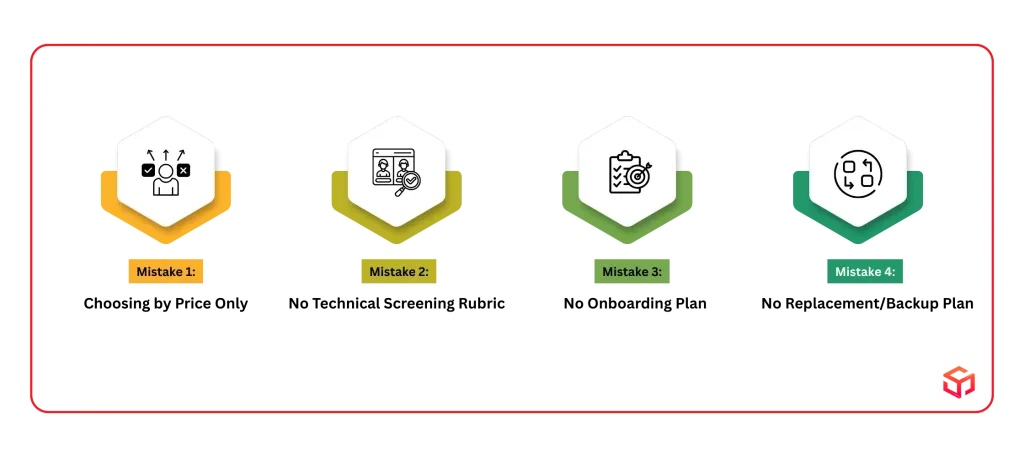
Mistake 1: Choosing by Price Only
Low hourly rates often create hidden long-term costs. Developers hired purely on price may lack architectural depth or production experience. This leads to unstable code, repeated debugging cycles, missed sprint deadlines, and refactoring efforts. The initial savings disappear when rework consumes engineering time and delays releases.
Mistake 2: No Technical Screening Rubric
Hiring without a structured screening framework increases the risk of skill mismatch. Reviewing resumes or ratings alone is not enough. A proper rubric should include coding assessments, system design evaluation, and architecture discussions. Without technical validation, quality control becomes reactive instead of proactive.
Mistake 3: No Onboarding Plan
Even skilled developers need structured onboarding. Without repository access, documentation, sprint context, and environment setup clarity, productivity drops. Poor onboarding leads to confusion, inconsistent coding standards, and integration errors. A defined ramp-up process ensures faster alignment and stable contribution from the first sprint cycle.
Mistake 4: No Replacement/Backup Plan
Freelancer availability can change unexpectedly due to competing contracts or personal commitments. Without a continuity plan, sprint velocity stops immediately. Restarting the hiring process delays releases and disrupts roadmap planning. Backup resource planning ensures engineering stability and protects long-term product timelines.
Test Our Developers Completely Risk-Free
Evaluate real code quality, communication clarity, and sprint discipline with our 40-hour free trial before committing budget, eliminating hiring risk completely.
Start TrialDecision Checklist (10 questions to pick the right option)
Use these questions before selecting a hiring model.
Is the project architecture complex?
Complex systems require experienced engineers and structured governance.Do we have internal QA oversight?
Without QA oversight, code quality risks increase significantly.Is this a single feature or a roadmap build?
Scope determines required stability, planning, and team structure.How critical is IP protection?
Sensitive projects demand strong contractual and compliance safeguards.Do we need multi-developer scaling?
Scaling increases coordination complexity and integration dependencies.Is speed more important than stability?
Rushed hiring may compromise long-term engineering reliability.Do we have time for interviews?
Screening requires bandwidth and structured evaluation processes.What is our compliance exposure?
Cross-border hiring introduces legal and regulatory considerations.Are we optimizing for short-term cost or long-term velocity?
Initial savings may reduce sustainable development momentum.Who owns delivery accountability?
Clear ownership prevents confusion, delays, and responsibility gaps.
Clear answers reduce hiring risks.
Conclusion
Choosing between Fiverr, Upwork, Freelancer, and Soft Suave is not about platform popularity. It’s about responsibility alignment.
Marketplaces give access to talent. They also shift management, QA, and continuity risk to you. Managed development partners reduce that operational burden.
If your project is a quick fix, marketplaces can work. If you’re building a product roadmap that demands architectural stability, sprint governance, and engineering continuity, choose a model designed for structured delivery.
Your hiring decision today directly impacts your release velocity tomorrow. Choose the structure that supports your growth – not just your budget.
FAQs
What are the major differences between Fiverr, Upwork, and Freelancer?
Fiverr uses fixed gig packages. Upwork uses proposal-based contracts. Freelancer uses competitive bidding. All require client-managed quality control and delivery oversight.
Which is best for hiring a developer quickly: Fiverr, Upwork, Soft Suave, or Freelancer?
Fiverr is usually the fastest because you can purchase predefined gigs immediately without interviews or proposal reviews. Upwork and Freelancer require job postings, bid evaluations, and screening before onboarding. Soft Suave follows a structured shortlisting process, prioritizing technical alignment over instant hiring speed.
Which platform is best for hiring a developer for a 1–3 month contract?
Short-term contracts can be managed through marketplaces like Upwork or Freelancer if you have internal technical oversight. However, if sprint stability and governance matter, a managed model like Soft Suave ensures structured onboarding, QA validation, and delivery continuity throughout the engagement period.
Which platform is best for hiring a senior developer: Fiverr, Upwork, Soft Suave, or Freelancer?
Marketplaces provide access to experienced profiles, but screening and architectural validation remain client responsibilities. For senior-level development requiring system design, scalability planning, and code governance, a managed engineering partner like Soft Suave reduces risk through structured technical evaluation and oversight.
What is the cost difference between Fiverr, Upwork, Soft Suave, and Freelancer?
Fiverr typically charges around 20% seller fees plus buyer service fees. Upwork and Freelancer generally charge about 10%, depending on contract terms. Soft Suave follows a structured engagement model where pricing reflects governance, QA support, and outcome-based accountability rather than just platform commissions.

Ramesh Vayavuru is the Founder & CEO of Soft Suave Technologies, with 15+ years of experience delivering innovative IT solutions.
Related Blogs