Hiring Platform Vs Offshore Development Company: Which Model Actually Works for Your Team?

TL;DR :-
Compare hiring platforms and offshore development companies across cost, scalability, ownership, continuity, and delivery management.
Understand when platform-based hiring works best and when dedicated offshore teams provide greater long-term value.
Explore why India leads both models and how to choose the right offshore development partner.
Should you hire developers through a hiring platform or work with an offshore development company instead?
It’s a common question for businesses looking to scale engineering capacity without increasing hiring complexity. The problem is that many decision-makers don’t fully understand the differences between these two models beyond developer availability and cost.
Hiring platforms help companies quickly access freelance developers for short-term tasks and flexible scaling. Offshore development companies provide managed engineering teams, structured delivery, and long-term operational continuity for complex software products.
The difference is not just where you hire developers. It is who owns delivery accountability, sprint governance, QA consistency, and engineering scalability as projects grow.
To help you make the best choice, we’ve compared both models across the key areas that influence software delivery outcomes, including cost, scalability, project ownership, and long-term engineering continuity.
Quick Comparison Table: Hiring Platform Vs Offshore Development Company
Both models provide access to global software talent, but they operate very differently in practice. The comparison below highlights the operational, technical, and business differences that impact delivery outcomes most.
What Is a Hiring Platform? (And What It’s Actually Good For)
A hiring platform is an online marketplace that helps companies find technical talent quickly. It connects businesses with freelance developers, contract engineers, and specialists for project-based or short-term work.
Instead of running a long hiring process, companies can post their needs, review candidate profiles, and compare skills in one place. This simplifies the process of locating the appropriate individual more quickly.
In simple terms, a hiring platform is a fast matching system for employers and talent. It saves time, improves hiring choices, and gives companies direct control over interviews and final selection.
Some popular examples include Upwork, Toptal, Fiverr, Arc, etc.
These platforms work well when companies:
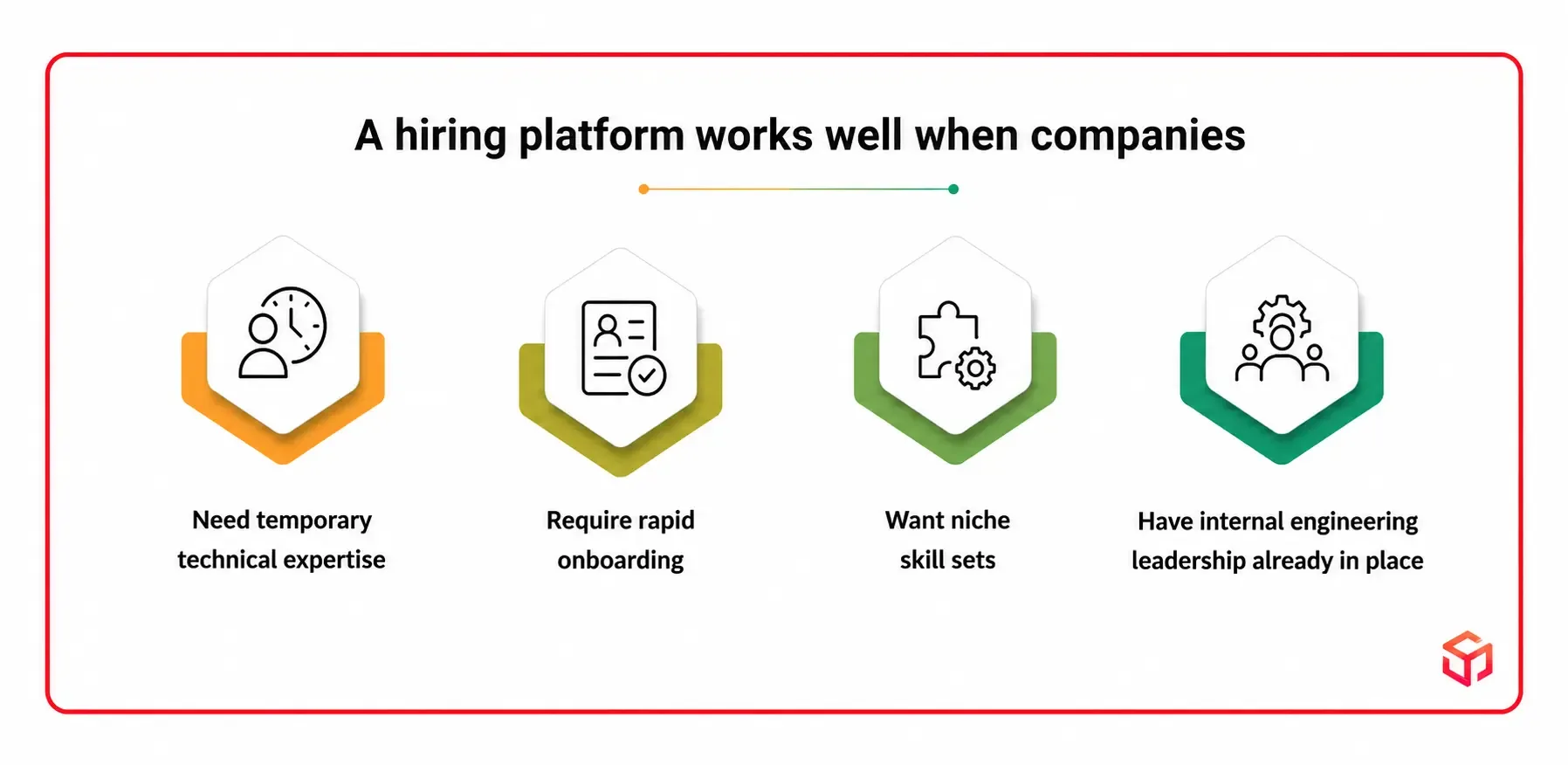
Need temporary technical expertise
Require rapid onboarding
Want niche skill sets
Have internal engineering leadership already in place
The biggest strength of these hiring platforms is their sourcing flexibility. A company can hire a React developer today and a DevOps consultant next week without long-term commitments. That agility makes platforms attractive for startups and early-stage product teams.
Hiring platforms are particularly useful when the work is clearly defined, and the required skills are easy to identify.
For example, a startup building an MVP may hire a software developer through a hiring platform to quickly add a specific skill set without committing to a long-term engagement. Since MVP development often focuses on validating an idea within a limited budget and timeframe, the flexibility to onboard talent quickly and scale resources up or down as needed can be particularly valuable.
Similarly, a growing SaaS company might hire a DevOps consultant through a platform to support a cloud migration. This provides access to niche expertise for the duration of the project without expanding the permanent team.
In these situations, platforms provide quick access to specialized talent without the commitment of a long-term engagement.
What Is an Offshore Development Company? (And How It’s Different)
Offshore development companies provide dedicated engineering teams that work as long-term extensions of a client’s internal software organization. The focus is not only on staffing. It is managed software delivery.
Instead of just placing individual developers, these companies take responsibility for how the work gets done day to day. They set up processes for sprint planning, code reviews, documentation, QA, and release management, so the client is not left coordinating every detail themselves.
Due to the long-term nature of the relationship, offshore development teams also prioritize consistency and the retention of knowledge.
They build domain understanding over time, align with the client’s tech stack and standards, and provide a stable, reusable engineering capacity rather than a rotating pool of short-term contractors.
In simple words, the client does not simply hire a developer. They engage an engineering structure designed to support long-term product delivery across multiple sprint cycles, release schedules, and scaling phases.
Modern offshore software development companies typically include developers, QA engineers, DevOps specialists, solution architects, delivery managers, and technical leads inside the engagement model itself.
This structure becomes especially valuable for:
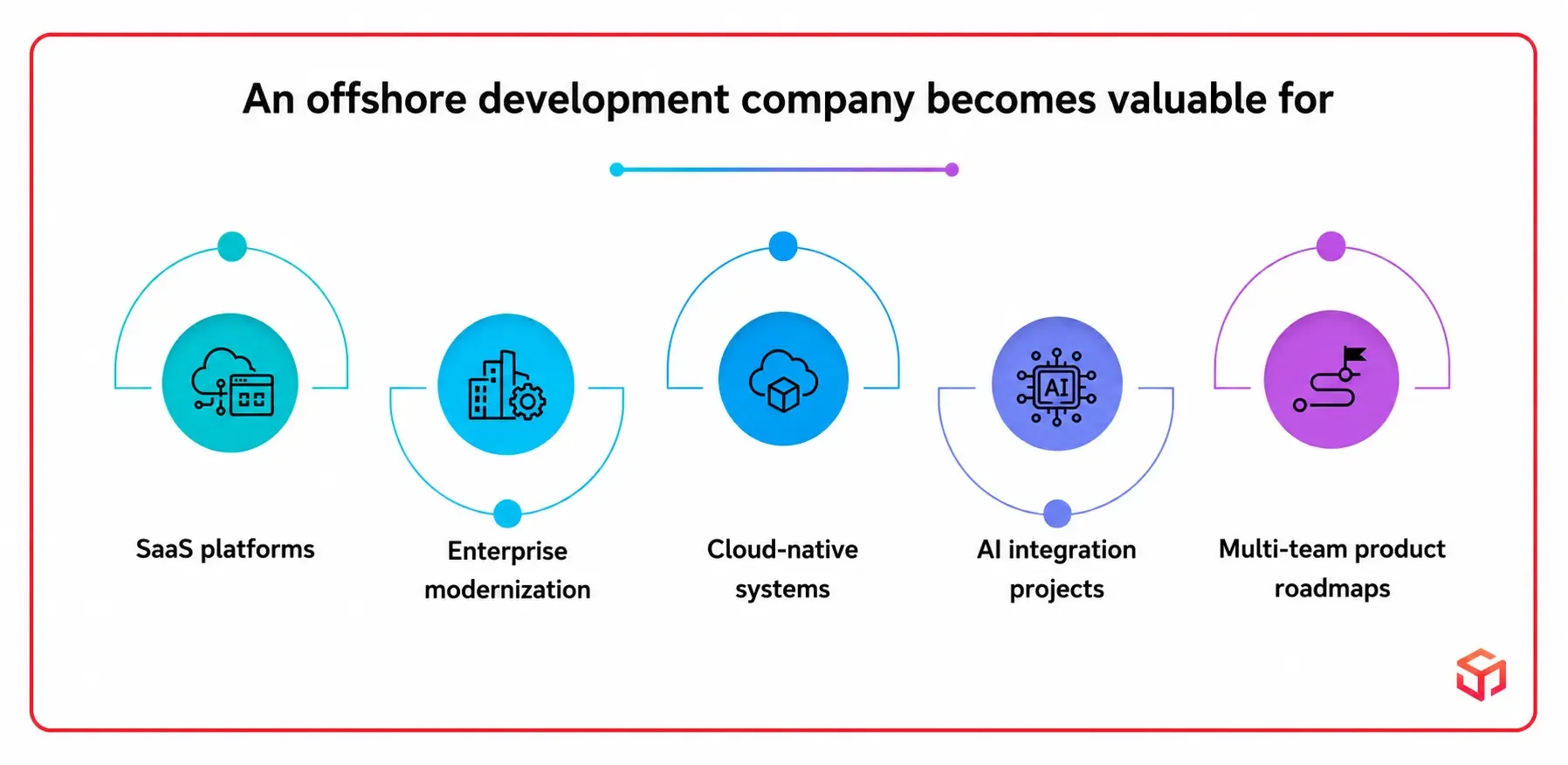
SaaS platforms
Enterprise modernization
Cloud-native systems
AI integration projects
Multi-team product roadmaps
For example, consider a SaaS company preparing to scale its product after a successful MVP launch.
Initially, hiring a few freelance developers through a platform may have been sufficient. However, as the product grows, the company may also need QA support, DevOps expertise, structured sprint planning, and release coordination.
Managing these functions across multiple independent contractors can quickly become challenging.
An offshore development company addresses this by providing a dedicated team with established processes, shared accountability, and delivery oversight.
Instead of managing individual contributors, the business works with an engineering team that is already aligned around common workflows, quality standards, and delivery goals.
So what is the major difference between these 2 models?
The biggest difference is operational ownership, meaning who manages delivery, continuity, quality, and scalability.
Hiring platforms give companies access to developers. A offshore development company helps companies sustain delivery quality, sprint continuity, and engineering scalability over time.
Put simply, hiring platforms are built to help you find people fast. You get quick access to many developers, but you still own how work is planned, managed, tested, and delivered.
Offshore development companies, on the other hand, focus on running the delivery engine, not just supplying talent. They put structures in place for sprints, QA, reviews, and long-term team growth so delivery stays consistent as you scale.
Why India-Based Offshore Development Companies Lead Both Models
India remains the global center for offshore software development and continues to dominate both hiring platforms and offshore development company models.
Businesses worldwide rely on Indian developers because the country offers one of the largest and most experienced engineering talent ecosystems available today.
Many global hiring platforms source a significant share of their developers from India. Simultaneously, numerous businesses collaborate directly with offshore development companies in India for dedicated engineering teams, managed delivery, and ongoing software development assistance.
So why does India continue to dominate both hiring platforms and offshore development company models?
The answer goes beyond cost alone. From developer availability and cross-border hiring demand to engineering scale and enterprise delivery experience, several factors have helped India become one of the world’s largest software talent hubs. Let’s look at some of the data behind this trend.
The nation provides one of the largest pools of engineering talent globally, with competitive development rates beginning at $15 per hour, excellent English communication skills, and years of experience in assisting global enterprise software initiatives.
With 17 million developers on GitHub in 2024, as per the India Brand Equity Foundation, India continues to strengthen its position as a global software development hub.
In a recent article published by The Times of India based on Deel’s State of Global Hiring Report 2025, India is ranked as the world’s third-largest cross-border talent base on that platform.
The report also highlighted strong year-over-year hiring growth from the United States, United Kingdom, and Australia, with software developers, testers, and UI specialists remaining among the most in-demand Indian professionals globally.
These factors have helped India become a global leader in both platform-based hiring and offshore software delivery models. Businesses can access highly skilled Indian developers either through freelance hiring platforms or through dedicated offshore development companies.
However, as software projects become larger and more complex, India-based offshore development companies often outperform platform-based hiring models in delivery stability, scalability, and long-term engineering continuity.
This is not simply a trend reflected in industry reports. Over the years, we have spoken with organizations across North America, Europe, and Australia that initially preferred platform-based hiring because it allowed them to move quickly. While this approach worked well during the early stages, many later found themselves searching for greater delivery continuity, stronger engineering processes, and easier team scalability as project complexity increased.
This shift is one of the reasons India-based offshore development companies continue to see growing demand alongside hiring platforms.
Hiring platforms offer access to talented engineers from India. But offshore development companies build structured delivery systems around that talent, which becomes critical for long-term product success.
Unlike platform-based hiring, offshore companies provide:
Dedicated Engineering Teams
Sprint Governance
QA Ownership
Devops Coordination
Project Management
Compliance-Ready Contracts
Long-Term Delivery Continuity
This structure reduces operational overhead for internal teams and improves delivery stability across larger software projects.
Platform hiring works well for isolated tasks or short-term scaling. But for enterprise applications, SaaS platforms, and multi-sprint product development, offshore development companies usually deliver better scalability, accountability, and engineering continuity.
Key reasons India-based offshore companies outperform platform-only hiring models include:
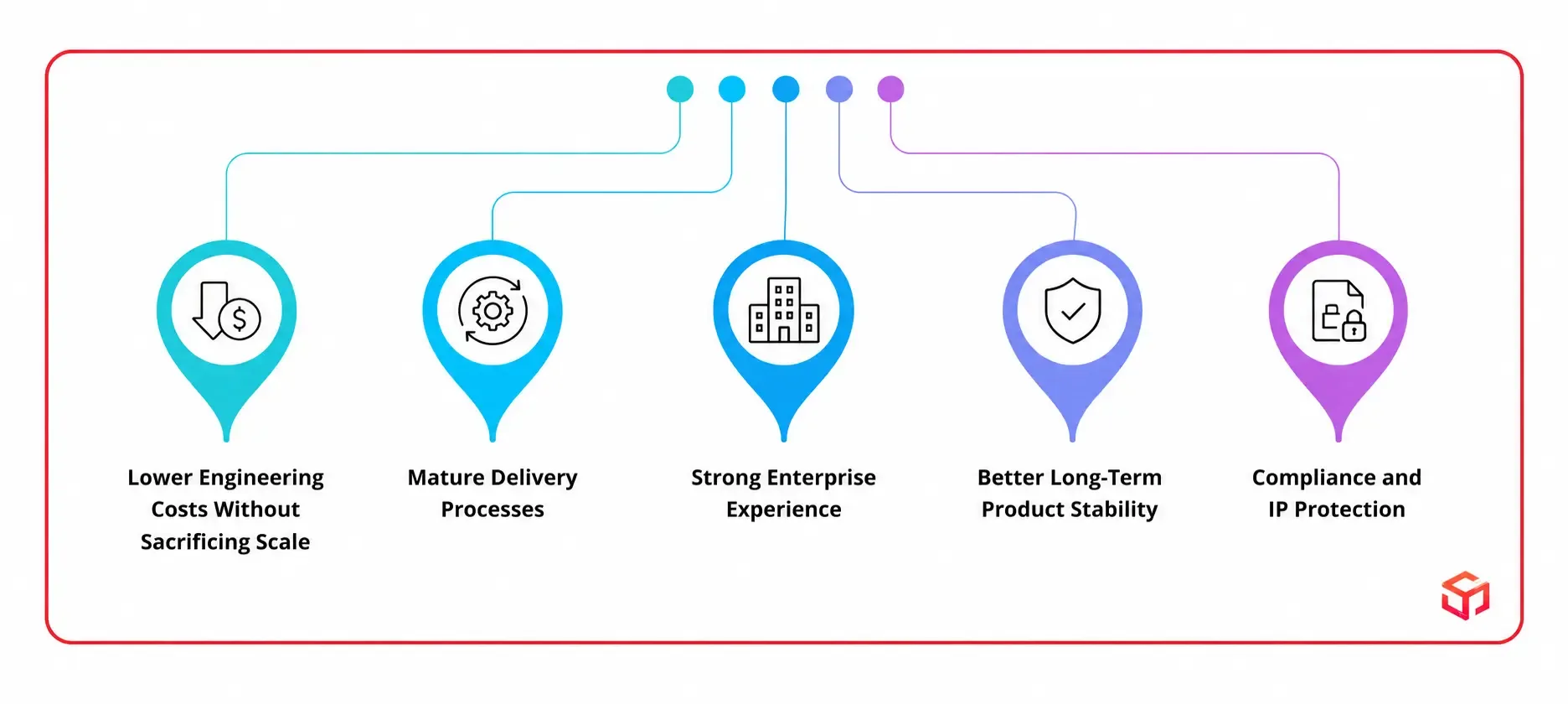
Lower Engineering Costs Without Sacrificing Scale: India-based teams often reduce engineering costs by 60–70% compared to US hiring while still supporting enterprise-grade Agile delivery environments and modern cloud-native architectures.
Mature Delivery Processes: Most offshore companies already operate with sprint planning, CI/CD workflows, QA automation, code reviews, DevSecOps practices, and structured release management built into delivery operations.
Strong Enterprise Experience: Indian engineering firms have supported Fortune 500 modernization projects for decades across healthcare, fintech, telecom, logistics, and ecommerce ecosystems.
Better Long-Term Product Stability: Freelancers may solve isolated technical tasks. Offshore engineering teams sustain roadmap execution, platform scalability, and long-term technical continuity more effectively.
Compliance and IP Protection: Established offshore firms typically include NDAs, IP assignment contracts, compliance frameworks, and enterprise procurement readiness directly inside their engagement structures.
Struggling to Find Proven AI Talent?
Hiring delays and weak AI expertise can stall projects. Soft Suave provides vetted AI engineers who accelerate delivery, reduce risk, and improve outcomes.
Hire AI ExpertsHead-to-Head Comparison: 6 Factors That Actually Matter
Most comparisons focus only on hourly rates. Real engineering outcomes depend on numerous other factors apart from just price alone. These factors determine whether projects accelerate smoothly or become operational bottlenecks later.
So to make the differences clearer, let’s compare hiring platforms and offshore development companies head-to-head across six critical factors, not just cost.
This comparison shows how two models that may appear similar at first can lead to very different long-term delivery outcomes.
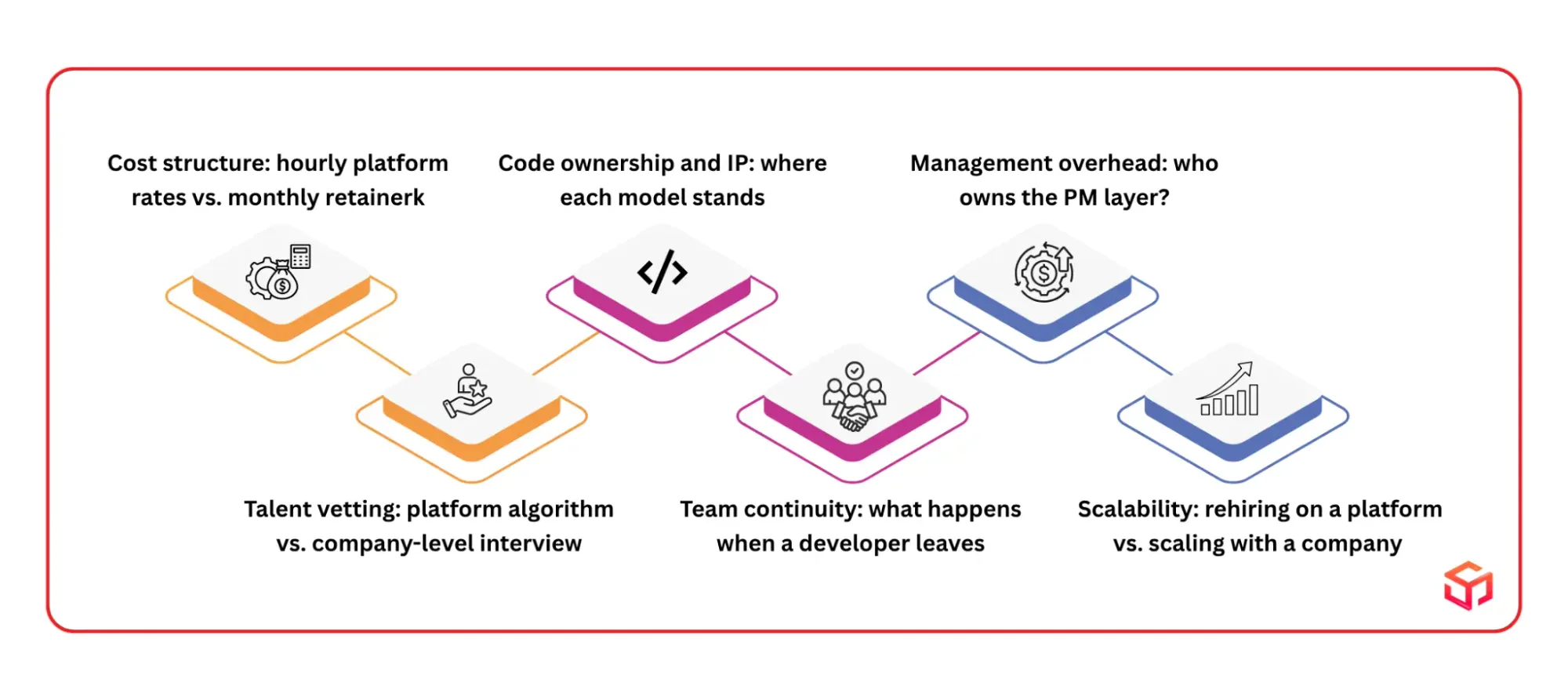
Cost structure: hourly platform rates vs. monthly retainer
Cost structure affects more than upfront budget planning. It directly impacts delivery predictability, operational efficiency, and long-term software scalability as engineering teams grow.
What hiring platforms usually offer
Hiring platforms like Upwork, Fiverr, and Toptal usually follow hourly or project-based pricing models. This gives companies flexibility for short-term work and rapid developer onboarding.
However, final costs can fluctuate based on platform fees, changing hourly rates, repeated hiring cycles, onboarding delays, and internal management overhead as projects scale.
For example, a top freelancing platform’s own pricing guide states that clients may incur service fees and contract-related charges in addition to freelancer rates.
What Soft Suave/offshore companies offer
Offshore development companies usually work through monthly, time & material, or sprint-based engagement models designed for long-term software delivery.
These provide more structured pricing with predictable billing cycles, dedicated resource allocation, and delivery support already included within the engagement structure.
These engagement models offer a more organized pricing approach with consistent billing intervals, committed resource assignment, and integrated delivery support as part of the engagement framework.
Soft Suave, for instance, offers multiple engagement models, including dedicated teams, hourly billing, and project-based delivery. Businesses can also review developer rate cards upfront, helping them estimate costs more accurately and choose an engagement model that aligns with their budget and delivery requirements.
Why this matters for delivery
Platform hiring may appear cheaper initially for short-term projects or MVPs. But for long-term software products, offshore delivery models often create better budget predictability, lower operational overhead, and more stable engineering continuity over time.
Talent vetting: platform algorithm vs. company-level interview
The quality of engineering talent depends heavily on how developers are evaluated before joining a project. Vetting standards directly affect delivery quality, communication reliability, and long-term engineering performance.
What hiring platforms usually offer
Hiring platforms like Upwork, Fiverr, and Toptal mainly rely on profile ratings, project history, review systems, and marketplace visibility algorithms to rank and recommend developers.
While these metrics help identify experienced freelancers, they do not always validate system design ability, Agile collaboration skills, architecture thinking, or experience working inside large engineering environments.
What Soft Suave/offshore companies offer
Dedicated offshore development companies like Soft Suave usually conduct structured technical screening before assigning engineers to client projects.
This often includes coding assessments, communication screening, and architecture interviews to validate technical capability before developers join client projects.
Soft Suave additionally conducts practical project-based evaluations, domain-specific screening, internal QA filtering, and Agile workflow assessments to measure real-world problem-solving ability and collaboration readiness.
Why this matters for delivery
A freelancer with strong platform reviews may still struggle inside distributed sprint workflows, complex DevOps environments, or cross-functional engineering teams.
Company-level vetting usually evaluates these operational capabilities more deeply, which helps improve engineering consistency, collaboration quality, and long-term delivery stability.
Code ownership and IP: where each model stands
Software ownership becomes critical once products scale, attract investment, or handle sensitive customer data. Clear IP structures reduce legal risk and simplify long-term product governance.
What hiring platforms usually offer
Hiring platforms typically require companies to manage NDAs, contractor agreements, IP assignment clauses, and compliance documentation independently for each freelancer engagement.
While platforms may provide basic legal protections, the responsibility for managing ownership clarity and compliance usually remains with the client throughout the project lifecycle.
Some hiring platforms offer additional NDA or IP protection features as optional add-ons or premium upgrades. Depending on the platform, these protections can add an average cost of $15 or more per contract, which can slightly increase the overall engagement cost.
What Soft Suave/offshore companies offer
Structured offshore engineering partners usually centralize these protections inside master service agreements and enterprise-ready engagement contracts.
At Soft Suave, these protections are supported through clear NDAs, IP assignment agreements, and service-level agreements (SLAs), helping businesses establish ownership, confidentiality, and delivery expectations from the start.
This structure improves legal clarity, compliance management, procurement readiness, and onboarding efficiency for businesses handling long-term software delivery or regulated workloads.
Why this matters for delivery
For industries like healthcare, fintech, and enterprise SaaS, fragmented IP ownership can create serious operational and legal risks as projects scale across multiple contributors.
Structured offshore delivery models help maintain stronger governance, clearer ownership accountability, and better long-term protection for software assets and sensitive business data.
Need More Than Just Developers?
Access developers, QA engineers, DevOps specialists, and delivery experts under one engagement. Accelerate releases while maintaining quality, visibility, and engineering consistency.
Explore TeamsTeam continuity: what happens when a developer leaves
Long-term software products depend heavily on engineering continuity. Knowledge transfer gaps often slow delivery more than technical complexity itself, especially in multi-sprint and large-scale development environments.
What hiring platforms usually offer
On hiring platforms, developer availability can change quickly because freelancers often work across multiple clients and projects simultaneously.
According to research published by TeamStage, nearly 70% of freelancers work on two to four projects simultaneously, which can make maintaining consistent focus and availability more challenging during critical project phases.
Developers may shift priorities, pause availability, accept competing projects, or leave during active sprint cycles. Replacing them usually requires restarting sourcing, interviews, onboarding, and knowledge transfer processes from the beginning.
What Soft Suave/offshore companies offer
Offshore delivery companies such as Soft Suave typically keep backup engineering resources, organized project documentation, and established internal transition processes to ensure consistency during team transitions.
These companies also follow managed onboarding processes that help reduce delivery disruption if resources need to be replaced or expanded during long-term engagements.
Why this matters for delivery
A single developer’s exit can delay releases significantly if product knowledge exists only with one freelancer. This risk increases as systems become larger, more integrated, and architecturally complex.
Structured offshore teams usually maintain stronger continuity through shared documentation, collaborative workflows, and centralized engineering oversight across the delivery lifecycle.
Management overhead: who owns the PM layer?
Management overhead is one of the most overlooked differences between these models. It directly impacts engineering productivity, release velocity, and delivery predictability across long-term software projects.
What hiring platforms usually offer
Hiring platforms typically place most project management responsibility on the client’s internal team. Companies often handle sprint planning, standups, backlog refinement, QA coordination, release tracking, and developer productivity monitoring independently.
This structure works well for businesses that already have experienced engineering managers, product owners, and technical leadership internally managing distributed development workflows.
What Soft Suave/offshore companies offer
Offshore companies with dedicated delivery structures usually absorb part of this operational responsibility through delivery managers, technical leads, Agile coordinators, and structured reporting systems.
This support layer helps manage engineering workflows, sprint execution, communication alignment, and delivery tracking more efficiently across distributed offshore teams.
Why this matters for delivery
As engineering teams scale, management overhead can quickly slow product velocity if coordination responsibilities remain fully dependent on internal leadership.
Structured offshore delivery models usually reduce this operational burden, allowing internal teams to focus more on product strategy, roadmap execution, and business growth instead of day-to-day engineering coordination.
Scalability: rehiring on a platform vs. scaling with a company
Engineering scalability becomes increasingly important once products move beyond the MVP stage. Scaling speed often determines how quickly companies can release features, support users, and expand into new markets.
What hiring platforms usually offer
Hiring platforms usually require repeated hiring cycles whenever companies need to expand engineering capacity. Businesses often need to source candidates, repeat technical interviews, manage onboarding again, and rebuild collaboration workflows for every scaling phase.
This process may work for smaller teams initially, but operational complexity often increases as more developers, technologies, and sprint dependencies are introduced.
What Soft Suave/offshore companies offer
Dedicated offshore leaders scale through existing engineering structures and delivery frameworks already aligned with the client’s workflows.
Teams can expand more smoothly using shared Agile processes, standardized QA practices, aligned DevOps pipelines, and centralized delivery governance across multiple engineering functions.
Why this matters for delivery
Scaling software products requires more than simply adding developers. Teams also need stable workflows, communication alignment, and engineering continuity across growing systems.
Structured offshore delivery models usually support faster and more stable scaling across frontend, backend, cloud infrastructure, QA automation, and platform engineering environments.
The Hidden Costs Nobody Talks About
Most companies compare hourly rates first. Very few calculate the operational costs created by coordination gaps, onboarding delays, and fragmented engineering ownership across distributed development environments.
In fact, one of the most common questions clients ask us during initial discussions is: “What is the hourly rate?” Very few ask about sprint governance, QA ownership, delivery continuity, or long-term operational scalability.
These are some of the overlooked operational factors where the real hidden costs usually begin to appear in both hiring platforms and offshore development company models.
Hidden costs in hiring platforms
Hiring platforms often create operational expenses beyond the visible developer rate. These costs usually increase as projects scale across multiple contributors and sprint cycles.
Screening and onboarding time: Engineering leaders may spend weeks reviewing profiles, conducting interviews, validating technical credibility, and onboarding freelancers before development even begins.
Multi-client freelancer risk: Many freelancers work across multiple projects simultaneously. This can affect sprint focus, communication responsiveness, and delivery consistency during critical release periods.
Knowledge transfer delays: When freelancers leave mid-project, companies often repeat onboarding, documentation, and environment setup processes, slowing overall engineering velocity.
Internal management overhead: Clients usually manage sprint planning, QA coordination, release tracking, and developer accountability internally, increasing operational workload on product and engineering teams.
Hidden costs in offshore development companies
Offshore development companies also introduce costs that businesses should evaluate carefully before entering long-term delivery engagements.
Management and delivery markups: Some offshore firms include additional pricing layers for project management, delivery governance, or account handling within the engagement structure.
Minimum engagement commitments: Certain offshore companies may require fixed team sizes or longer contract durations that reduce flexibility for short-term projects.
Process-heavy delivery environments: Not every offshore company operates efficiently. Some firms introduce excessive reporting layers, approvals, or unnecessary management processes that slow engineering execution.
Vendor dependency risks: Businesses relying heavily on one offshore vendor may face operational disruption if documentation, communication workflows, or product knowledge are not shared transparently.
To avoid unexpected hidden costs later, our advice is to evaluate these models beyond hourly engineering rates alone. Long-term software success depends more on delivery stability, scalability, continuity, and execution quality over time.
Is Developer Coordination Slowing Growth?
Managing multiple developers, workflows, and priorities can drain valuable time. Soft Suave provides dedicated engineering teams with accountability, continuity, and predictable execution.
Scale ConfidentlyWhich Model Fits Your Situation? (Decision Framework)
The right hiring model depends on project complexity, delivery ownership, engineering maturity, and long-term scaling goals. Different software environments require different operational structures to stay efficient.
A hiring platform is usually better if you:
Need Short-Term Technical Help: Platforms work well for isolated features, temporary workload spikes, or highly specialized engineering tasks requiring rapid onboarding flexibility.
Already Have Strong Internal Engineering Leadership: Companies with experienced product managers, architects, and QA teams can coordinate freelancers more effectively across sprint environments.
Want Fast MVP Experimentation: Freelance platforms help startups validate ideas quickly without committing to long-term delivery contracts or dedicated engineering structures.
An offshore development company is usually better if you:
Need Long-Term Product Continuity: Dedicated offshore teams maintain engineering consistency across multiple sprint cycles, release schedules, and evolving product roadmaps.
Require Structured Delivery Governance: Managed engineering environments improve sprint planning, QA ownership, DevOps coordination, and release predictability across larger software systems.
Plan to Scale Engineering Capacity Quickly: Offshore firms expand teams faster using existing workflows, onboarding systems, and centralized engineering management structures.
Handle Compliance-Sensitive Workloads: Industries like fintech, healthcare, logistics, and enterprise SaaS often require stronger IP governance and structured contractual protections.
The biggest decision factor is operational ownership.
If your internal team wants direct control over daily execution, platforms may work well. If you need managed delivery stability, offshore development companies usually provide stronger long-term outcomes.
How to Choose the Right Offshore Development Company in India
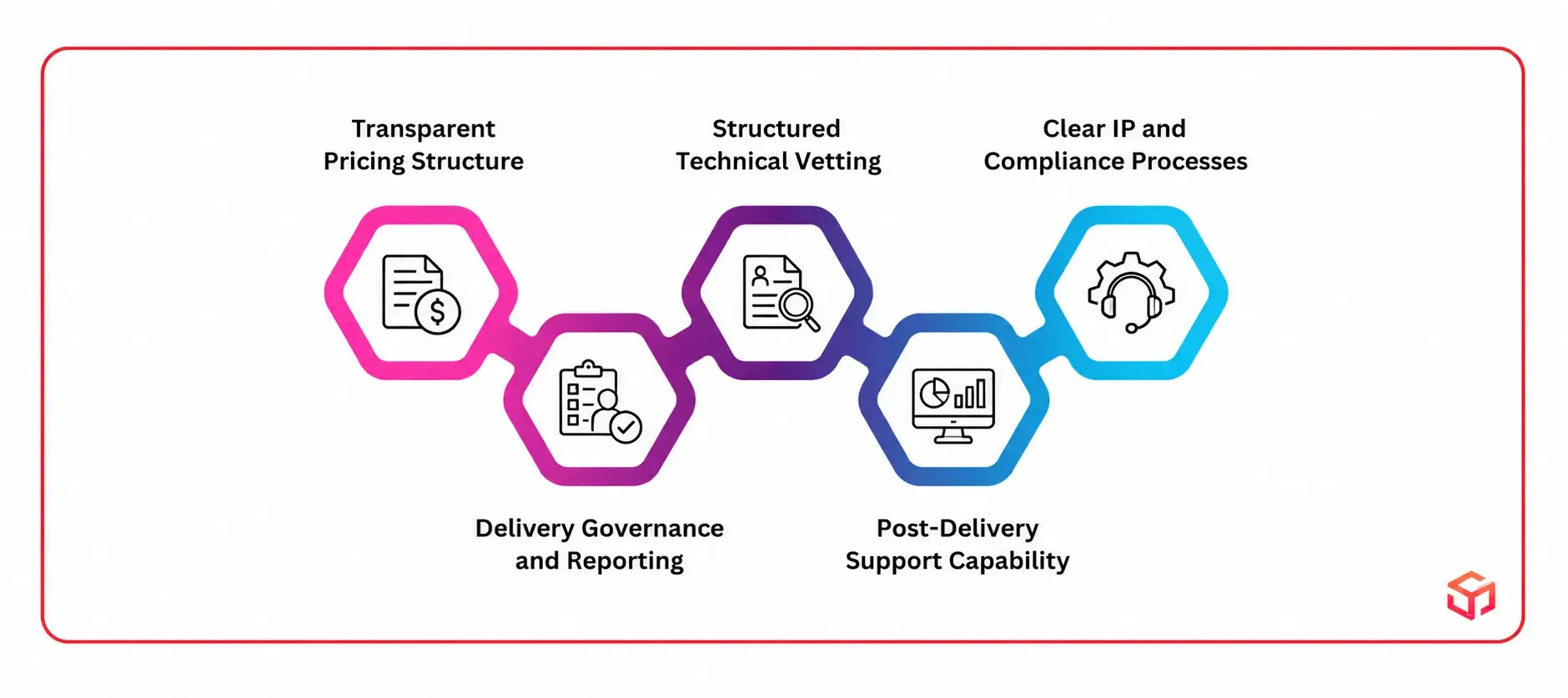
Choosing the right offshore partner requires more than reviewing portfolios or hourly rates. Long-term delivery success depends on engineering processes, governance maturity, communication quality, and operational transparency.
Key evaluation criteria include:
Transparent Pricing Structure: The engagement model should clearly define billing, resource allocation, sprint ownership, and scope management without hidden operational costs later.
Structured Technical Vetting: Strong offshore firms use internal coding assessments, architecture reviews, and communication screening before assigning engineers to client projects.
Clear IP and Compliance Processes: Look for firms with enterprise-ready contracts, NDAs, data protection workflows, and clearly defined ownership structures for source code and deliverables.
Delivery Governance and Reporting: Reliable offshore partners maintain sprint tracking, QA visibility, release reporting, and consistent communication rhythms across distributed engineering environments.
Post-Delivery Support Capability: Long-term support matters for scaling products, infrastructure upgrades, cloud optimization, and production issue management after initial development phases.
Businesses should evaluate offshore partners based on their ability to support long-term software delivery – not just developer availability. The right offshore company should function as an extension of the internal engineering team with clear communication, stable workflows, structured delivery ownership, and the ability to scale reliably as products evolve.
This becomes especially important for SaaS platforms, enterprise applications, and multi-sprint development environments where continuity, governance, and operational stability directly impact release velocity and product quality.
Soft Suave Technology is built around exactly this model – a dedicated India-based offshore development company with structured delivery and direct client access to its engineering team.
The company provides direct access to engineering teams, structured sprint execution, and transparent communication workflows for long-term software delivery. Soft Suave helps businesses scale engineering capacity without compromising delivery stability, code quality, or operational visibility.
To reduce hiring risk further, Soft Suave also offers a 40-hour free trial, allowing businesses to evaluate technical capability, collaboration quality, and delivery alignment before making a long-term engagement decision.
Test Before You Commit
Evaluate our developers through a 40-hour free trial. Assess technical expertise, communication, and delivery quality before making any commitment.
Start TrialConclusion
The choice between a hiring platform and an offshore development company is not really about where you find developers. It is about how much delivery risk your business is willing to manage.
Hiring platforms can help you find talent quickly, but speed alone does not guarantee successful outcomes. As projects grow, challenges around continuity, knowledge retention, accountability, and team scalability often become more important than the initial hiring process.
The most common mistake we see companies make is jumping to a conclusion and choosing a hiring model before fully understanding the trade-offs involved.
Decisions are often driven by speed, cost, or familiarity, without considering how the model will support delivery over time.
The right choice is not the option that helps you hire the fastest. It is the one that gives your business the best chance of delivering software consistently, reliably, and at scale.
FAQs
What is the difference between a hiring platform and an offshore development company?
Hiring platforms primarily help companies source freelance developers quickly. Offshore development companies provide managed engineering teams, delivery governance, QA ownership, and long-term operational continuity for larger software initiatives and scalable product development.
Which is cheaper: a hiring platform or an offshore development company?
Hiring platforms may appear cheaper initially because of flexible hourly pricing. Offshore development companies often reduce long-term operational costs through structured delivery, better continuity, centralized QA, and lower management overhead across extended software projects.
Who owns the code when using a hiring platform vs. an offshore company?
With hiring platforms, companies usually manage IP ownership through individual contractor agreements. Offshore development companies typically centralize IP protection, NDAs, and ownership structures inside formal enterprise-ready service contracts for stronger legal clarity.
Can I hire a full development team through a hiring platform?
Yes. Companies can build distributed engineering teams using hiring platforms. However, internal teams usually handle project management, onboarding, sprint coordination, QA ownership, and continuity planning independently throughout the engagement lifecycle.
What happens if a developer leaves mid-project on a platform?
If a freelancer leaves unexpectedly, companies often restart sourcing, onboarding, and knowledge transfer processes. Offshore development companies usually provide replacement planning, internal documentation, and continuity workflows to minimize delivery disruption during transitions.
Which model is better for long-term product development?
Offshore development companies are usually better for long-term product development because they provide engineering continuity, structured Agile delivery, QA governance, and scalable team support. Companies like Soft Suave also help reduce operational overhead through managed offshore delivery models.

Ramesh Vayavuru is the Founder & CEO of Soft Suave Technologies, with 15+ years of experience delivering innovative IT solutions.
Related Blogs