How Companies Safeguard IP with Offshore Teams

TL;DR :-
Learn how companies protect IP with offshore developers using contracts, access controls, and secure engineering workflows
Explore the legal, technical, and operational best practices that prevent IP loss during distributed software development
Also see the practical safeguards covering ownership, patents, trademarks, and secure environments for offshore teams
Your product idea is valuable. Your source code is sensitive. One wrong outsourcing move can expose both.
Many companies hesitate to scale offshore because intellectual property feels harder to control across borders. That fear is valid. Offshore development introduces new people, new systems, and new legal realities.
But leading technology-driven companies still build offshore teams every day—without losing control of their IP. They rely on clear ownership rules, secure engineering practices, and disciplined vendor governance.
This guide breaks down how companies protect IP with offshore developers using proven legal, technical, and operational safeguards that work in real-world software delivery environments.
What are Intellectual Property Rights?
Intellectual property rights define who legally owns the ideas, assets, and outputs created during software development. These rights form the foundation for control, monetization, and long-term business value.
In offshore development, IP typically includes:
Source code and compiled software
Architecture designs and system documentation
Algorithms, workflows, and proprietary logic
Brand assets and product names
Without clear IP ownership, companies risk disputes, reuse, or loss of competitive advantage.
Why are Intellectual Property Rights Important in Offshore Software Development?
Offshore development multiplies risk when ownership, access, and accountability are unclear. Distance does not cause IP loss—weak governance does.
When companies fail to protect IP offshore, consequences include:
Loss of ownership clarity: Code may legally belong to the developer, not the business, creating future disputes and valuation issues.
Unauthorized reuse or exposure: Shared repositories and weak access controls can expose proprietary logic unintentionally.
Jurisdiction enforcement challenges: Legal recovery becomes complex when contracts lack enforceable cross-border protection.
Strong IP rights ensure offshore scale does not compromise control.
Offshore Development Feels Risky When IP Control, Access Governance, And Accountability Are Unclear Across Teams
Our senior engineers follow strict access controls, secure environments, and ownership-first contracts, helping you eliminate IP leaks while accelerating delivery timelines across distributed development teams.
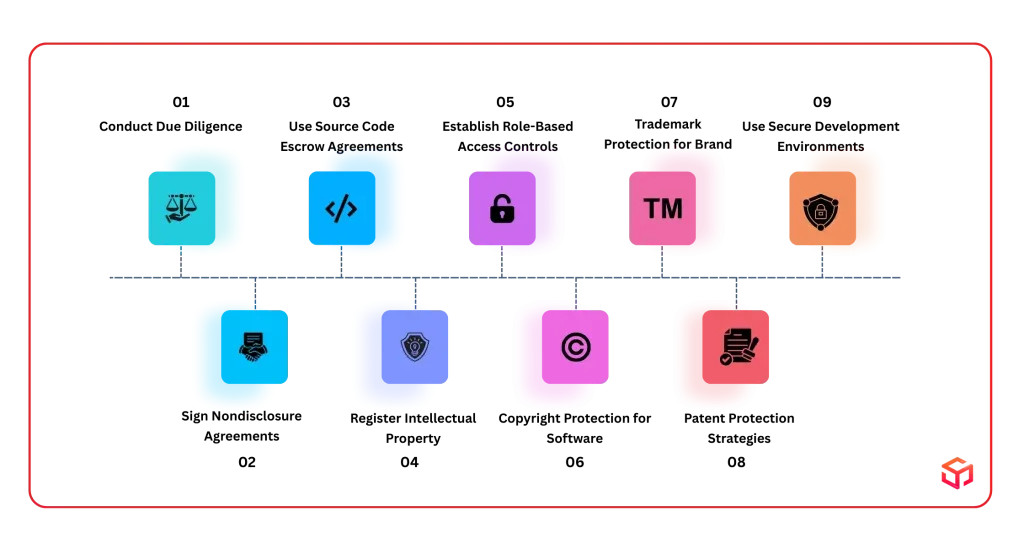
Best Practices for Protecting Intellectual Property Rights in Offshore Software Development
Protecting IP offshore is not about one document or one tool. It requires layered protection across legal contracts, engineering processes, and daily operational discipline.
The following practices reflect how mature technology organizations secure IP while scaling distributed development teams.
Conduct Due Diligence
Before code is written, risk must be assessed. Due diligence determines whether a vendor can protect IP at an operational level.
Effective due diligence includes:
Security process evaluation
Review access policies, repository management, and incident response procedures used across active projects.Delivery governance review
Assess sprint discipline, documentation practices, and internal quality controls that prevent accidental IP leakage.Past client validation
Verify how the vendor handled IP ownership, exits, and handovers in previous engagements.
Strong vendors prove IP safety through systems, not promises.
Build Offshore Software Faster With Expert Developers Who Treat IP Protection As Core Architecture Practice
Soft Suave combines proven tech stacks, security-first engineering, and transparent processes to help product teams scale confidently, maintain control, and deliver predictable outcomes every sprint.
Get 7days Free TrialSign Nondisclosure Agreements
NDAs establish confidentiality expectations but should never stand alone. They work best when aligned with ownership and enforcement clauses.
Key NDA considerations include:
Clear confidentiality scope
Define what constitutes confidential information, including derivatives and internal tooling.Survival and termination clauses
Confidentiality obligations must continue after contract completion or termination.Alignment with IP ownership
NDAs must support, not replace, explicit ownership definitions in master agreements.
An NDA sets boundaries, but enforcement comes from structure.
Use Source Code Escrow Agreements
Escrow agreements protect continuity when offshore dependencies increase. They ensure access without compromising control.
Escrow strategies help by:
Ensuring business continuity
Code access is preserved if a vendor relationship ends unexpectedly.Reducing operational dependency risk
Critical systems remain accessible without vendor lock-in.Supporting investor and compliance requirements
Escrow adds credibility during audits, acquisitions, and funding reviews.
Escrow strengthens resilience without exposing live systems.
Register Intellectual Property
Formal registration strengthens enforceability across jurisdictions. It converts ownership intent into legal protection.
Registration benefits include:
Stronger legal standing
Registered IP simplifies enforcement during disputes or infringements.Cross-border clarity
Ownership becomes easier to assert when development spans multiple regions.Increased enterprise value
Registered IP directly impacts valuation, due diligence, and exit readiness.
Companies need to know how to patent an application idea, along with offshore execution planning to avoid disclosure risks during development.
Turn Offshore Development Into A Competitive Advantage Without Sacrificing Code Ownership Or Control During Scale
From architecture to deployment, our developers align security, velocity, and governance so your offshore delivery stays compliant, scalable, and fully aligned with business goals and objectives.
Establish Role-Based Access Controls
Access limitation is one of the strongest IP protection mechanisms. Developers should only access what they actively build.
Role-based access controls prevent IP exposure by:
Segmenting code repositories
Teams see only assigned modules, reducing unnecessary visibility.Restricting sensitive systems
Core algorithms and production credentials remain isolated.Creating audit-ready access trails
Access logs support compliance and incident investigation.
RBAC protects IP from mistakes, not just malicious intent.
Copyright Protection for Software
Copyright defines legal ownership of code and derivative works. A trusted offshore software development company assigns this ownership clearly.
Effective copyright protection involves:
Explicit ownership clauses
All deliverables must transfer ownership to the client upon creation.Coverage of derivative works
Modifications, extensions, and refactors must remain client-owned.Clear exit documentation
Ownership survives team changes or contract termination.
Copyright clarity prevents reuse without consent.
Trademark Protection for Brand
Brand assets often get overlooked during offshore builds. Trademarks protect identity, not code.
Trademark safeguards include:
Ownership of product names
Logos, names, and taglines must remain client-controlled.Restricted brand usage rights
Vendors should not reuse branding beyond approved scopes.Market expansion readiness
Trademark ownership supports global launches and partnerships.
Brand misuse creates risk beyond technology.
Patent Protection Strategies
Patents protect innovation but require careful timing during offshore development. Disclosure missteps can invalidate protection.
Smart patent strategies include:
Controlled invention disclosure
Share only necessary design elements during early builds.Pre-development filing consideration
File provisional patents before exposing core logic offshore.Confidential architecture segmentation
Separate patentable components from general development tasks.
Patent safety depends on planning, not speed.
Test Offshore Developers Risk Free And Validate IP Security Before You Commit Long-Term Engagements
With our 40-hour free trial, experience real engineering output, security discipline, and communication clarity before investing, ensuring confidence in code ownership and delivery quality outcomes.
Use Secure Development Environments
Daily engineering practices determine IP safety more than contracts. Secure environments enforce discipline by default.
Secure development environments protect IP through:
Hardened repositories
Encrypted storage and access monitoring reduce breach risk.Controlled CI/CD pipelines
Build systems prevent unauthorized code movement.Isolated testing infrastructure
Sensitive logic stays out of shared environments.
Modern offshore software development relies on environment security as a first-line defense.
Conclusion
Offshore development does not weaken intellectual property—poor structure does. Companies that protect IP successfully treat ownership, access, and security as system-level responsibilities, not paperwork tasks.
Legal contracts define rights. Engineering controls are enforced daily. Governance keeps everything aligned as teams scale. When these layers work together, offshore teams become an advantage, not a liability.
If your product roadmap depends on distributed development, IP protection must be designed upfront, reviewed continuously, and enforced operationally. Companies that get this right move faster, scale safely, and build lasting competitive value without fear.
FAQ
How to protect intellectual property when outsourcing?
Protect IP by combining clear ownership contracts, restricted code access, secure development environments, and vendor due diligence. Legal safeguards must align with daily engineering controls to remain effective.
What is offshore IP?
Offshore IP refers to intellectual property created by external teams located in other countries. Ownership depends on contracts, not geography, and must be clearly defined before development begins.
What is the strongest form of intellectual property protection?
There is no single strongest protection. Layered safeguards—legal ownership, access control, secure environments, and process discipline—work together to provide durable IP protection across offshore teams.

Ramesh Vayavuru is the Founder & CEO of Soft Suave Technologies, with 15+ years of experience delivering innovative IT solutions.
Related Blogs