
IT Staff Augmentation Contract: Clauses and Checklist

TL;DR
Know what to review in your contract, from billing and responsibilities to IP ownership, security, and exit terms.
Learn how engagement models, billing options, and supporting documents shape your staff augmentation agreement.
Explore cross-border considerations and use a practical checklist to clarify important terms before you sign.
When external developers join your team, both sides need to understand their responsibilities. This is where an IT staff augmentation contract comes into play. An IT staff augmentation contract defines how you will work together, including the assigned roles, payment terms, confidentiality, and conditions for ending the engagement.
Before signing, both sides need clarity on responsibilities, billing, intellectual property, confidentiality, and how the engagement can change or end. Agreeing on these details before work begins helps both sides understand what to expect.
This guide explains the clauses to review, the questions to ask, and the details to document. It also covers cross-border considerations and a practical checklist to help you prepare for discussions with your provider and legal counsel.
This guide provides general information, not legal advice. Have qualified legal counsel review any agreement before signing.
What Is an IT Staff Augmentation Contract?
An IT staff augmentation contract is an agreement between a business and a provider supplying technology specialists to work within the business’s existing team.
It records the conditions of that relationship: who supplies the professionals, who directs their work, what is billable, and how information and intellectual property are handled. It should also explain how either party can request changes or end the engagement.
A clear contract should answer these practical questions:
Who will join your team? Specify the required roles, experience, technical skills, and work location so both sides understand which professionals the provider is expected to supply.
What availability are you agreeing to? Define working hours, time-zone overlap, and how leave or absences are handled, based on your team’s needs and the agreed engagement.
How will changes be managed? Explain how either party can request changes to roles, team size, or working terms, including who approves them and how they are documented.
How Does Staff Augmentation Work in IT?
So we have seen that staff augmentation means bringing external professionals into your existing team to fill skill gaps or provide additional capacity. They work alongside your employees under your team’s day-to-day direction.
In IT staff augmentation, these professionals include software developers, quality assurance (QA) engineers, DevOps specialists, and other technical personnel. They contribute to your projects using your tools and processes, while the provider handles the personnel support defined in your agreement.
The process generally follows these steps:
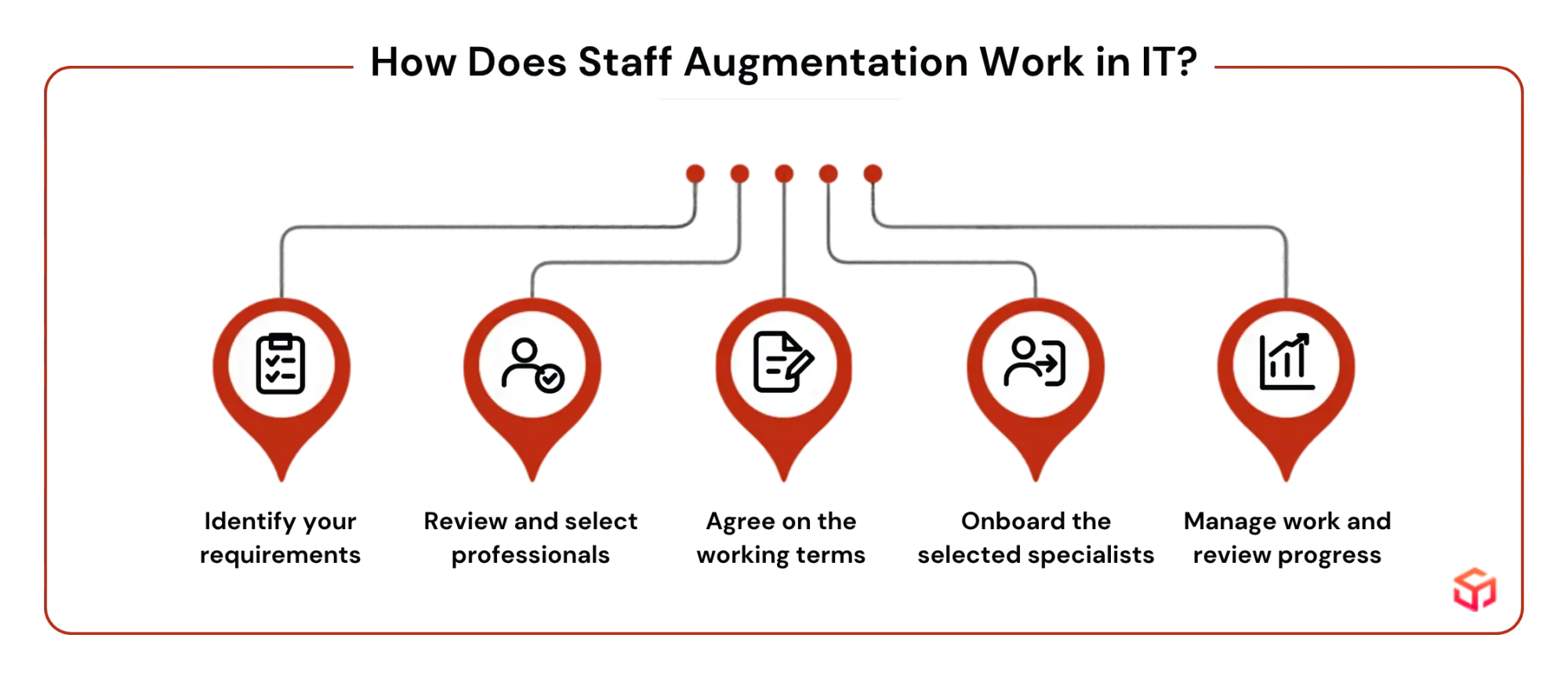
Identify your requirements: Define the skills, experience, and additional capacity your project needs. Explain the work involved, preferred working hours, and how the specialists will support your team.
Review and select professionals: The provider shares suitable profiles based on your requirements. You assess their technical skills, discuss relevant experience, and select professionals who fit your project.
Agree on the working terms: Both sides confirm responsibilities, availability, billing, confidentiality, ownership, and exit conditions. These details form the basis of the staff augmentation agreement.
Onboard the selected specialists: Introduce them to your team, explain the project, and provide approved access to the tools, documentation, and systems they need for their work.
Manage work and review progress: Your internal leads assign tasks, review contributions, and provide feedback. The provider handles the agreed personnel support and helps address concerns or changing requirements.
Throughout this process, your business and the provider share different responsibilities. The table below explains who typically handles each part of the engagement.
Area | Client’s usual role | Provider’s agreed role |
Daily work | Set priorities, assign tasks, and review code. | Supply professionals matching the agreed requirements. |
Access and onboarding | Approve accounts, permissions, and project guidance. | Coordinate personnel readiness and agreed onboarding support. |
Personnel administration | Coordinate project needs and report concerns. | Handle the employment, payroll, and benefits obligations applicable to its arrangement. |
Performance concerns | Provide specific feedback and technical evidence. | Manage escalation and agreed corrective or replacement steps. |
The contract should clearly state who handles employment, taxes, insurance, and security. Managing the developers’ daily work does not mean your business takes on all responsibilities. The provider must still meet its agreed duties and applicable legal requirements.
Fill Technical Skill Gaps in Your Team With Soft Suave
Add the technical expertise your team needs with Soft Suave. Explore suitable roles, working arrangements, and support options based on your current software development requirements.
Discuss Your NeedsIT Engagement Models and Billing Options
Now let’s look at the different engagement models and billing options you can consider when exploring IT staff augmentation services.
IT staff augmentation contracts vary by engagement duration, billing model, and delivery responsibilities. Understanding these differences helps you choose an arrangement that fits your project and team.
Basically, the engagement model defines how your business and the provider work together. Billing terms explain how you pay for the agreed people, services, or project.
Staff Augmentation
Staff augmentation adds external specialists to your existing team. Your internal leads assign tasks, set priorities, and review their work. The provider supplies suitable professionals and handles agreed personnel support. This model suits businesses that need additional skills or capacity while retaining day-to-day management of development and their delivery process.
Managed Services
Managed services give a provider responsibility for running an agreed service, such as application support or infrastructure monitoring. The provider organizes the team and manages service performance against agreed requirements. Your business defines expectations and reviews results, while the contract sets the service scope, reporting arrangements, escalation process, and responsibilities.
Project Outsourcing
Project outsourcing assigns a defined development project or scope of work to an external provider. The provider manages its team and delivery activities, while your business agrees requirements, reviews progress, and approves deliverables. The contract defines scope, acceptance criteria, responsibilities, change procedures, and payment terms based on the agreed engagement.
The table below summarizes how these models differ:
Model | Who manages daily work? | Main contract focus | Billing options |
Staff augmentation | Your internal leads | Skills, availability, and personnel support | Hourly, daily, or monthly capacity |
Managed services | Provider’s service team | Service scope, performance, and support obligations | Recurring service fees or usage-based charges |
Project outsourcing | Provider’s project team | Deliverables, acceptance, and scope changes | Fixed-price or time-and-materials arrangements |
How Billing Options Work
The billing arrangement should explain what you are paying for and how charges are approved:
Hourly or daily billing: You pay for the approved hours or days worked at the agreed rate. Your invoice shows the billable time and the total charges for that period.
Monthly capacity: You pay an agreed monthly fee to reserve a developer’s or team’s availability. The contract defines the included hours and how additional work is charged.
Recurring service fees: You pay a regular fee for an ongoing service, such as application support. Work or usage beyond the included service may attract additional charges.
Fixed-price projects: You agree on a total fee for a defined project scope. You pay according to an agreed schedule, which may be linked to completed milestones.
Engagement duration is agreed separately. The contract should explain when the work starts, how it continues or renews, and how either party can end it.
One important thing to note here is that these are common patterns and not fixed rules. Check the actual allocation of responsibility, especially in hybrid arrangements. A pricing label alone does not establish who manages the team or guarantees an outcome.
Find the Right Staffing Arrangement for Your Project
Discuss your technical requirements, expected availability, and preferred billing approach with Soft Suave to explore an engagement that reflects how your team needs to work.
Explore Engagement OptionsDocuments You May Need for Staff Augmentation
Depending on the engagement, these terms may be included in one agreement or spread across several documents. You do not necessarily need each document separately.
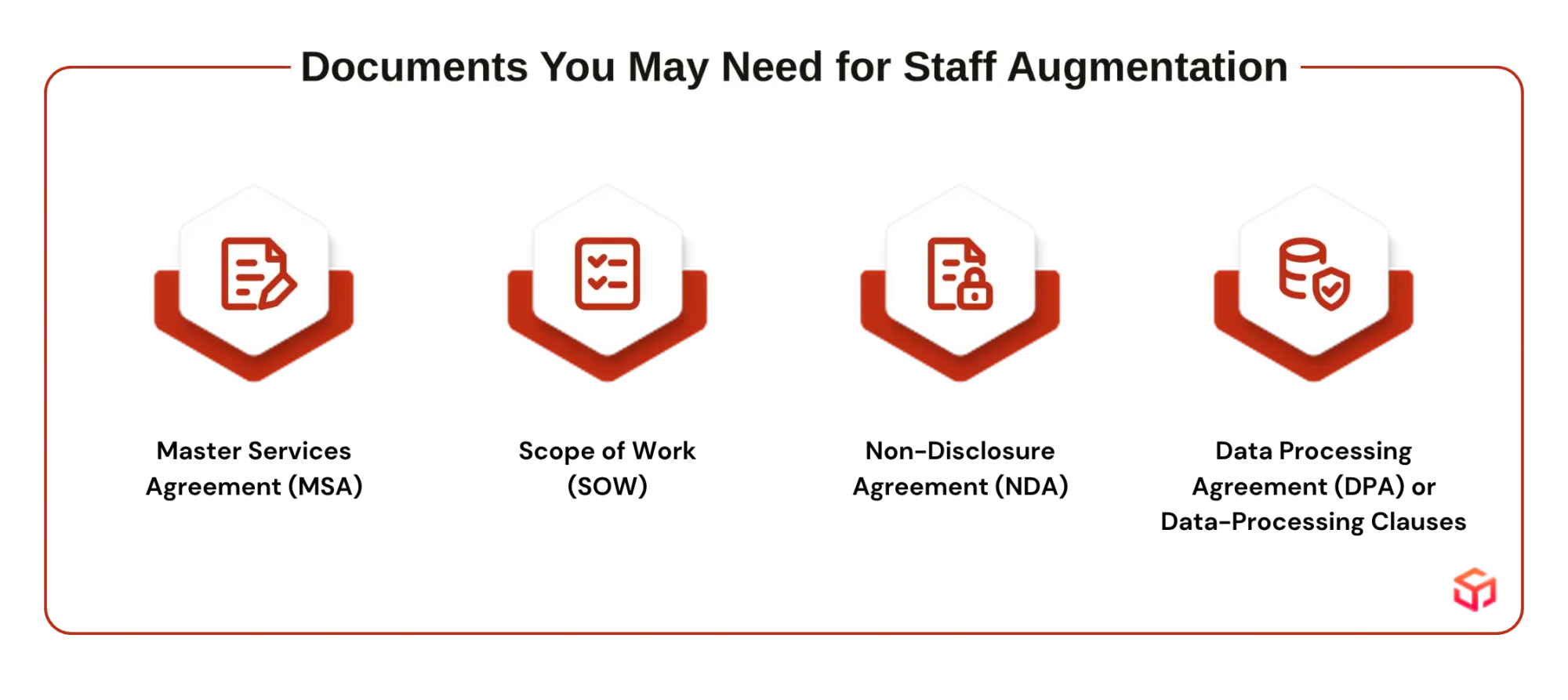
Document | What it does | Key details to review |
Master Services Agreement (MSA) | Sets the general terms between your business and the provider. | Payment terms, confidentiality, IP ownership, liability, termination, and dispute resolution. |
Scope of Work (SOW) | Describes the work and responsibilities covered by the engagement. | Required roles, technical skills, work location, availability, duration, and expected contributions. |
Non-Disclosure Agreement (NDA) | Sets rules for protecting confidential information. | Information covered, permitted use, who may access it, exceptions, and confidentiality obligations after the engagement ends. |
Data Processing Agreement (DPA) or Data-Processing Clauses, Where Applicable | Defines responsibilities when the provider processes personal data on your behalf, and applicable law requires these terms. | Data involved, processing purpose, instructions, security, approved subprocessors, incident support, data return or deletion, and assistance or audit obligations. |
These documents cover different needs. For example, an NDA addresses confidentiality, while data-processing terms explain how personal data must be handled where applicable.
Before signing, check that the documents are consistent. If their terms differ, the agreement should explain which document takes priority and how changes are approved.
Essential Clauses in an IT Staff Augmentation Contract
The essential clauses explain how the relationship operates when work begins, requirements change, problems arise, or the engagement ends; review them against your actual delivery needs.
Scope, Technical Roles, and Responsibilities
Specify the roles, experience, technology stack, work location, and reporting lines. Describe the expected contribution clearly enough to evaluate whether the assigned professional matches the requirement.
Separate the developer’s work from the provider’s promises. An engineer contributing to a release does not automatically mean the provider guarantees the entire release date. Identify who owns architecture, task prioritization, code review, testing, and acceptance decisions.
Also agree on how role changes are approved. Moving a developer into a different responsibility should trigger a discussion about suitability, availability, and any commercial changes.
Working Hours, Availability, and Communication
State the expected working pattern and required collaboration overlap. Record how availability is coordinated across time zones, including public holidays, planned leave, and unexpected absence.
Agree on the tools, reporting lines, and escalation contacts that support the work. Clarify who approves overtime and whether additional availability attracts extra charges.
Check how onboarding, meetings, training, and handover are treated for billing. If the arrangement reserves capacity, establish what happens when the client cannot provide tasks or access. These details affect cost and continuity even when the headline rate stays unchanged.
Rates, Billing, and Payment Terms
Pricing depends on the role, experience, skills, location, and engagement arrangement. The agreement should clearly explain how charges are calculated and what they cover.
Clarify timesheet approval, minimum commitments where applicable, invoicing frequency, payment currency, expenses, and relevant tax treatment. Specify how disputed charges are raised and resolved, along with any applicable late-payment terms.
For rate changes, document the approval or notification process and when a revised rate takes effect. Avoid overlapping adjustment clauses that leave the final payable amount unclear.
Intellectual Property and Third-Party Materials
Explain who owns newly created work and how the necessary rights reach the client. Clarify transfer timing, any payment conditions, and the provider’s responsibility for obtaining rights from its personnel.
Separate new work from existing tools, reusable components, and third-party materials. Record any licenses needed to use, modify, and maintain the resulting software.
Confidentiality and ownership address different issues. A non-disclosure agreement does not replace ownership clauses. The US Copyright Office distinguishes initial ownership from transfers and sets out signed-writing requirements for transfers, subject to legal exceptions.
Confidentiality, Data Protection, and Security
Define which information is confidential, how it may be used, and who may receive it. Address the provider and the individuals who access the information, including approved subcontractors.
Translate security expectations into practical responsibilities: account approval, access restrictions, devices, permitted tools, and incident reporting. Specify whether source code or customer information may enter external platforms, including AI tools.
Where personal data is involved, determine the relevant processing roles and required terms. Agree how information is returned or deleted and which obligations continue after the engagement ends.
Screening, Employment, and Compliance Responsibilities
Record the screening checks agreed for the role, such as identity, experience, credentials, or references. Additional checks depend on applicable law, the work, and relevant client policies.
Identify the organization responsible for employing or engaging each professional and administering payroll, benefits, insurance, and related obligations. Ask whether any subcontracting is involved.
Legal responsibilities vary by region and working arrangement. For example, IRS guidance explains that a contract label alone does not determine US worker status. Have the applicable arrangement assessed rather than assuming vendor involvement settles every obligation.
Performance Reviews and Developer Replacement
Set expectations that fit the individual’s role and your delivery process. Use evidence such as code-review findings, task quality, communication, and adherence to agreed practices rather than vague satisfaction statements.
Agree how concerns are documented, who responds, and what corrective steps may follow. Distinguish performance problems from missing requirements, delayed access, or changing priorities.
Replacement conditions depend on the agreement and suitable talent availability. Clarify approval, transition arrangements, handover, and potential charges. A replacement provision should explain the process without implying that an equally suitable professional is always immediately available.
Engagement Duration, Team Changes, and Renewals
Document when the assignment begins, how long it is expected to run, and whether it ends automatically or continues through renewal. Include any minimum commitment or trial conditions actually agreed.
Explain how requests to add, reduce, or change personnel are approved. Team flexibility can depend on notice, availability, and existing commitments.
Check any direct-hiring restrictions or conversion provisions, including their scope, duration, and potential fees. These require review in the relevant jurisdiction. Record authorized changes in writing so the assignment schedule reflects the team you are actually using.
Liability and Dispute Resolution
Review how the contract allocates responsibility for breaches, losses, and third-party claims. Discuss liability limits, exclusions, responsibility for covering certain losses or claims, and relevant insurance with qualified counsel rather than treating them as interchangeable standard wording.
Consider how the provisions relate to confidentiality, security, and IP obligations. A broad commitment elsewhere may be affected by limitations in another clause.
Specify how a dispute moves from operational escalation to formal resolution. Identify the governing law and agreed forum or process. In a cross-border engagement, counsel should assess how the proposed arrangement works in practice.
Termination, Knowledge Transfer, and Offboarding
Explain when either party may end the engagement and what notice, payment, or other conditions apply. Distinguish ending one assignment from terminating the wider relationship.
Clearly define who will handle each part of the handover before an exit becomes urgent. Identify the documentation, work in progress, repositories, and administrative access the client needs to retain.
Include account removal, company-property return, and applicable data-return or deletion procedures. Clarify handover charges and final billing. Responsibilities that continue after termination should be identifiable, so neither party assumes every obligation ends on the last working day.
Legal and Cross-Border Considerations
Cross-border engagements require a location-aware review because the client, provider, developers, and data may be subject to different legal requirements within the same working relationship.
Start by identifying the contracting entities, where professionals actually work, and where information can be accessed. Give that picture to legal, tax, and security reviewers. Choosing a governing law does not, by itself, resolve every applicable local obligation.
Employment and tax responsibilities vary by region and arrangement. The IRS considers how the parties actually work together when assessing worker status. In the UK, HMRC’s off-payroll guidance addresses services supplied through a worker’s own intermediary; it should not be applied indiscriminately to every offshore staffing engagement.
Data location also needs careful interpretation. ICO guidance explains that making personal information accessible to a separate organization outside the UK can constitute an international transfer when the relevant conditions apply. Keeping servers in one country therefore does not settle every overseas-access question.
For work involving India or any other delivery location, review the applicable employment, invoicing, tax, IP, and data-protection requirements for that arrangement. Check current rules and implementation dates rather than borrowing a compliance checklist written for another jurisdiction.
Finally, align ownership documents, subcontracting permissions, and dispute provisions across the relationship. The aim is a workable agreement reflecting where work happens and who performs it. A qualified lawyer should advise on which contract terms to include for the engagement.
Have Immediate Technical Staffing Needs? Let’s Talk
Discuss with Soft Suave about the technical roles you need, your project requirements, and engagement expectations to explore practical next steps for extending your team.
Discuss Staffing NeedsIT Staff Augmentation Contract Checklist Before Signing
Use this checklist to test whether the agreement answers the questions your team will face in practice, and flag unclear wording before anyone starts work.
This checklist can make your initial review easier and help clarify common questions. It does not replace professional advice. So have qualified legal counsel review the agreement before you sign or begin the engagement.
Question | What to verify | Warning sign |
Are the roles clear? | Skills, seniority, location, reporting, and responsibilities. | A broad role title with no agreed expectations. |
Do we understand the charges? | Billing basis, approvals, expenses, and changes. | “Standard charges” without an attached schedule. |
Is availability defined? | Working pattern, overlap, leave, and commitments. | “Full availability” without practical boundaries. |
Is ownership addressed? | Assignment, transfer conditions, and existing materials. | Confidentiality wording presented as the ownership arrangement. |
Are security duties practical? | Access, approved tools, incidents, and data handling. | A general security promise with no responsibilities. |
Can concerns be resolved? | Escalation, corrective steps, and replacement terms. | “Replacement provided” without a process or conditions. |
Can we change or end the engagement? | Renewals, notice, handover, and final billing. | Flexibility promised verbally but absent from the agreement. |
Do reviewers have the full picture? | Entities, work locations, data access, and applicable obligations. | Documents contradicting the actual working arrangement. |
For example, hypothetical wording such as “monthly availability” leaves open whether the fee covers reserved capacity or approved working time. Clarify the billing basis and treatment of absences.
Similarly, “client owns the code” may leave pre-existing components and assignment conditions unexplained. Ask for the ownership and licensing arrangements to be documented.
A promise to “replace unsuitable personnel” needs an agreed evaluation and transition process. Resolve those questions with the provider before relying on the wording.
Conclusion
A useful IT staff augmentation contract connects the people you need with clear expectations about how the engagement will operate, change, and eventually end.
Review responsibilities, billing, ownership, security, replacement, and exit provisions together. Make sure the documents describe the same arrangement and that your team understands its commitments. Commercial terms depend on what both parties agree, while legal requirements depend on the circumstances.
Before signing, resolve any questions about the terms and have qualified legal counsel review the agreement. And if you have immediate technical staffing needs, discuss your requirements and engagement options with Soft Suave.
Frequently Asked Questions
These answers address practical questions that arise when businesses compare agreements, plan team changes, and clarify the commercial details of a proposed staff augmentation engagement.
Is a staff augmentation agreement different from a contract?
The terms are often used interchangeably. What matters is the document’s content: the parties, roles, responsibilities, commercial conditions, and legal provisions. Review the full agreement and its related schedules rather than judging the arrangement by its title.
Can you use a standard staff augmentation contract template?
A template can provide a starting structure, but it needs to reflect the actual engagement, locations, and responsibilities. Adapt its scope, billing, ownership, data handling, and exit terms, then obtain qualified legal review before signing.
What happens if an assigned developer leaves?
The agreement should explain notification, transition support, and any replacement process. Availability, approval, handover, and charges depend on the agreed terms. Confirm how work and access will be transferred so your team can plan for continuity.
Are holidays, leave, and onboarding time billable?
That depends on the billing arrangement and written terms. Clarify whether charges cover actual approved work or reserved capacity, and how holidays, leave, onboarding, and training are treated. Document the answer before comparing provider quotations.
Can you hire an augmented developer directly?
Direct hiring depends on the agreement and applicable law. Check any non-solicitation, conversion, or hiring provisions, including permissions and potential fees. Discuss the intended change with the provider and obtain advice on any relevant restrictions.
Can you reduce team size before the engagement ends?
Possibly, depending on the contract’s commitments and change provisions. Review the process for reducing assignments, any notice or payment conditions, and handover responsibilities. Confirm the approved change in writing rather than relying on informal discussions.

Ramesh Vayavuru is the Founder & CEO of Soft Suave Technologies, with 15+ years of experience delivering innovative IT solutions.
Related Blogs