Moving from Express.js to NestJS in Modern Node.js Development: Why Itâs Time to Upgrade

TL;DR :-
Explore why developers are shifting from Express.js to NestJS for backend development.
Compare learning curves, code structure, scalability, real-world scenarios, and more features.
Discover how NestJS improves productivity, maintainability, and long-term project success.
Web development evolves at lightning speed, and the framework you choose shapes everything: architecture, scalability, and even developer satisfaction.
For years, Express.js dominated Node backends, powering countless applications with its simplicity. But simplicity often turns messy at scale, leaving scattered routes and unstructured code that challenge long-term productivity.
Now NestJS has been introduced – the modern era of structured, maintainable, and scalable backend development. It’s no longer just about writing code quickly; it’s about sustaining growth.
That’s why more teams are moving beyond Express and Fastify toward NestJS. Let’s explore why organizations are embracing this shift, and why it may be the right move for you.
Express.js: Fast and Simple
Express.js, often referred to simply as Express, is a Node.js web application framework designed for building web applications and APIs. It is a free and open-source software and is widely considered the best standard server framework for Node.js.
Express.js is lightweight, flexible, and simple. It allows us to have full control over the request and response pipeline, which is just so suitable for rapid building of REST APIs on a smaller or medium-sized level.
But this minimalism also has its drawbacks:
Lack of a contract: Express has no contracts to prescribe architecture or design, leaving code bases inconsistent and hard to maintain.
Boilerplate Code: Every middleware chain and error handling falls into manual implementation by default, which needs to be copied and pasted from the existing code base to new implementations.
Limited Dependency Injection support: Dependency management is fully manual, and it becomes most difficult to test and maintain modularity.
Second Class TypeScript Citizenship: TypeScript can be used, but support is limited, making development harder and less smooth. Technically doable, but not a first-class citizen with native or optimized support.
NestJS: The Backend Framework Inspired by Angular

NestJS is a TypeScript-based progressive Node.js framework that draws a lot of inspiration from the design of Angular. To introduce modern features outside of the box, it wraps around Express (or Fastify) and provides a strong layer of abstraction. It also provides
Injection of Dependency
Type-safety development using TypeScript and modularity
Support for WebSockets, Microservices, GraphQL, and REST
Guards, filters, pipes, middleware, and interceptors
Integrated CLI tools and support for testing
NestJS may appear more complex initially, but that complexity pays off:
Junior devs onboard faster
Features are easier to isolate and extend
You avoid tech debt by default
The CLI helps reduce boilerplate
Struggling To Scale Express.js Applications Without Clear Structure And Maintainability?
Express.js apps can get messy as they grow. Our expert NestJS developers bring structure, scalability, and reliability, helping you future-proof projects with clean, maintainable code.
Hire Experts NowFeatures of NestJS and Express.js
This is a small comparison of the features of Express.js and NestJS
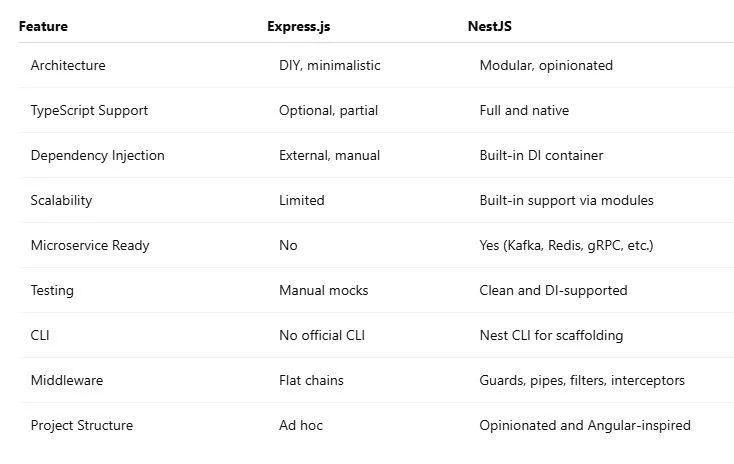
Key Reasons to Move from Express to NestJS
Let’s take a look at some of the reasons to move from Express to NestJS
1. Scalability Made Easy
NestJS uses controllers, providers, and modules to support a modular architecture. This facilitates you to:
Divide your application into reasonable portions.
Use the same code for all features.
Rapidly onboard new developers.
2. In-built Dependency Injection(DI)
NestJS includes a robust Dependency Injection, unlike Express, where you need to manually manage your dependencies or make use of third-party tools. Better testability, loose coupling, and maintainable code are the outcomes of this.

3. First-Class TypeScript Support
TypeScript is used throughout the development of the NestJS application. On the other hand, Express uses only type definitions that are supplied by the community.
Type safety enhances tooling (auto-complete, for example), helps find bugs early, and improves the developer experience.
4. Convention Over Configuration
NestJS avoids the need for boilerplate decisions by sticking to clear architectural patterns (inspired by Angular). Instead of inventing the wheel, you stick to established guidelines for:
Controllers
Services
Guards
DTOs and Validation
Codebases become consistent and more readable as a result.
5. Ready for Microservices
Microservices and event-driven architecture are becoming most common in modern systems. NestJS offers native support for:
Kafka
RabbitMQ
Redis Pub/Sub
gRPC
WebSockets
All use a consistent and declarative syntax.

6. Best Testing Strategy
With built-in DI (dependency injection) and mocking feature, NestJS allows us to use tools like Jest for writing unit and integration tests, making it test-friendly.
7. Cleaner Middleware and Lifecycle Management
Complex lifecycles and middleware logic can close the Express applications.
NestJS uses pipes, guards, and interceptors, which have distinct functionalities, to divide the concerns neatly.
NestJS doesn’t throw away Express, it builds on it:
Uses Express under the hood (can switch to Fastify)
All Express middleware remains compatible
Gradual migration path for existing applications
Is Your Express.js Codebase Slowing Productivity And Increasing Maintenance Over Time?
Unstructured code leads to bottlenecks. Soft Suave developers seamlessly migrate or rebuild your backend in NestJS, ensuring faster delivery and reduced long-term technical debt.
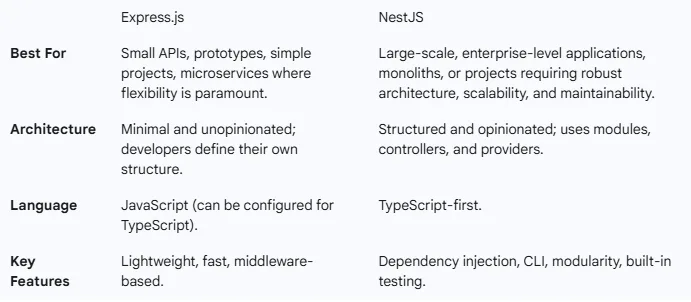
Get Experts TodayExpress.js vs NestJS: A Short Comparison
Here’s a short overview of both Express.js and NestJS side-by-side
Code structure
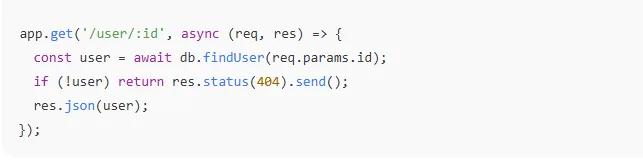
Here’s a code block from Express and NestJS each.
Express:
NestJS:
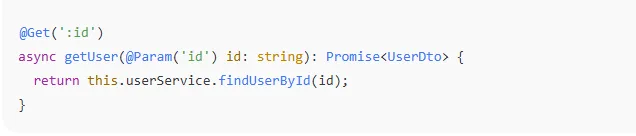
NestJS code is cleaner, more structured, and easier to test.
Learning Curve: Is NestJS Hard to Learn?
NestJS may seem to be wordy or “too Angular-like structure” at first when you’re from Express. But after you master these:
Decorators
Providers
Modules
Dependency Injection
You’ll realise that NestJS increases maintainability and long-term productivity.
Also, the NestJS CLI (nest g module, nest g controller, and nest g service) uses scaffolding to advance development.

When should you migrate?
Consider these when migrating to NestJS :
Your Express codebase is getting larger and harder to manage.
You wish to use webSockets, GraphQL, or microservices.
You’re developing apps of an enterprise calibre.
You desire improved tooling and type safety.
You intend to assemble a sizable team for the project.
Because NestJS can work with existing Express middleware and routers, you don’t need to completely redo everything at once. Modules can be moved gradually.
Conclusion
The Node.js community benefited most from Express.js in its early years, but as JavaScript development advances, we require frameworks that support scalable, maintainable architecture.
The next big thing is NestJS, which adds the structure required for enterprise applications while maintaining the flexibility we love about Node.js.
Learning NestJS benefits the teams by allowing them to create flexible, long-lasting applications in terms of maintainability, developer experience, and future adaptability. It’s time for our backend frameworks to change with the JavaScript ecosystem.

Ramesh Vayavuru is the Founder & CEO of Soft Suave Technologies, with 15+ years of experience delivering innovative IT solutions.
Related Blogs