The 2026 Definitive Guide to Cloud App Development Services
In 2026, cloud app development services focus on AI-native engineering, Serverless 2.0, and Zero-Trust security. Modern cloud applications leverage 6G-ready edge computing and Multi-Cloud portability to deliver sub-10ms latency and 99.999% uptime. By adopting a cloud-native mindset, enterprises reduce operational waste by 40% while accelerating time-to-market.Cloud app development services in 2026 are specialized engineering workflows used to build, deploy, and manage applications designed specifically for distributed cloud environments. Unlike legacy migrations, these services utilize micro-frontends, containerized microservices, and AI-driven infrastructure to ensure that software is infinitely scalable, resilient to outages, and cost-optimized via real-time FinOps automation.For years, businesses were satisfied with “Cloud-Ready” apps legacy software moved to a virtual server. However, 2026 demands a Cloud-Native approach. This involves building software using a microservices architecture where every function from the user login to the payment processor is a small, independent “service” that can scale or be updated without affecting the rest of the application.Success in 2026 requires more than just coders; it requires a Technical Thought Partner. Selecting The Best Cloud-Native Application Development Partners involves vetting teams that demonstrate mastery in GitOps and Infrastructure as Code (IaC). These partners ensure your code is “cloud-agnostic,” meaning it can run on AWS, Azure, or Google Cloud interchangeably, protecting your business from the financial risks of vendor lock-in.In 2026, cloud computing in manufacturing serves as the “Digital Nervous System” for Industry 5.0. It integrates Information Technology with Operational Technology to enable real-time Digital Twins, Autonomous Supply Chains, and AIOps-driven predictive maintenance, resulting in a typical 20% boost in factory floor profitability.When exploring Cloud Computing in Manufacturing: What to Know, three technical breakthroughs stand out for 2026:
IT/OT Convergence: Cloud platforms now bridge the gap between factory floor machinery and corporate software.
Real-Time Digital Twins: Manufacturers use the cloud to host 1:1 virtual replicas of their assembly lines to simulate production changes safely
Predictive Maintenance: AI models in the cloud analyze sensor data from machines (sound, vibration, heat) to predict failures before they happen, saving millions in unplanned downtime.
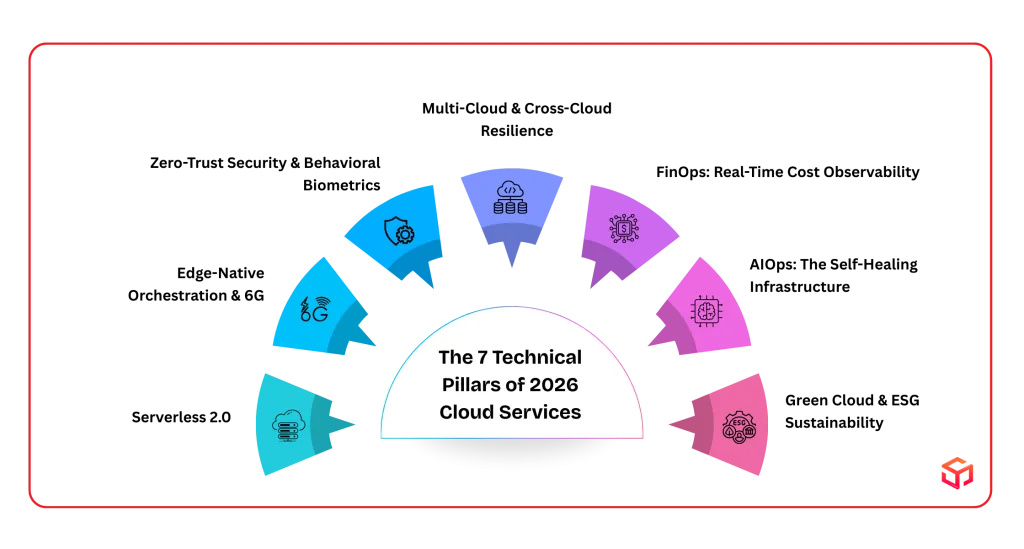
To reach enterprise-grade scale, your cloud app development services must be built upon these seven foundational technologies:
1. Serverless 2.0
Traditional serverless was stateless and suffered from “cold starts.” In 2026, Serverless 2.0 allows for stateful memory, enabling complex financial transactions and long-running AI tasks to run on a “Pay-per-Execution” model. This eliminates the need for expensive, always-on virtual machines.
2. Edge-Native Orchestration & 6G
With the global rollout of 6G, the cloud has moved to the Edge. By processing data in local city nodes rather than a central data center 1,000 miles away, latency is reduced to sub-10ms. This is critical for real-time applications like autonomous vehicle coordination and remote robotic surgery.
3. Zero-Trust Security & Behavioral Biometrics
In 2026, the network perimeter is gone. We use Identity-First Security. Every request is verified using AI that monitors Behavioral Biometrics identifying users by their typing rhythm and mouse patterns to block unauthorized access even if credentials are stolen.
4. Multi-Cloud & Cross-Cloud Resilience
Enterprise leaders no longer trust a single provider. The standard is now Multi-Cloud Portability. By using WebAssembly and Kubernetes, developers ensure that if one provider (like AWS) fails, the application automatically shifts to another (like Azure) without a single second of downtime.
5. FinOps: Real-Time Cost Observability
Cloud bills used to be a surprise. In 2026, FinOps AI agents monitor spending 24/7. They automatically shut down unused development environments and switch to “Spot Instances” for heavy processing, ensuring you only pay for the resources you actually use.
6. AIOps: The Self-Healing Infrastructure
2026 is the year of “No-Ops.” If a database starts to slow down, the AIOps agent detects the anomaly, spins up a replacement node, and migrates traffic automatically. This results in the “Five Nines” (99.999%) uptime that modern users demand.
7. Green Cloud & ESG Sustainability
Data centers are now carbon-monitored. Modern cloud engineering uses Carbon-Aware Scheduling, where heavy data processing (like AI training) is moved to data centers currently powered by renewable energy, ensuring your company stays ESG-compliant.Legacy modernization in 2026 is the process of transforming outdated “monolith” software into agile cloud-native applications. This is achieved through the 3R Strategy: Rehosting (moving to the cloud as-is), Refactoring (modifying code for better efficiency), or Rearchitecting (completely rebuilding with microservices for maximum scalability).
R1: Rehosting (The “Lift and Shift”)
The fastest way to move to the cloud, but often the least efficient. It is best used for non-critical systems where speed of migration is more important than operational cost.
R2: Refactoring
This involves “wrapping” your old code in modern containers. It allows legacy apps to benefit from cloud features like auto-scaling and better security without a full, expensive rewrite.
R3: Rearchitecting
The “Gold Standard.” You rebuild the application from the ground up using 2026 technologies like Rust, Go, and Serverless 2.0. This offers the highest long-term ROI and the best performance.Choosing the right tools is essential for 2026 performance benchmarks.
Category | Technology | Best For | Benefit |
Language | Rust | High Performance | Memory safety and 40% lower energy consumption. |
Language | Go (Golang) | Microservices | Built specifically for cloud-native concurrency. |
Frontend | Next.js 16 | User Experience | AI-driven pre-rendering for zero-latency pages. |
Database | Pinecone / Milvus | AI Applications | Essential for managing “Vector Data” in LLM apps. |
Orchestrator | Kubernetes (K8s) | Scaling | The industry standard for managing cloud containers. |
As we have explored, cloud app development services in 2026 are the engine of global business. Whether you are modernizing a legacy manufacturing plant through Cloud Computing in Manufacturing: What to Know or looking for the Best Cloud-Native Application Development Partners to build a global SaaS platform, the journey starts with technical precision and a vision for scalability.
The cloud is no longer a destination; it is an operating model. By embracing AI-native architectures, Zero-Trust security, and FinOps driven management, your company won’t just survive the digital transformation it will lead it.
Soft Suave is ready to be your partner in this innovation. We combine the world’s top 1% of cloud talent with a deep understanding of the 2026 tech landscape to build applications that are as resilient as they are groundbreaking.In 2026, a mid-sized cloud-native application typically starts at $45,000, while enterprise-grade systems with integrated Agentic AI range from $150,000 to $500,000. These figures reflect a shift toward “Intelligence Orchestration,” where backend complexity is higher, but front-end development is accelerated by AI tools.In 2026, cloud computing drives manufacturing efficiency through IT/OT Convergence, enabling Predictive Maintenance that reduces equipment downtime by 30-50%. By shifting from reactive to proactive maintenance, factories achieve a 20-30% boost in overall productivity and energy ROI.A Multi-Cloud strategy eliminates “Single Point of Failure” risks by distributing workloads across providers like AWS, Azure, and Google Cloud. In 2026, this is the industry standard for high-availability systems, ensuring that a regional outage at one provider does not result in total business downtime.Serverless 2.0 allows for Stateful Execution, meaning cloud functions can now “remember” user sessions and handle long-running tasks without a permanent server. This reduces cloud waste by up to 60% and allows developers to build complex, event-driven apps without managing any underlying infrastructure.The best partners in 2026 are those who specialize in Platform Engineering and Zero-Trust Security. Look for a partner who offers “Cloud-Agnostic” solutions using Kubernetes and ensuring your application can move between cloud providers without expensive rewrites or vWebAssembly,endor lock-in.JTNDc2NyaXB0JTIwdHlwZSUzRCUyMmFwcGxpY2F0aW9uJTJGbGQlMkJqc29uJTIyJTNFJTBBJTBBJTdCJTBBJTBBJTIwJTIwJTIyJTQwY29udGV4dCUyMiUzQSUyMCUyMmh0dHBzJTNBJTJGJTJGc2NoZW1hLm9yZyUyMiUyQyUwQSUwQSUyMCUyMCUyMiU0MHR5cGUlMjIlM0ElMjAlMjJGQVFQYWdlJTIyJTJDJTBBJTBBJTIwJTIwJTIybWFpbkVudGl0eSUyMiUzQSUyMCU1QiUwQSUwQSUyMCUyMCUyMCUyMCU3QiUwQSUwQSUyMCUyMCUyMCUyMCUyMCUyMCUyMiU0MHR5cGUlMjIlM0ElMjAlMjJRdWVzdGlvbiUyMiUyQyUwQSUwQSUyMCUyMCUyMCUyMCUyMCUyMCUyMm5hbWUlMjIlM0ElMjAlMjJXaGF0JTIwaXMlMjB0aGUlMjBhdmVyYWdlJTIwY29zdCUyMG9mJTIwY2xvdWQlMjBhcHAlMjBkZXZlbG9wbWVudCUyMGluJTIwMjAyNiUzRiUyMiUyQyUwQSUwQSUyMCUyMCUyMCUyMCUyMCUyMCUyMmFjY2VwdGVkQW5zd2VyJTIyJTNBJTIwJTdCJTBBJTBBJTIwJTIwJTIwJTIwJTIwJTIwJTIwJTIwJTIyJTQwdHlwZSUyMiUzQSUyMCUyMkFuc3dlciUyMiUyQyUwQSUwQSUyMCUyMCUyMCUyMCUyMCUyMCUyMCUyMCUyMnRleHQlMjIlM0ElMjAlMjJJbiUyMDIwMjYlMkMlMjBhJTIwbWlkLXNpemVkJTIwY2xvdWQtbmF0aXZlJTIwYXBwbGljYXRpb24lMjBzdGFydHMlMjBhdCUyMCUyNDQ1JTJDMDAwJTJDJTIwd2hpbGUlMjBlbnRlcnByaXNlLWdyYWRlJTIwc3lzdGVtcyUyMHdpdGglMjBpbnRlZ3JhdGVkJTIwQWdlbnRpYyUyMEFJJTIwcmFuZ2UlMjBmcm9tJTIwJTI0MTUwJTJDMDAwJTIwdG8lMjAlMjQ1MDAlMkMwMDAuJTIwVXNlJTIwb2YlMjBBSS1jb2RpbmclMjBhc3Npc3RhbnRzJTIwaGFzJTIwcmVkdWNlZCUyMHRvdGFsJTIwZGV2ZWxvcG1lbnQlMjB0aW1lJTIwYnklMjAzNSUyNSUyMGNvbXBhcmVkJTIwdG8lMjAyMDI0LiUyMiUwQSUwQSUyMCUyMCUyMCUyMCUyMCUyMCU3RCUwQSUwQSUyMCUyMCUyMCUyMCU3RCUyQyUwQSUwQSUyMCUyMCUyMCUyMCU3QiUwQSUwQSUyMCUyMCUyMCUyMCUyMCUyMCUyMiU0MHR5cGUlMjIlM0ElMjAlMjJRdWVzdGlvbiUyMiUyQyUwQSUwQSUyMCUyMCUyMCUyMCUyMCUyMCUyMm5hbWUlMjIlM0ElMjAlMjJIb3clMjBkb2VzJTIwdGhlJTIwY2xvdWQlMjBpbXByb3ZlJTIwbWFudWZhY3R1cmluZyUyMGVmZmljaWVuY3klM0YlMjIlMkMlMEElMEElMjAlMjAlMjAlMjAlMjAlMjAlMjJhY2NlcHRlZEFuc3dlciUyMiUzQSUyMCU3QiUwQSUwQSUyMCUyMCUyMCUyMCUyMCUyMCUyMCUyMCUyMiU0MHR5cGUlMjIlM0ElMjAlMjJBbnN3ZXIlMjIlMkMlMEElMEElMjAlMjAlMjAlMjAlMjAlMjAlMjAlMjAlMjJ0ZXh0JTIyJTNBJTIwJTIyQ2xvdWQlMjBjb21wdXRpbmclMjBkcml2ZXMlMjBtYW51ZmFjdHVyaW5nJTIwZWZmaWNpZW5jeSUyMHRocm91Z2glMjBJVCUyRk9UJTIwQ29udmVyZ2VuY2UlMjBhbmQlMjBQcmVkaWN0aXZlJTIwTWFpbnRlbmFuY2UlMkMlMjB3aGljaCUyMHJlZHVjZXMlMjBlcXVpcG1lbnQlMjBkb3dudGltZSUyMGJ5JTIwMzAtNTAlMjUlMjBhbmQlMjBib29zdHMlMjBvdmVyYWxsJTIwZmFjdG9yeSUyMHByb2R1Y3Rpdml0eS4lMjIlMEElMEElMjAlMjAlMjAlMjAlMjAlMjAlN0QlMEElMEElMjAlMjAlMjAlMjAlN0QlMkMlMEElMEElMjAlMjAlMjAlMjAlN0IlMEElMEElMjAlMjAlMjAlMjAlMjAlMjAlMjIlNDB0eXBlJTIyJTNBJTIwJTIyUXVlc3Rpb24lMjIlMkMlMEElMEElMjAlMjAlMjAlMjAlMjAlMjAlMjJuYW1lJTIyJTNBJTIwJTIyV2h5JTIwaXMlMjBNdWx0aS1DbG91ZCUyMGJldHRlciUyMHRoYW4lMjBhJTIwU2luZ2xlLUNsb3VkJTIwc3RyYXRlZ3klM0YlMjIlMkMlMEElMEElMjAlMjAlMjAlMjAlMjAlMjAlMjJhY2NlcHRlZEFuc3dlciUyMiUzQSUyMCU3QiUwQSUwQSUyMCUyMCUyMCUyMCUyMCUyMCUyMCUyMCUyMiU0MHR5cGUlMjIlM0ElMjAlMjJBbnN3ZXIlMjIlMkMlMEElMEElMjAlMjAlMjAlMjAlMjAlMjAlMjAlMjAlMjJ0ZXh0JTIyJTNBJTIwJTIyTXVsdGktQ2xvdWQlMjBlbGltaW5hdGVzJTIwJTI3U2luZ2xlJTIwUG9pbnQlMjBvZiUyMEZhaWx1cmUlMjclMjByaXNrcy4lMjBJZiUyMG9uZSUyMHByb3ZpZGVyJTIwZmFpbHMlMkMlMjB5b3VyJTIwYXBwJTIwcmVtYWlucyUyMGxpdmUlMjBvbiUyMGFub3RoZXIuJTIwSXQlMjBhbHNvJTIwcHJldmVudHMlMjB2ZW5kb3IlMjBsb2NrLWluJTIwYW5kJTIwYWxsb3dzJTIwcmVhbC10aW1lJTIwY29zdCUyMG9wdGltaXphdGlvbiUyMHZpYSUyMEZpbk9wcyUyMGF1dG9tYXRpb24uJTIyJTBBJTBBJTIwJTIwJTIwJTIwJTIwJTIwJTdEJTBBJTBBJTIwJTIwJTIwJTIwJTdEJTJDJTBBJTBBJTIwJTIwJTIwJTIwJTdCJTBBJTBBJTIwJTIwJTIwJTIwJTIwJTIwJTIyJTQwdHlwZSUyMiUzQSUyMCUyMlF1ZXN0aW9uJTIyJTJDJTBBJTBBJTIwJTIwJTIwJTIwJTIwJTIwJTIybmFtZSUyMiUzQSUyMCUyMldoYXQlMjBpcyUyMHRoZSUyMHJvbGUlMjBvZiUyMFNlcnZlcmxlc3MlMjAyLjAlMjBpbiUyMDIwMjYlMjBhcHBsaWNhdGlvbiUyMGRlc2lnbiUzRiUyMiUyQyUwQSUwQSUyMCUyMCUyMCUyMCUyMCUyMCUyMmFjY2VwdGVkQW5zd2VyJTIyJTNBJTIwJTdCJTBBJTBBJTIwJTIwJTIwJTIwJTIwJTIwJTIwJTIwJTIyJTQwdHlwZSUyMiUzQSUyMCUyMkFuc3dlciUyMiUyQyUwQSUwQSUyMCUyMCUyMCUyMCUyMCUyMCUyMCUyMCUyMnRleHQlMjIlM0ElMjAlMjJTZXJ2ZXJsZXNzJTIwMi4wJTIwaW50cm9kdWNlcyUyMFN0YXRlZnVsJTIwRXhlY3V0aW9uJTJDJTIwYWxsb3dpbmclMjBjbG91ZCUyMGZ1bmN0aW9ucyUyMHRvJTIwcmV0YWluJTIwbWVtb3J5JTIwd2l0aG91dCUyMHBlcm1hbmVudCUyMHNlcnZlcnMuJTIwVGhpcyUyMHJlZHVjZXMlMjBjbG91ZCUyMHdhc3RlJTIwYnklMjB1cCUyMHRvJTIwNjAlMjUlMjBhbmQlMjBlbmFibGVzJTIwY29tcGxleCUyQyUyMGV2ZW50LWRyaXZlbiUyMGFwcGxpY2F0aW9ucy4lMjIlMEElMEElMjAlMjAlMjAlMjAlMjAlMjAlN0QlMEElMEElMjAlMjAlMjAlMjAlN0QlMkMlMEElMEElMjAlMjAlMjAlMjAlN0IlMEElMEElMjAlMjAlMjAlMjAlMjAlMjAlMjIlNDB0eXBlJTIyJTNBJTIwJTIyUXVlc3Rpb24lMjIlMkMlMEElMEElMjAlMjAlMjAlMjAlMjAlMjAlMjJuYW1lJTIyJTNBJTIwJTIySG93JTIwZG8lMjB5b3UlMjBjaG9vc2UlMjB0aGUlMjBiZXN0JTIwY2xvdWQtbmF0aXZlJTIwYXBwbGljYXRpb24lMjBkZXZlbG9wbWVudCUyMHBhcnRuZXIlM0YlMjIlMkMlMEElMEElMjAlMjAlMjAlMjAlMjAlMjAlMjJhY2NlcHRlZEFuc3dlciUyMiUzQSUyMCU3QiUwQSUwQSUyMCUyMCUyMCUyMCUyMCUyMCUyMCUyMCUyMiU0MHR5cGUlMjIlM0ElMjAlMjJBbnN3ZXIlMjIlMkMlMEElMEElMjAlMjAlMjAlMjAlMjAlMjAlMjAlMjAlMjJ0ZXh0JTIyJTNBJTIwJTIyQ2hvb3NlJTIwYSUyMHBhcnRuZXIlMjBzcGVjaWFsaXppbmclMjBpbiUyMFBsYXRmb3JtJTIwRW5naW5lZXJpbmclMjBhbmQlMjBaZXJvLVRydXN0JTIwc2VjdXJpdHkuJTIwTG9vayUyMGZvciUyMGV4cGVydGlzZSUyMGluJTIwY2xvdWQtYWdub3N0aWMlMjB0b29scyUyMGxpa2UlMjBLdWJlcm5ldGVzJTIwYW5kJTIwV2ViQXNzZW1ibHklMjB0byUyMGVuc3VyZSUyMHlvdXIlMjBhcHAlMjBjYW4lMjBzY2FsZSUyMGFjcm9zcyUyMGFueSUyMHByb3ZpZGVyLiUyMiUwQSUwQSUyMCUyMCUyMCUyMCUyMCUyMCU3RCUwQSUwQSUyMCUyMCUyMCUyMCU3RCUwQSUwQSUyMCUyMCU1RCUwQSUwQSU3RCUwQSUzQyUyRnNjcmlwdCUzRSUwQSUyMA==
Ramesh Vayavuru is the Founder & CEO of Soft Suave Technologies, with 15+ years of experience delivering innovative IT solutions.
Related Blogs