Hire Dedicated AI Chatbot Developers in India: Skills & Cost Breakdown

TL;DR :-
Compare dedicated hiring models, technical skills, and operational risks before selecting AI chatbot developers in India.
Understand hidden scaling challenges, freelancer limitations, and why managed AI teams improve long-term chatbot performance.
Explore Soft Suave’s hiring process, free trial model, and real AI chatbot outcomes across industries.
AI chatbot initiatives often fail due to one fundamental reason. Businesses hire developers who can build demos but cannot manage production-scale AI systems.
Modern AI chatbots need more than prompt engineering. They require NLP expertise, retrieval pipelines, LLM integration, conversation analytics, and continuous optimization after deployment.
That is why many companies now prefer dedicated AI chatbot developers instead of short-term project contractors.
A dedicated team understands your workflows, customer behavior, compliance requirements, and product roadmap over time. This improves chatbot accuracy, response quality, and long-term scalability.
India has become a leading destination for AI chatbot development because businesses can access experienced AI engineers faster and at significantly lower operational costs.
This guide explains how to hire AI chatbot developers in India, what skills matter most, pricing models, hidden costs, and how to avoid expensive hiring mistakes.
Why “Dedicated” Beats Project-Based for AI Chatbot Development
AI chatbots are evolving systems that improve through monitoring, retraining, and real-user feedback. Understanding why dedicated engagement works better helps businesses avoid costly deployment failures.
Project-based development works for static software. AI chatbots are different. Large language models continuously learn from user interactions, workflow changes, and business data updates. A one-time development approach often creates performance gaps after deployment.
Dedicated AI chatbot developers stay aligned with your business goals. They improve prompt accuracy, optimize retrieval pipelines, reduce hallucinations, and refine conversation flows continuously.
This creates measurable long-term business value. Dedicated developers also understand your domain deeply over time.
For example, a FinTech chatbot handling loan eligibility queries requires constant updates based on compliance changes, customer behavior, and evolving workflows.
A project-based freelancer may complete the deployment. But they rarely remain involved during optimization, monitoring, or retraining stages.
Dedicated engagement models also improve delivery speed. The development team already understands your architecture, APIs, vector databases, and customer interaction patterns. This reduces repeated onboarding delays.
Companies building enterprise conversational AI systems increasingly prefer long-term partnerships because AI accuracy improves through iteration, not one-time implementation.
Zero-Risk AI Developer Trial
Reduce hiring uncertainty with Soft Suave’s 40-hour free trial. Assess real-world AI chatbot execution, workflow compatibility, and engineering quality before scaling your development team.
Claim TrialThe Exact Skill Set to Demand From Your AI Chatbot Developer
Hiring the right AI chatbot developer requires more than checking Python experience. Businesses should evaluate technical expertise, communication ability, and real production deployment experience carefully.
Must-Have Technical Skills
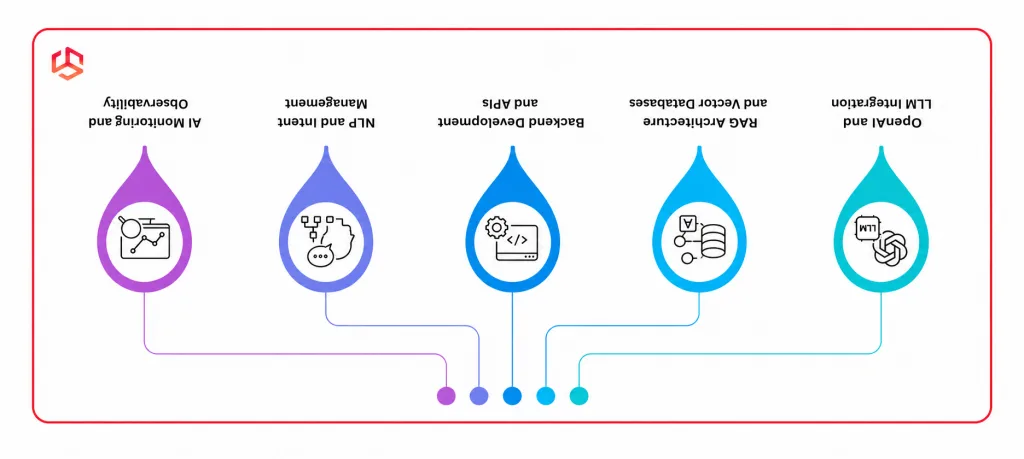
Modern AI chatbot development involves multiple technologies working together. Businesses should evaluate whether developers understand production-ready AI architecture beyond simple chatbot demos.
Strong AI chatbot developers should understand modern LLM ecosystems.
Core technical skills include:
OpenAI and LLM Integration: Developers should understand GPT models, Claude, Gemini, token optimization, prompt engineering, and context window management for enterprise-grade conversational AI systems.
RAG Architecture and Vector Databases: Production chatbots rely heavily on retrieval-augmented generation. Developers should understand Pinecone, Weaviate, embeddings, semantic search, and retrieval optimization.
Backend Development and APIs: AI chatbots connect with CRMs, ERPs, payment systems, and internal applications. Proficient skills in FastAPI, Python, and API integration are essential.
NLP and Intent Management: Developers should understand intent classification, entity recognition, conversation memory handling, and multilingual NLP processing for scalable AI-powered chatbot experiences.
AI Monitoring and Observability: Production AI systems require monitoring pipelines, hallucination detection, response analytics, fallback logic, and conversation performance tracking.
Must-Have Soft Skills
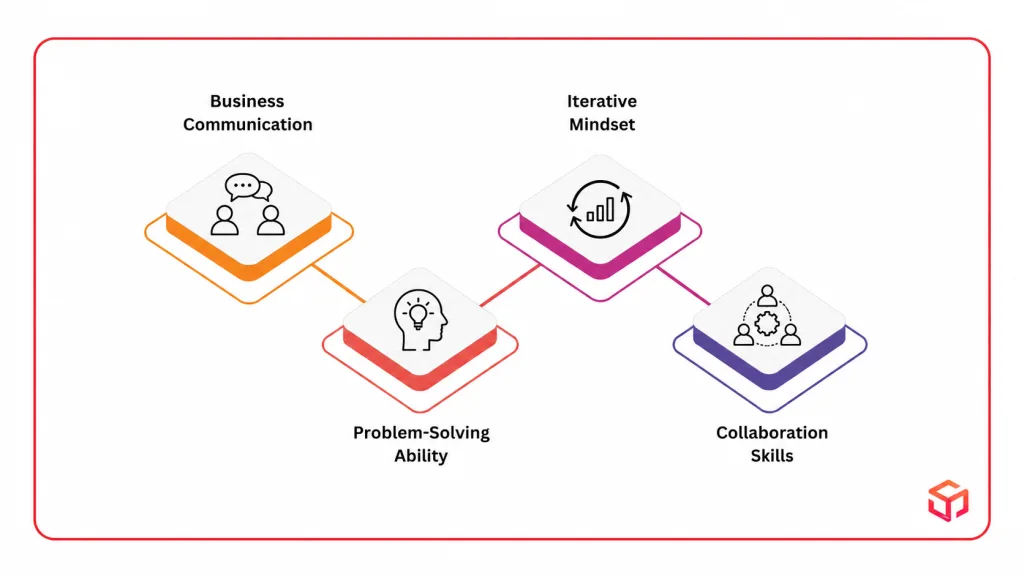
Technical expertise alone does not guarantee successful chatbot deployment. Developers must also understand business workflows, stakeholder communication, and AI implementation challenges.
AI chatbot projects involve constant collaboration.
Developers must translate business goals into conversation workflows, automation logic, and scalable AI experiences.
Important soft skills include:
Business Communication: Developers should explain technical limitations clearly without using confusing AI jargon during stakeholder discussions.
Problem-Solving Ability: Enterprise chatbot systems frequently face context drift, inaccurate responses, and integration issues requiring analytical thinking.
Iterative Mindset: Successful conversational AI systems evolve continuously. Developers should embrace experimentation, retraining, and ongoing optimization.
Collaboration Skills: AI chatbot systems require collaboration among product teams, QA engineers, designers, and backend developers during the delivery process.
Many chatbot failures happen because developers understand code but fail to understand customer workflows properly.
Red Flags to Watch For
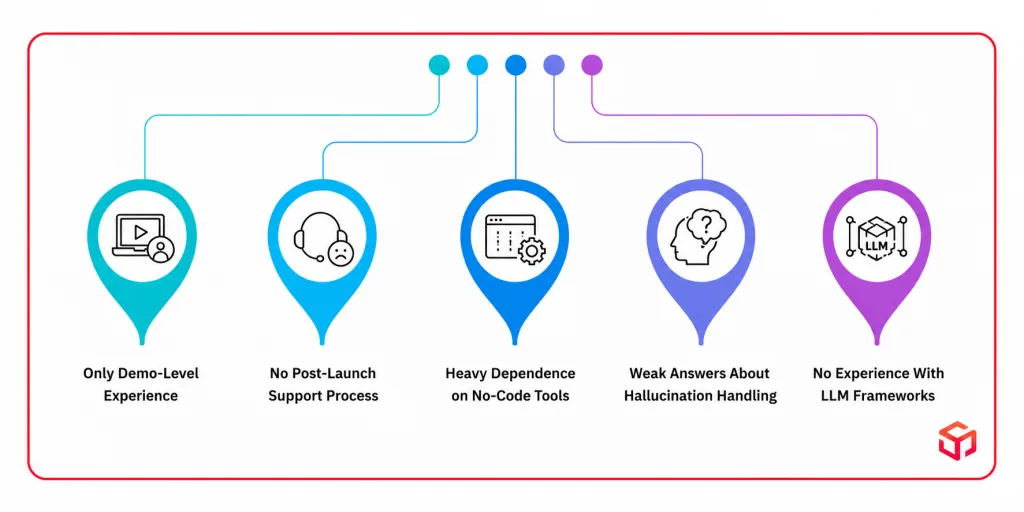
Many developers showcase impressive chatbot demos online. Businesses should still evaluate whether those systems can survive real production environments and enterprise-scale workloads.
Certain warning signs indicate major delivery risks.
Watch for these red flags carefully:
Only Demo-Level Experience: Developers who cannot explain production architecture, scaling, or retrieval systems may lack enterprise deployment experience.
No Post-Launch Support Process: AI systems require monitoring and optimization. Avoid developers who disappear after initial deployment.
Heavy Dependence on No-Code Tools: No-code builders work for simple workflows but struggle with advanced enterprise conversational AI requirements.
Weak Answers About Hallucination Handling: Experienced developers should explain fallback mechanisms, retrieval validation, and AI guardrails confidently.
No Experience With LLM Frameworks: Developers should understand LangChain, LlamaIndex, Semantic Kernel, or similar orchestration frameworks used in modern AI systems.
If a developer only explains chatbot UI screens but avoids discussing architecture, vector storage, or observability pipelines, treat that as a serious warning sign.
Tired Of Unreliable AI Freelancers?
Freelance bottlenecks create inconsistent chatbot experiences and missed deadlines. Soft Suave provides managed AI development teams, ensuring stability, faster releases, and long-term support.
Hire ExpertsDedicated Hiring Models Explained: Which One Fits Your Business
Different businesses require different AI hiring structures based on project complexity, scalability goals, and operational control. Understanding each engagement model helps companies choose the right delivery strategy.
Model | Best For | Who Manages | Cost Level | Control Level |
Single Dedicated Developer | MVPs and startups | Client | Low | Medium |
Dedicated Pod | Growing AI products | Shared | Medium | High |
Augmentation | Existing internal teams | Client | Medium | High |
Offshore Dedicated Team | Enterprise scaling | Shared | Medium-High | Very High |
Model 1 – Single Dedicated Developer
This model works best for startups or early-stage products needing fast MVP development with limited budgets and relatively simple conversational AI requirements.
A single dedicated developer handles chatbot development independently.
This model suits:
Startup MVPs
Prototype development
Basic chatbot automation
Small internal tools
Advantages include lower initial costs and faster onboarding. However, there are limitations.
One developer cannot fully manage architecture, DevOps, QA, monitoring, and AI optimization simultaneously.
This model also creates a single point of dependency.
Model 2 – Dedicated Pod
Dedicated pods combine multiple specialists into one focused delivery unit. This structure improves scalability, delivery speed, and operational stability for growing AI chatbot platforms.
A dedicated pod typically includes:
AI chatbot developer
Backend engineer
QA engineer
Project manager
DevOps support
This model improves collaboration and reduces delivery bottlenecks. It also creates better accountability during deployment and optimization phases.
Dedicated pods work well for:
Customer support automation
AI commerce platforms
Healthcare chatbot systems
Enterprise workflow automation
Model 3 – Augmentation
Staff augmentation helps companies extend existing internal engineering teams quickly without going through long recruitment cycles or permanent hiring overhead.
This model works when businesses already have internal product teams. External AI engineers integrate directly into existing sprint workflows.
Advantages include:
Faster scaling
Specialized AI expertise
Flexible team expansion
Lower recruitment delays
This model works well for companies building custom generative AI applications while retaining internal architecture ownership.
Model 4 – Offshore Dedicated Team
Offshore dedicated teams provide long-term scalability, structured governance, and broader technical coverage for enterprise-grade AI chatbot development initiatives.
This model offers the highest scalability. Businesses gain access to complete offshore engineering teams with structured sprint management, QA processes, and delivery governance.
Key benefits include:
Faster team scaling
Lower operational costs
Continuous delivery support
Time-zone overlap
Better resource availability
Offshore development challenges usually happen because of weak governance, not geography.
Well-managed offshore development teams can deliver enterprise conversational AI systems efficiently while maintaining predictable delivery cycles.
Real Cost Breakdown: India vs USA / UK
AI chatbot development costs vary significantly based on region, experience level, engagement model, and infrastructure complexity. Understanding total ownership cost prevents unexpected budget overruns later.
AI chatbot developer pricing differs dramatically across global markets.
Businesses in the USA and UK typically spend significantly more on AI chatbot development because of higher engineering salaries, operational overhead, and recruitment costs.
India offers a strong competitive advantage by providing access to experienced AI engineers, scalable development teams, and mature offshore delivery ecosystems at a much lower operational investment.
Approximate starting rates for AI chatbot developers across global regions include:
Region | Starting Cost |
US | Starts from $35/hour |
Western Europe | Starts from $35/hour |
Eastern Europe | Starts from $25/hour |
India/Asia | Starts from $15/hour |
Many global companies now prefer India for AI chatbot development because they can scale faster without compromising engineering quality or delivery speed.
However, development cost alone does not determine total project expense.
Additional AI chatbot operational costs include:
OpenAI API usage
Cloud infrastructure
Vector database hosting
Monitoring tools
AI retraining
Maintenance support
Many companies underestimate token consumption costs during production scaling. As chatbot usage increases, inference and API costs also grow significantly.
AI Chatbot Delays Killing Growth?
Slow chatbot development drains customer engagement and revenue. Soft Suave delivers dedicated AI engineers who accelerate deployment, optimization, and scalable conversational AI performance.
Scale FasterHidden Costs to Watch For (Freelance vs Agency)
Many businesses compare only upfront development pricing during hiring. The real difference between freelancers and agencies usually appears during scaling, maintenance, and production support stages.
Freelancers may work well for small chatbot MVPs or short-term experiments.
However, enterprise AI chatbot projects often require larger delivery ecosystems involving QA, DevOps, monitoring, security, and ongoing optimization.
Common freelancer-related challenges include:
No Structured QA: Poor testing processes increase production bugs and chatbot inaccuracies.
Weak Documentation: Limited documentation creates future maintenance challenges and onboarding delays.
Limited Scalability: One freelancer cannot scale rapidly during feature expansion or urgent delivery timelines.
Security and Compliance Gaps: Enterprise AI systems require strong security practices, access control, and compliance awareness.
Delivery Dependency Risks: Project continuity becomes difficult if freelancers become unavailable unexpectedly.
Cheap AI development often becomes expensive during scaling, retraining, and long-term maintenance phases.
Agencies typically reduce these operational risks by providing structured delivery workflows, dedicated QA teams, backup resources, technical oversight, and long-term support models.
That is why businesses building production-grade AI chatbot systems often view agency pricing as a long-term operational investment instead of a short-term development expense.
Why Agency Rates Are Worth the Premium
Agencies typically charge higher rates because they provide structured engineering processes, broader technical coverage, and lower operational risk across the entire AI delivery lifecycle.
Good agencies offer more than developers.
They provide:
Solution architects
QA engineers
DevOps specialists
Delivery managers
Security oversight
Scalable engineering resources
This improves delivery predictability. Businesses also gain structured sprint planning, transparent reporting, architecture reviews, and replacement support.
For enterprise conversational AI systems, operational maturity matters as much as coding capability.
Five Questions to Ask Before You Hire (Non-Negotiables)
Hiring the right AI chatbot development partner requires a deeper technical evaluation. Asking the right questions helps businesses avoid weak vendors and identify experienced production-focused teams.
Do you have live chatbot projects in my industry?
Industry experience improves workflow understanding, compliance awareness, and conversation accuracy. A healthcare chatbot differs significantly from a retail recommendation chatbot.
What LLM frameworks have you shipped to production?
Experienced developers should confidently discuss frameworks like LangChain, LlamaIndex, Semantic Kernel, and orchestration pipelines used in production AI systems.
How do you handle NLP model retraining?
Strong teams should explain conversation analytics, feedback loops, intent drift monitoring, and retraining processes clearly. AI systems require continuous optimization after deployment.
What is your escalation process for post-launch bugs?
Reliable partners should explain SLAs, severity management, rollback plans, and monitoring workflows for production incidents.
Do you offer a trial before full commitment?
Trial engagement reduces hiring risk. Businesses can evaluate technical quality, communication, delivery speed, and workflow compatibility before long-term onboarding.
How Soft Suave’s Dedicated Hiring Process Works (Step by Step)
A structured hiring process reduces onboarding delays, minimizes project risk, and helps businesses evaluate technical compatibility before committing to long-term AI chatbot development engagements.
Step 1 – Share Requirements
Clear requirement gathering helps align business goals, AI feasibility, workflow expectations, and technical architecture before the development process begins.
Businesses share:
Use cases
Workflow requirements
Integration needs
AI objectives
Compliance considerations
This helps define the right chatbot architecture and engagement model.
Step 2 – Receive Shortlisted Profiles
Shortlisting focuses on technical alignment, industry experience, and production AI expertise so businesses can evaluate candidates faster without wasting recruitment time.
Soft Suave evaluates developers based on:
LLM experience
NLP expertise
AI deployment knowledge
Industry alignment
Communication ability
Businesses receive carefully matched profiles instead of generic resumes.
Step 3 – Interview & Select
Technical interviews help businesses assess architecture understanding, workflow thinking, communication skills, and real-world AI deployment capability before final selection.
Clients directly interview shortlisted developers. This ensures technical alignment and workflow compatibility before onboarding begins.
Architecture discussions and technical evaluations are also conducted during this stage.
Step 4 – 40-Hour Free Trial
Trial engagement helps businesses validate engineering quality, communication standards, and delivery speed before entering a long-term development commitment.
The 40-hour free trial reduces hiring risk significantly.
Businesses can evaluate:
Technical execution
Sprint participation
Communication quality
Problem-solving approach
Workflow compatibility
This creates confidence before long-term engagement.
Step 5 – Full Onboarding
Structured onboarding ensures developers integrate smoothly into existing workflows, communication systems, and sprint processes without affecting ongoing delivery timelines.
Once approved, developers are fully onboarded into the project.
This includes:
Sprint setup
Reporting workflows
DevOps access
Communication channels
Delivery governance
Teams can usually begin active development quickly after onboarding.
Industries We’ve Built AI Chatbots For (Real Outcomes)
AI chatbot adoption continues expanding across industries because businesses now automate support workflows, improve customer engagement, and streamline operational processes using conversational AI systems.
FinTech – Automated Loan Query Bot
AI chatbots help financial institutions automate customer interactions, reduce manual support workload, and improve response speed across loan processing workflows.
The chatbot handled:
Loan eligibility queries
Document verification workflows
EMI calculations
Customer onboarding support
This reduced manual customer support workload significantly while improving response consistency.
HealthTech – Appointment Scheduling Bot
Healthcare chatbots improve appointment management, reduce administrative workload, and provide faster patient assistance through intelligent conversational workflows.
The chatbot supported:
Appointment scheduling
Patient FAQs
Follow-up reminders
Multilingual patient interactions
This improved operational efficiency while reducing front-desk workload.
Build Smarter AI Chatbots Faster
From OpenAI integration to RAG pipelines and vector databases, Soft Suave builds enterprise AI chatbot systems engineered for scalability, automation, and seamless customer interactions.
Start BuildingeCommerce – Product Recommendation Bot
Conversational AI helps eCommerce businesses improve product discovery, personalize shopping experiences, and increase customer engagement across digital commerce channels.
The chatbot delivered:
Product recommendations
Upselling suggestions
Order tracking
Customer support automation
This improved customer interaction quality and engagement rates.
EdTech – Student Onboarding Bot
AI chatbot systems simplify student onboarding workflows by automating repetitive communication tasks and improving accessibility across educational platforms.
The chatbot assisted with:
Student onboarding
Course recommendations
FAQ automation
Enrollment guidance
This reduced manual support effort while improving onboarding speed.
Ready to Hire a Dedicated AI Chatbot Developer?
AI chatbot success depends on much more than building a working interface. The real challenge is maintaining accuracy, scalability, workflow alignment, and continuous optimization after deployment.
That is why businesses increasingly prefer dedicated AI chatbot developers instead of short-term project contractors. A dedicated team understands your architecture, customer behavior, business workflows, and long-term product goals deeply over time.
This improves response quality, reduces operational friction, and accelerates feature delivery. India continues to lead global AI development because companies can access experienced AI engineers faster while controlling operational costs effectively.
If you want production-ready conversational AI systems instead of short-lived demos, choosing the right development partner becomes the most important decision.
FAQs
Why choose dedicated AI chatbot developers instead of freelancers?
Dedicated developers provide long-term support, continuous optimization, and better workflow alignment. Businesses also gain improved scalability, structured delivery processes, and reduced operational dependency risks.
Which technologies are commonly used in AI chatbot development?
Modern AI chatbot systems commonly use OpenAI APIs, LangChain, Python, vector databases, FastAPI, LlamaIndex, retrieval-augmented generation, and cloud infrastructure platforms.
Do AI chatbots require maintenance after deployment?
Yes. AI chatbots require continuous monitoring, prompt optimization, retraining, conversation analytics, and infrastructure maintenance to maintain response quality and operational performance.
How do businesses evaluate AI chatbot developers effectively?
Businesses should evaluate production deployment experience, LLM framework expertise, post-launch support processes, communication ability, and industry-specific conversational AI experience before hiring.

Ramesh Vayavuru is the Founder & CEO of Soft Suave Technologies, with 15+ years of experience delivering innovative IT solutions.
Related Blogs