Hiring Dedicated Front-End Developers â What to Check & Who to Choose

TL;DR :-
Discover why frontend hiring failures usually begin with unclear requirements, not weak developer skills or framework expertise alone.
Compare frontend hiring companies, pricing factors, and framework-fit strategies for scalable React, Angular, and Vue development.
Understand how structured frontend hiring improves sprint execution, UI performance, delivery transparency, and long-term product scalability.
Frontend hiring delays rarely stay limited to engineering. Poor frontend execution slows product releases, damages Core Web Vitals, increases bounce rates, and weakens user experience across devices.
Many companies hire developers with strong framework knowledge but still struggle with delivery consistency, sprint alignment, and frontend scalability. The problem is usually not technical expertise alone.
Modern frontend teams now influence SEO performance, accessibility, UI responsiveness, and customer retention. That is why businesses must evaluate much more than coding ability before they hire dedicated front-end developers for long-term projects.
The Reason Most Frontend Developer Hires Fail Is Not the Developer
Most businesses focus heavily on frameworks during hiring but ignore delivery workflows, communication maturity, and product alignment. That gap creates hiring failures long before code quality becomes the problem.
Many companies assume frontend hiring is simple. They shortlist candidates based on React, Angular, or Vue experience alone. But frontend development has changed significantly over the last few years.
Today’s frontend developers influence:
User experience consistency: A poorly designed frontend creates friction across customer journeys. Slow interfaces, inconsistent layouts, and unstable interactions directly affect engagement and customer retention.
SEO and Core Web Vitals: Frontend rendering efficiency impacts page speed, layout stability, and mobile responsiveness. These factors now influence both search visibility and conversion performance.
Product scalability: Frontend architecture decisions affect long-term maintainability. Weak component structures often create technical debt that slows future feature releases.
Cross-functional collaboration: Frontend teams work closely with QA engineers, product managers, backend developers, and UI/UX designers. Communication gaps often delay sprint execution.
Many hiring failures begin because businesses do not clearly define:
• ownership expectations
• sprint responsibilities
• framework requirements
• collaboration workflows
• scalability expectations
This creates confusion from the onboarding stage itself.
Some companies also hire developers without evaluating their communication capability or product understanding. A developer may write clean code but still struggle in agile delivery environments.
That is why successful frontend hiring now depends on technical alignment and workflow compatibility equally.
Your Dedicated Developers, Ready Now
Imagine onboarding vetted developers already aligned with agile processes and delivery ownership. Soft Suave helps you launch projects faster without recruitment uncertainty or onboarding delays.
Get StartedWhat You Actually Need to Ask for When You Hire a Dedicated Front-End Developer
Modern frontend development requires far more than JavaScript expertise. Businesses must evaluate technical depth, performance awareness, scalability thinking, and framework alignment before finalizing frontend hiring decisions.
Core skills (non-negotiables)
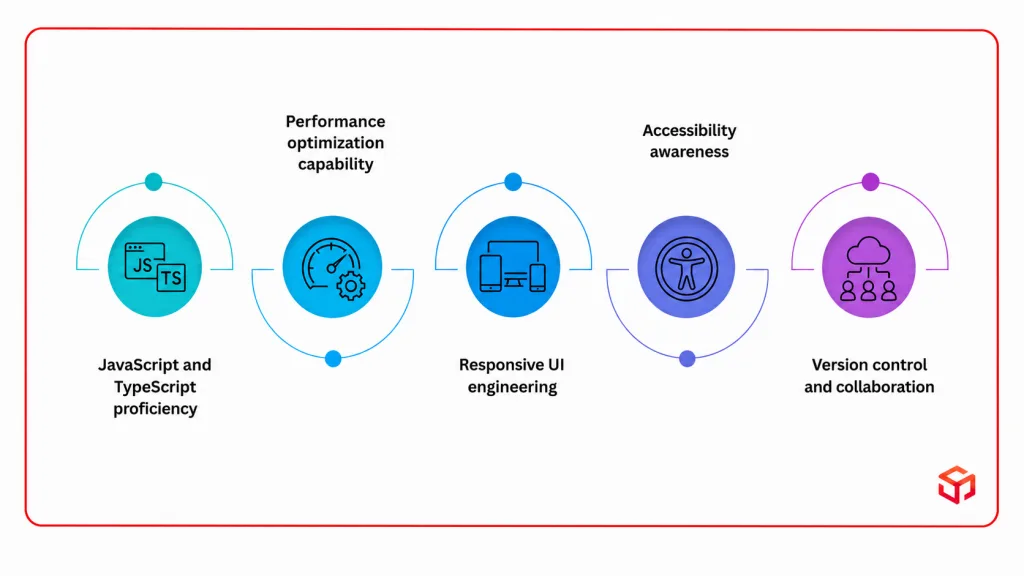
Strong frontend developers combine framework expertise with performance optimization, accessibility standards, and collaboration maturity. These technical foundations directly influence delivery quality and long-term product stability.
Frontend developers today handle much more than interface styling. Modern frontend teams work on:
• component architecture
• API integration
• responsive design
• accessibility compliance
• state management
• rendering optimization
• testing workflows
That is why businesses should evaluate several non-negotiable skills.
JavaScript and TypeScript proficiency: TypeScript adoption has grown rapidly across enterprise frontend environments. Strong TypeScript skills improve maintainability, scalability, and debugging efficiency in large applications.
Performance optimization capability: Frontend developers should understand lazy loading, image optimization, rendering behavior, and bundle management to improve Core Web Vitals and page responsiveness.
Responsive UI engineering: Applications must work consistently across mobile, tablet, and desktop environments. Responsive frontend engineering directly impacts user engagement and retention.
Accessibility awareness: Modern frontend development requires compliance with accessibility standards. Developers should understand semantic HTML, keyboard navigation, and screen-reader compatibility.
Version control and collaboration: Frontend teams work inside structured Git workflows. Developers must understand pull requests, sprint collaboration, and code review processes.
Framework fit
Framework selection affects scalability, maintainability, performance, and hiring flexibility. Businesses should align frontend frameworks with long-term product architecture instead of short-term development convenience.
Many companies make the mistake of hiring frontend developers first and discussing frameworks later.
That usually creates architectural inconsistencies. Different frontend frameworks solve different business problems.
React for scalable product ecosystems: React works well for SaaS products, enterprise dashboards, and highly interactive applications. Its reusable component architecture supports rapid feature expansion.
Angular for enterprise-grade systems: Angular suits large-scale enterprise applications requiring structured architecture, strict TypeScript usage, and complex workflow management.
Vue.js for lightweight development: Vue works effectively for agile product teams needing flexibility, faster onboarding, and lightweight frontend implementations.
Framework selection should also consider:
• long-term maintenance
• developer availability
• ecosystem maturity
• integration flexibility
• migration complexity
Businesses that plan scaling early usually experience fewer frontend rebuilds later.
That is why many organizations carefully evaluate framework specialization before they hire front-end developers for long-term delivery environments.
Frontend Delays Killing Sprint Velocity?
Weak frontend hiring slows releases and frustrates users. Soft Suave provides dedicated engineers aligned with agile workflows, helping teams accelerate delivery without chaos.
Scale FasterHere Is the Part Most Front-end Hiring Decisions Skip
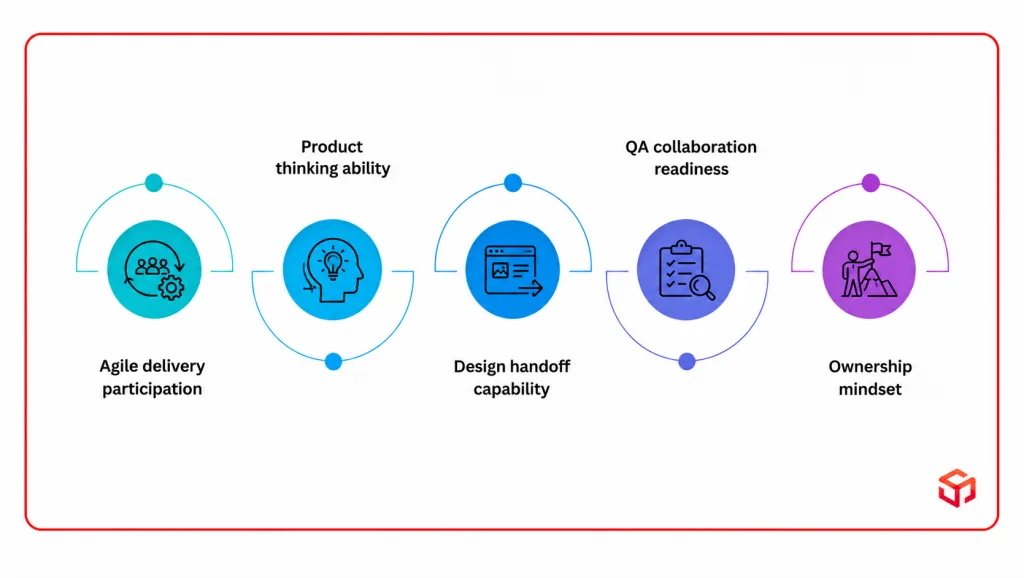
Technical evaluations alone rarely predict frontend delivery success. Businesses must also evaluate workflow compatibility, ownership mindset, and collaboration maturity before onboarding dedicated frontend engineers.
Many frontend developers perform well during technical interviews. But delivery problems often begin after sprint execution starts. This usually happens because companies overlook operational compatibility.
Frontend developers work closely with:
• Product managers
• Backend engineers
• QA teams
• UI/UX designers
• DevOps teams
If teams do not work well together, sprint delivery will slow down quickly. Businesses should evaluate several overlooked areas before hiring.
Agile delivery participation: Developers should understand sprint planning, standups, backlog refinement, and release cycles. Agile maturity improves delivery predictability significantly.
Product thinking ability: Strong frontend engineers understand business logic, customer behavior, and usability priorities alongside technical implementation.
Design handoff capability: Frontend developers frequently work with Figma-based workflows. Poor design translation often creates inconsistent user experiences.
QA collaboration readiness: Frontend teams should coordinate closely with testing engineers to reduce UI bugs, responsiveness issues, and regression risks.
Ownership mindset: Dedicated developers should proactively identify performance risks, UI inconsistencies, and scalability concerns before they affect releases.
Many businesses fail to evaluate these areas during hiring. That is why technically strong developers sometimes struggle in real-world product environments.
Top Companies to Hire Dedicated Front-End Developers in 2026
Frontend hiring platforms vary widely in delivery models, technical screening, governance quality, and scalability support. Businesses should evaluate vendors based on long-term engineering compatibility rather than hourly pricing alone.
Soft Suave

Dedicated frontend development works best when engineering talent aligns closely with sprint execution, architecture standards, and long-term delivery goals. That operational alignment is where Soft Suave positions itself strongly.
Soft Suave focuses on dedicated frontend engineering support for startups, SaaS businesses, and enterprise technology teams.
The company emphasizes structured delivery rather than simple resource allocation. Its frontend developers work across React, Angular, Vue.js, TypeScript, and modern UI engineering ecosystems.
Teams are integrated directly into agile workflows with sprint tracking, QA collaboration, and delivery oversight.
Soft Suave also supports flexible engagement models for businesses scaling frontend initiatives quickly. This includes faster onboarding, timezone-aligned collaboration, and dedicated engineering continuity.
Unlike marketplace-driven hiring platforms, Soft Suave operates with governance-focused delivery processes. That includes architecture guidance, sprint visibility, code review workflows, and structured communication management.
Test Frontend Talent Risk-Free
Evaluate Soft Suave frontend developers through a 40-hour free trial before commitment. Validate technical fit, communication quality, and sprint readiness without financial pressure first.
Try FreeCodiant

Frontend delivery quality often depends on a company’s ability to support complex digital products across multiple platforms and user environments. Codiant focuses heavily on that implementation-driven approach.
Codiant provides full-stack and frontend development services for enterprise applications, mobility solutions, and customer-facing digital platforms.
The company supports React, Angular, and modern JavaScript ecosystems while focusing on scalable UI development and enterprise integrations.
Its strength lies in handling UI-heavy applications requiring broader digital transformation support.
Lemon.io

Startup-focused hiring environments require flexibility, faster onboarding, and access to remote frontend talent pools. Lemon.io positions itself strongly around those operational priorities.
Lemon.io operates as a developer marketplace connecting startups with remote frontend engineers.
The platform focuses heavily on freelance and contract-based hiring while emphasizing quick talent matching.
Its frontend talent pool includes developers experienced in React, Vue.js, and TypeScript-based environments. The platform is particularly popular among startups seeking flexible remote hiring models.
Toptal

Premium freelance networks usually prioritize advanced technical screening and access to highly experienced engineering professionals. Toptal follows this premium talent marketplace positioning closely.
Toptal is known for its strict screening processes and curated freelance talent network. The platform provides access to senior frontend developers, UI engineers, and JavaScript specialists across global markets.
Many businesses use Toptal for short-term frontend scaling or specialized technical expertise requiring experienced independent contractors.
Arc.dev

Remote-first engineering models continue growing across modern product companies. Arc.dev focuses heavily on supporting distributed frontend hiring and flexible remote development structures.
Arc.dev connects businesses with remote developers across frontend, backend, and full-stack domains. The platform supports contract-based and remote engineering hiring while emphasizing developer flexibility.
Its frontend talent ecosystem includes React, Angular, Vue.js, and JavaScript-focused developers suitable for distributed product teams and remote engineering operations.
ScienceSoft

Enterprise frontend initiatives often require broader consulting expertise, modernization support, and long-term technology transformation planning. ScienceSoft operates strongly within those enterprise delivery environments.
ScienceSoft provides enterprise IT consulting and software development services across multiple industries.
The company supports frontend engineering alongside cloud modernization, enterprise transformation, and legacy application upgrades.
Its frontend delivery model suits organizations requiring structured enterprise processes, governance frameworks, and large-scale technology implementation support.
What Nobody Tells You About Offshore Frontend Developer Rates – Until You Have Already Signed
Frontend pricing often looks simple during vendor discussions, but becomes confusing once delivery starts. Businesses must understand what actually affects offshore frontend development costs before signing long-term contracts.
Many companies compare frontend rates using hourly pricing alone. That creates misleading expectations. Frontend development costs vary based on several factors.
Framework specialization: React, Angular, and Vue.js developers often have different pricing structures depending on ecosystem demand and enterprise adoption levels.
Seniority and architecture capability: Developers handling scalable frontend architecture, performance optimization, and complex UI systems typically command higher rates.
Delivery model: Freelancers usually appear cheaper initially. However, structured engineering teams often reduce long-term delivery risks significantly.
Communication maturity: Timezone overlap, sprint coordination, and collaboration quality strongly affect productivity across offshore frontend engagements.
QA and governance support: Projects with testing workflows, delivery oversight, and engineering governance generally achieve better release stability.
Regional pricing also differs considerably.
US: Starts from $35/hour
Western Europe: Starts from $35/hour
Eastern Europe: Starts from $25/hour
Latin America: Starts from $25/hour
India/Asia: Starts from $15/hour
Ukraine: Starts from $15/hour
Poland: Starts from $25/hour
Philippines: Starts from $15/hour
Vietnam: Starts from $15/hour
Nevertheless, choosing to hire for frontend positions should not be based solely on low pricing. Many offshore projects become expensive because of:
• delayed releases
• weak code quality
• inconsistent UI implementation
• scalability issues
• onboarding losses
• communication breakdowns
This is also why many companies prefer frontend partners that operate with structured engineering oversight instead of isolated freelancer management.
Soft Suave, for example, combines transparent pricing structures with sprint visibility, QA coordination, architecture alignment, and dedicated delivery workflows so businesses can scale frontend teams without unexpected operational or cost-related surprises.
Tired Of Unreliable Frontend Freelancers?
Inconsistent frontend execution creates technical debt and missed deadlines. Soft Suave delivers vetted developers supported by governance, QA oversight, and transparent collaboration workflows.
Hire ExpertsBetter Brief. Better Developer. Here Is How to Start
Strong frontend hiring begins with clarity, not urgency. Businesses that define technical expectations, product goals, and delivery workflows early usually achieve better onboarding and faster sprint execution.
Many frontend hiring problems begin before recruitment starts. Companies often approach hiring with vague requirements such as:
• “Need a React developer.”
• “Need frontend support quickly.”
• “Need UI improvements.”
That creates weak developer alignment.
A strong frontend brief should define:
Framework expectations: Specify whether the project requires React, Angular, Vue.js, TypeScript, or multi-framework expertise.
Product complexity: Explain application scale, user load expectations, integrations, and frontend architecture maturity.
Sprint responsibilities: Clarify whether developers will participate in standups, code reviews, QA coordination, or architecture discussions.
Performance expectations: Frontend teams should understand page speed priorities, Core Web Vitals targets, accessibility requirements, and responsiveness standards.
Team collaboration structure: Define communication workflows, timezone expectations, reporting systems, and engineering ownership models.
Once these operational expectations are clearly defined, businesses can match developers more accurately to both technical and delivery requirements.
That alignment becomes extremely important in dedicated frontend engagements where delivery consistency depends on both technical capability and operational compatibility.
Soft Suave follows a skills-first matching approach for dedicated frontend hiring to ensure stronger alignment between technical expertise, sprint workflows, product complexity, and long-term delivery expectations.
Here is how Soft Suave matches that brief to a dedicated React, Angular, or Vue developer:
Framework specialization alignment: Developers are matched based on real project experience in React, Angular, Vue.js, and TypeScript ecosystems instead of generic frontend classification.
Product complexity evaluation: Frontend engineers are selected according to application scale, UI complexity, integration requirements, and long-term scalability expectations.
Sprint-readiness assessment: Developers are evaluated for agile workflow participation, communication maturity, and collaboration readiness before onboarding begins.
Business and delivery compatibility: Matching also considers timezone overlap, reporting expectations, engineering ownership, and long-term delivery continuity instead of only technical screening.
That helps businesses onboard frontend developers faster while improving delivery consistency and long-term engineering scalability. Strong frontend products rarely happen through rushed hiring.
They are built through better requirement clarity, better engineering alignment, and better delivery execution from day one.
Conclusion
Hiring dedicated frontend developers is no longer just about filling technical gaps. The right frontend team directly impacts product performance, user experience, scalability, and release velocity.
Businesses that focus only on frameworks often overlook the delivery alignment needed for long-term success. Clear requirements, structured workflows, and strong engineering collaboration now matter as much as coding expertise itself.
That is why companies are moving toward dedicated frontend engagement models with better transparency, governance, and sprint integration.
Whether you need React, Angular, or Vue specialists, choosing developers who align with both technical and business goals will always create faster releases, stronger products, and more predictable growth.
FAQs
How much does it cost to hire dedicated front-end developers?
Frontend developer pricing varies based on framework expertise, seniority, region, and delivery model. Offshore frontend developers’ costs typically start from $15 per hour in India, while US and UK rates are significantly higher.
What skills should frontend developers have in 2026?
Modern frontend developers should understand JavaScript, TypeScript, React, Angular, or Vue.js alongside accessibility, responsive design, performance optimization, API integration, and collaborative agile workflows.
Can frontend developers improve SEO performance?
Yes. Frontend developers directly influence Core Web Vitals, mobile responsiveness, rendering behavior, and page speed, all of which impact SEO visibility and user experience.
How long does it take to onboard dedicated frontend developers?
Onboarding timelines vary by vendor and project complexity. Many structured frontend staffing partners can onboard developers within a few days after requirement alignment.
Why do frontend hiring projects fail?
Most frontend hiring failures happen because businesses define requirements poorly, ignore workflow compatibility, or evaluate developers based only on framework expertise instead of delivery capability.
Tags:

Ramesh Vayavuru is the Founder & CEO of Soft Suave Technologies, with 15+ years of experience delivering innovative IT solutions.
Related Blogs