Finding reliable developers shouldn’t feel like gambling with your roadmap.Yet most CTOs and founders waste weeks on interviews, only to onboard the wrong freelancer.

Timelines slip. Budgets increase. Product quality becomes unpredictable. The lack of talent is not the real issue.

It’s choosing the right hiring channel, with the right level of vetting, cost control, and flexibility for your use case.

This guide breaks down the top freelance developer hiring platforms in 2026 and when your business is better off partnering with an engineering-focused team.

Why Companies Prefer Hiring Freelance Developers Today

Many technology leaders now mix in-house engineers with flexible freelance resources.

This hybrid model helps balance delivery speed, cost, and access to specific skills across global time zones.

Businesses are under constant pressure to ship faster while keeping engineering costs predictable. Hiring freelance developers lets you plug skill gaps quickly, without long recruitment cycles or full-time headcount commitments.

Most top freelance platforms offer thousands of experienced developers across stacks like React, Node.js, Java, .NET, Python, mobile, and cloud-native architectures.

You can scale squads up or down as projects evolve, instead of being locked into fixed staffing levels.

However, on open marketplaces, you handle screening, technical interviews, code quality checks, and communication yourself, which drains time from your core software delivery.

That’s why many companies now lean toward IT-focused partners who act more like engineering staffing agencies.

These partners pre-vet developers, manage retention, and align talent with product strategy rather than just filling a seat.

If you want the flexibility of freelancers without the overhead, one major solution is to hire dedicated developers through a reliable IT staff augmentation service provider like Soft Suave, giving you curated engineers who integrate into your sprint cycles, toolchain, and SDLC standards just like internal team members.

A well-designed model also includes clear SLAs, governance, and backup resources. That way, you avoid the common freelancing drawback where a critical developer disappears mid-sprint and leaves your release hanging.

Top Freelance Developer Hiring Platforms for Businesses in 2026

Each platform in this section solves the freelance hiring problem differently.Understanding their strengths and limitations helps you match the right platform to your project’s budget, timeline, and technical risk.

Upwork

Upwork is one of the largest global marketplaces for software engineers, QA specialists, DevOps experts, and other technical roles. It’s built for companies that need access to a huge pool of contractors at almost every price point.

You’ll find millions of profiles covering full-stack development, legacy system maintenance, microservices, and cloud migrations.

Clients typically post a job, receive multiple bids, and then shortlist based on ratings, portfolios, and hourly or fixed-price quotes.

Upwork supports escrow-style payments, time tracking, and dispute resolution, which lowers some transactional risk. But the platform doesn’t guarantee deep technical vetting, so your engineering leaders must still run code reviews and system design interviews.

Toptal

Toptal positions itself as a premium network of elite engineers. It focuses on vetting rather than volume, which appeals to teams that value quality and reliability over the lowest hourly rate.

Candidates go through language checks, algorithmic tests, technical interviews, and test projects before entering client-facing talent pools.

As a client, you typically receive a shortlist of senior developers for roles in backend, frontend, data, or architecture. Premium pricing reflects that vetting depth, and Toptal often offers a trial with dedicated account support for onboarding.

Fiverr

Fiverr grew famous for compact, fixed-price ā€œgigs,ā€ but its programming and tech category now hosts serious freelance developers as well.

It is often used for tightly scoped tasks with clear deliverables and smaller risk envelopes.

Companies often turn to Fiverr for micro-projects, such as landing page builds, quick API integrations, performance optimisations, or one-off automation scripts.

Its catalog-style interface and upfront pricing make browsing and shortlisting straightforward, especially for non-technical founders.

The downside is that you still rely heavily on reviews, portfolios, and instinct rather than rigorous, platform-driven technical screening. For large refactors, multi-sprint builds, or complex distributed systems, it can be risky without strong in-house engineering oversight.

Freelancer

Freelancer.com is one of the early players in the freelancing ecosystem. It supports a huge number of software projects across stacks, from greenfield builds to maintenance and migration work.

The core model is a bid-based marketplace. You post a requirement, receive proposals from developers worldwide, and then choose based on rates, ratings, and previous project history.

This makes Freelancer attractive if you need aggressive pricing and are willing to invest time in screening and managing risk.

But it also means engineering leaders must allocate capacity to technical interviews and code assessment for each shortlisted candidate.

Guru

Guru is another large-scale freelance marketplace often highlighted in comparison lists. It offers software and IT professionals alongside designers, writers, and other knowledge workers.

Many guides describe Guru as a good fit for businesses that want multiple engagement models, including hourly, milestone-based, and recurring payments.Its workroom tools support collaboration and documentation across long-running development projects.

As with other open platforms, Guru’s main strength is breadth rather than deep, platform-managed vetting.

Companies looking for consistent engineering quality must implement their own technical screening pipeline.

PeoplePerHour

PeoplePerHour is popular in Europe and the UK, but it serves global clients too.It combines project postings with pre-packaged hourly rates that cover defined software tasks.

From a software perspective, it can work well for smaller enhancements, integrations, or POCs that require a quick, fixed-fee engagement.

Ratings, reviews, and portfolio snapshots are central to how clients hire a software developer.

However, like many other non-specialist marketplaces, PeoplePerHour doesn’t focus exclusively on complex enterprise-grade software delivery. That means you’ll still need strong internal architecture oversight for mission-critical systems.

Turing

Turing is often called an ā€œIntelligent Talent Cloudā€ rather than a simple job board. It combines AI-based matching with extensive pre-vetting to provide remote software developers at scale.

According to various sources, Turing’s automated matching has saved engineering teams more than 50 hours per hire by streamlining talent search and shortlisting.

Developers undergo rigorous testing, including coding challenges and technical interviews, before joining the network.

Turing focuses heavily on long-term, remote engagements rather than one-off gigs, making it a good fit for distributed engineering teams.

It is especially popular with companies that want senior engineers embedded in their existing Scrum or Kanban workflows.

Freelance Developer Hiring vs Development Companies

Before you commit to a marketplace, it helps to compare all the available options.

This section compares freelance platforms with partnering directly with software development companies to handle end-to-end delivery.

Some projects only need an extra pair of hands. Others need architectural ownership, product thinking, DevOps workflows, QA automation, and long-term support.

That’s where the choice between freelancers and a software development company becomes critical.

Here’s a simple comparison matrix:

For high-risk releases or complex distributed systems, a dedicated development company can own architecture, sprint planning, QA, and performance tuning.This lets your internal team focus on business strategy and product discovery instead of day-to-day resource firefighting.

Key Factors to Evaluate Before Choosing a Developer Hiring Platform

Not every platform suits every product roadmap or organisation. Use these core evaluation pillars to shortlist platforms that align with your engineering maturity and delivery risk profile.
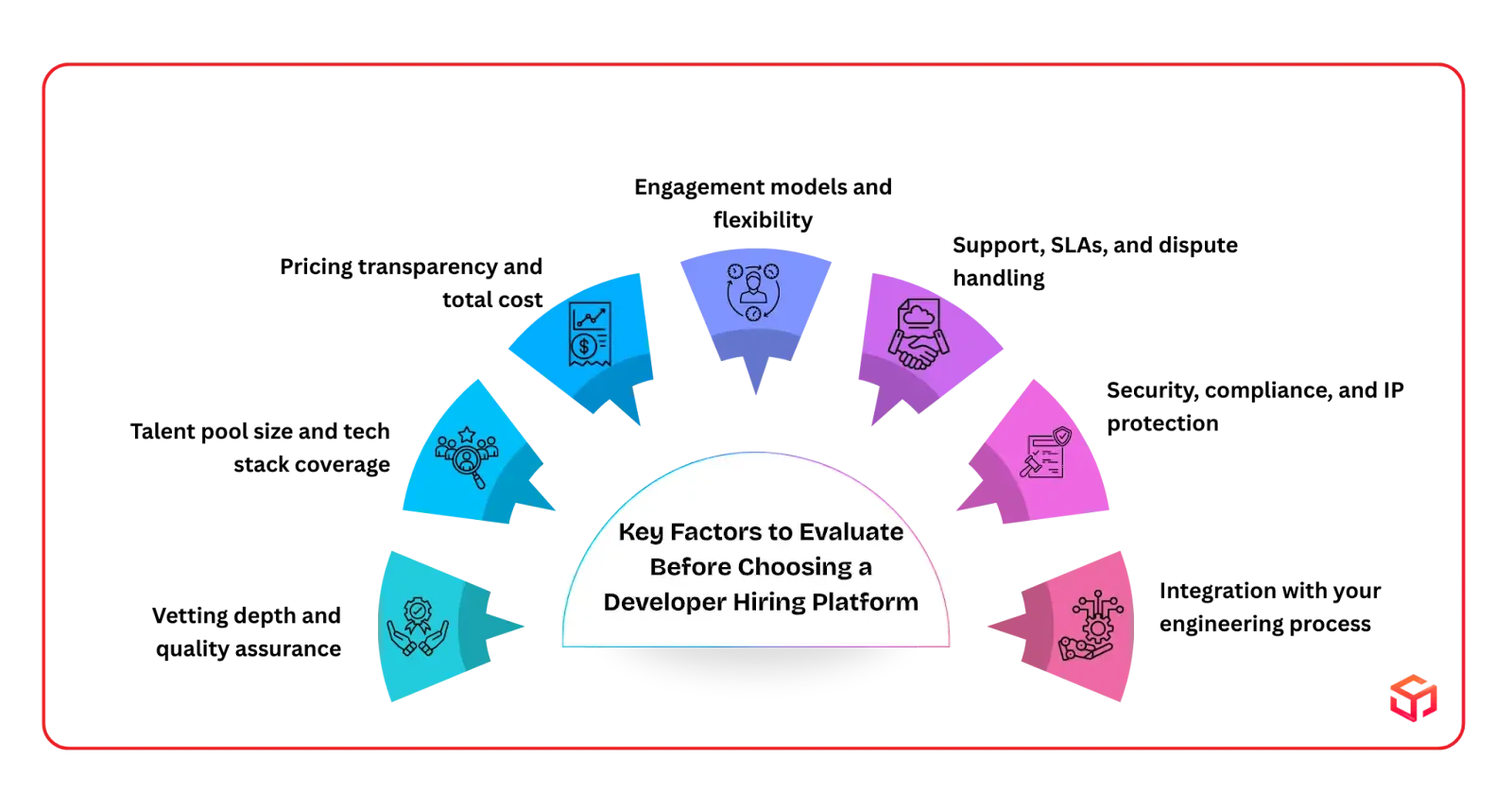
  • Vetting depth and quality assurance: A strong platform should go beyond resume checks and include coding tests, reference checks, and portfolio validation to reduce hiring risk and protect your production systems.
  • Talent pool size and tech stack coverage: Check whether the platform can supply developers across your required languages, frameworks, cloud providers, and architectural patterns, especially if you expect future scaling needs.
  • Pricing transparency and total cost: Evaluate hourly or project rates, platform fees, and hidden costs like your internal screening time to compare the true total cost of ownership between options.
  • Engagement models and flexibility: Look for support for part-time, full-time, contract-to-hire, and team-based engagements so you can adapt as your roadmap and funding evolve.
  • Support, SLAs, and dispute handling: Strong customer support, clear SLAs, and structured dispute resolution can make the difference when you hit delays, scope creep, or quality issues in production.
  • Security, compliance, and IP protection: Ensure contracts, NDAs, and platform policies clearly define IP ownership, data handling, and confidentiality to protect your application and customer data.
  • Integration with your engineering process: The best platform or partner should integrate with your tools (Git, CI/CD, issue trackers) and ceremonies, so remote talent feels like part of your core engineering organisation.

Best Practices for Successfully Hiring Freelance Developers

Good platforms are only half the equation. How you define, screen, and manage freelance developers determines whether they accelerate or slow down your software delivery.
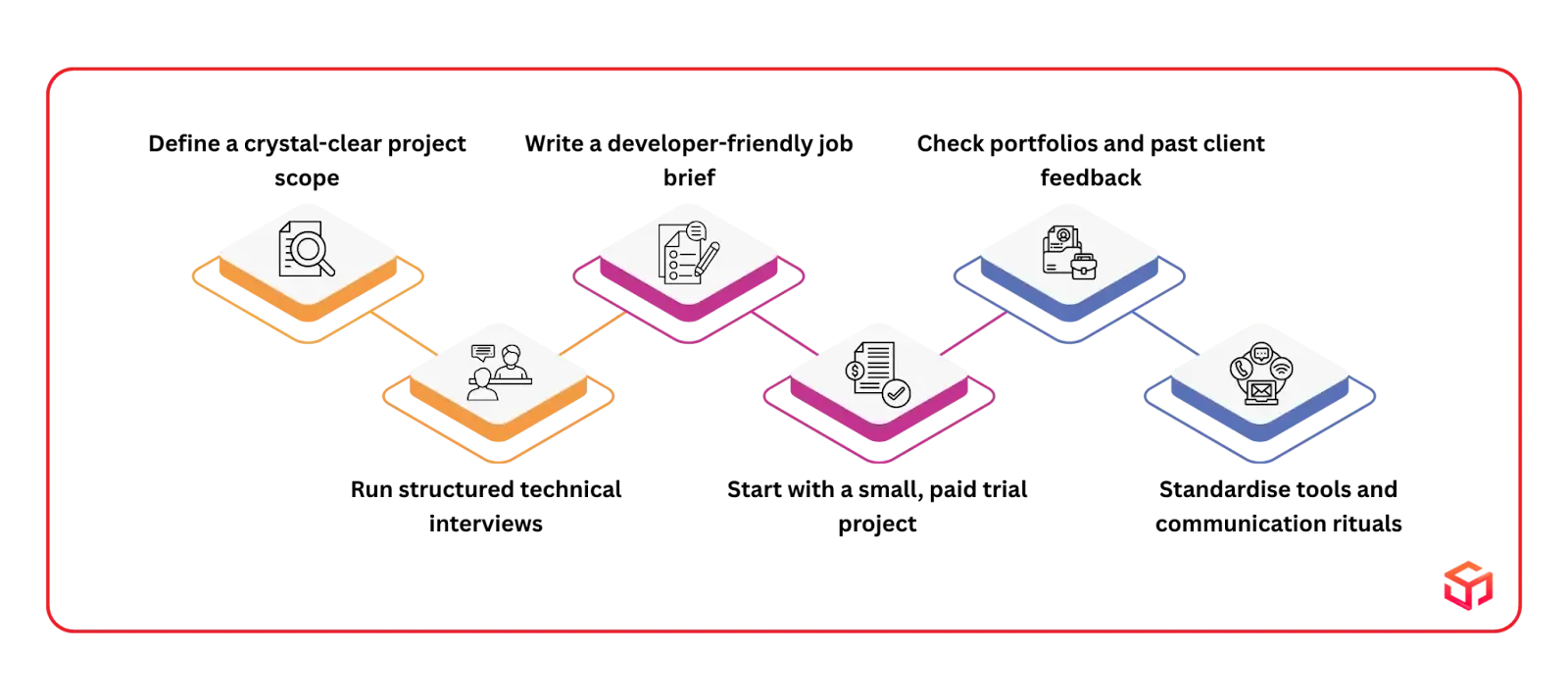
  • Define a crystal-clear project scope: Document business goals, user stories, tech stack, integrations, non-functional requirements, and acceptance criteria so freelancers know exactly what success looks like from day one.
  • Write a developer-friendly job brief: Include technical context, codebase details, environment specifics, and tooling upfront to attract the right engineers and filter out mismatched applicants quickly.
  • Check portfolios and past client feedback: Look for projects similar in complexity, architecture, and domain, and read reviews for patterns around communication, reliability, and on-time delivery.
  • Run structured technical interviews: Combine problem-solving questions, code reviews, and system design discussions to make sure the freelancer can operate at the level your architecture requires.
  • Start with a small, paid trial project: Use a separate module, feature, or refactor to validate quality, communication, and ownership before scaling the engagement to critical-path workstreams.
  • Standardise tools and communication rituals: Align on time zones, stand-ups, sprint ceremonies, code review practices, and documentation standards to keep everyone in sync across the SDLC.

Mistakes Businesses Should Avoid When Hiring Freelance Developers

Many failed freelance projects trace back to preventable mistakes. Avoid these common pitfalls to safeguard your product quality and timelines.

  • Choosing purely on the lowest hourly rate: Lowest pricing often correlates with limited experience, weak communication, or unstable commitment, which ultimately increases cost through rework and missed deadlines.
  • Keeping requirements unclear or incomplete: Unclear scopes lead to mismatched expectations, inconsistent implementations, and scope creep, forcing you into endless change requests and strained relationships.
  • Skipping technical screening and test work: Relying only on ratings can hide weak fundamentals; always validate skills with code reviews, pair programming, or small test tasks before critical production work.
  • Ignoring time zone and communication fit: Distributed teams need overlapping hours, clear language skills, and agreed response times to unblock issues quickly during sprints.
  • Failing to document architecture and decisions: Without clear technical documentation, new freelancers struggle to understand the system, leading to weak fixes and knowledge loss when individuals quit.
  • Not planning for backup or continuity: Depending on a single freelancer for core modules creates a single point of failure if they become unavailable without notice.

How much does it cost to hire a freelance developer?

Budget clarity is essential before you compare platforms. This section gives rough pricing patterns so you can forecast and benchmark offers more confidently.

Rates vary by region, tech stack, experience, and platform type. Open marketplaces often list broad ranges, from junior developers at lower hourly rates to senior engineers commanding premium pricing.

Curated networks like Toptal and Turing lean toward higher hourly rates due to their extensive vetting and support services.

These costs may still be lower than hiring full-time senior engineers in expensive markets.

When comparing platforms, factor in platform fees, your internal vetting time, potential rework, and the cost of delays. The cheapest headline rate can become the most expensive if quality is inconsistent.

Development and IT staffing companies simplify this by publishing a transparent developer rate card that maps roles, stacks, and engagement models, making it easier to compare platform freelancers against dedicated, long-term engineering capacity.

When Should You Choose Freelancers vs Development Companies?

Choosing the right model depends on your product stage, team maturity, and risk tolerance. Use these practical scenarios to align your hiring strategy with your roadmap.

Freelancers are ideal when you need:

  • Short-term, isolated tasksEnhancements, bug fixes, and small integrations that sit outside your core architecture are well-suited for individual freelancers on major platforms.
  • Experiments and proofs of conceptWhen validating an idea or testing a new technology, freelancers can help you move fast without long-term commitments.
  • Specialist skills for a limited scopeNiche optimisations like performance tuning, security auditing, or one-off cloud cost reviews can be handled by targeted freelance engagements.

Development companies are a better fit when you need:

  • End-to-end product ownershipFrom discovery to deployment, you want a partner managing architecture, implementation, DevOps, and long-term support with consistent engineering standards.
  • Multi-disciplinary teams from day oneYou require backend, frontend, QA, DevOps, and UX working as a unified product squad with shared rituals and governance.
  • Long-term strategic roadmap executionYour application is core to the business model, so you need continuity, documentation, and a stable engineering partner invested in long-term outcomes.

Conclusion

Freelance platforms have transformed how businesses source engineering talent, but more choice also means more complexity.

Selecting the right mix of marketplaces, curated networks, and dedicated partners now sits at the heart of modern software delivery strategy.

If you only chase the lowest hourly rate, you risk unstable delivery and technical debt that slows every future sprint. If you only choose premium networks, you might overpay for work that a good mid-level engineer could handle.

The companies that win are those that treat talent selection as an engineering decision, not just a procurement exercise. They apply the same severity they use for architecture and security when choosing platforms and partners.

Now is the time to rethink how you hire developers, upgrade your talent strategy, and build a delivery model you can actually trust.

Frequently Asked Questions

Can businesses hire freelance developers for short-term projects?

Yes. Freelance platforms and curated networks are well-suited for short-term tasks, experiments, and POCs, especially when scopes are clearly defined and not deeply coupled to complex legacy systems.

Do freelance platforms provide secure payment systems?

Most leading platforms use escrow-style payments, milestone releases, and dispute resolution workflows to protect both clients and freelancers during software development engagements.

Can freelance developers work on long-term projects?

Yes. Many businesses retain high-performing freelancers for months or years, especially when they integrate cleanly into existing communication and engineering processes, but staff augmentation and development companies are often better for long-term, strategic delivery.

Is it safe to hire freelance developers online?

It can be safe if you use reputable platforms, apply proper vetting, sign NDAs, and secure IP through clear contracts and access controls.

Should startups hire freelance developers or full-time developers?

Early-stage startups often blend freelancers for speed and experimentation with core full-time engineers who own critical architecture and long-term product vision.

Ramesh Vayavuru Founder & CEO

Ramesh Vayavuru is the Founder & CEO of Soft Suave Technologies, with 15+ years of experience delivering innovative IT solutions.

Finding reliable developers shouldn’t feel like gambling with your roadmap.Yet most CTOs and founders waste weeks on interviews, only to onboard the wrong freelancer.

Timelines slip. Budgets increase. Product quality becomes unpredictable. The lack of talent is not the real issue.

It’s choosing the right hiring channel, with the right level of vetting, cost control, and flexibility for your use case.

This guide breaks down the top freelance developer hiring platforms in 2026 and when your business is better off partnering with an engineering-focused team.

Why Companies Prefer Hiring Freelance Developers Today

Many technology leaders now mix in-house engineers with flexible freelance resources.

This hybrid model helps balance delivery speed, cost, and access to specific skills across global time zones.

Businesses are under constant pressure to ship faster while keeping engineering costs predictable. Hiring freelance developers lets you plug skill gaps quickly, without long recruitment cycles or full-time headcount commitments.

Most top freelance platforms offer thousands of experienced developers across stacks like React, Node.js, Java, .NET, Python, mobile, and cloud-native architectures.

You can scale squads up or down as projects evolve, instead of being locked into fixed staffing levels.

However, on open marketplaces, you handle screening, technical interviews, code quality checks, and communication yourself, which drains time from your core software delivery.

That’s why many companies now lean toward IT-focused partners who act more like engineering staffing agencies.

These partners pre-vet developers, manage retention, and align talent with product strategy rather than just filling a seat.

If you want the flexibility of freelancers without the overhead, one major solution is to hire dedicated developers through a reliable IT staff augmentation service provider like Soft Suave, giving you curated engineers who integrate into your sprint cycles, toolchain, and SDLC standards just like internal team members.

A well-designed model also includes clear SLAs, governance, and backup resources. That way, you avoid the common freelancing drawback where a critical developer disappears mid-sprint and leaves your release hanging.

Top Freelance Developer Hiring Platforms for Businesses in 2026

Each platform in this section solves the freelance hiring problem differently.Understanding their strengths and limitations helps you match the right platform to your project’s budget, timeline, and technical risk.

Upwork

Upwork is one of the largest global marketplaces for software engineers, QA specialists, DevOps experts, and other technical roles. It’s built for companies that need access to a huge pool of contractors at almost every price point.

You’ll find millions of profiles covering full-stack development, legacy system maintenance, microservices, and cloud migrations.

Clients typically post a job, receive multiple bids, and then shortlist based on ratings, portfolios, and hourly or fixed-price quotes.

Upwork supports escrow-style payments, time tracking, and dispute resolution, which lowers some transactional risk. But the platform doesn’t guarantee deep technical vetting, so your engineering leaders must still run code reviews and system design interviews.

Toptal

Toptal positions itself as a premium network of elite engineers. It focuses on vetting rather than volume, which appeals to teams that value quality and reliability over the lowest hourly rate.

Candidates go through language checks, algorithmic tests, technical interviews, and test projects before entering client-facing talent pools.

As a client, you typically receive a shortlist of senior developers for roles in backend, frontend, data, or architecture. Premium pricing reflects that vetting depth, and Toptal often offers a trial with dedicated account support for onboarding.

Fiverr

Fiverr grew famous for compact, fixed-price ā€œgigs,ā€ but its programming and tech category now hosts serious freelance developers as well.

It is often used for tightly scoped tasks with clear deliverables and smaller risk envelopes.

Companies often turn to Fiverr for micro-projects, such as landing page builds, quick API integrations, performance optimisations, or one-off automation scripts.

Its catalog-style interface and upfront pricing make browsing and shortlisting straightforward, especially for non-technical founders.

The downside is that you still rely heavily on reviews, portfolios, and instinct rather than rigorous, platform-driven technical screening. For large refactors, multi-sprint builds, or complex distributed systems, it can be risky without strong in-house engineering oversight.

Freelancer

Freelancer.com is one of the early players in the freelancing ecosystem. It supports a huge number of software projects across stacks, from greenfield builds to maintenance and migration work.

The core model is a bid-based marketplace. You post a requirement, receive proposals from developers worldwide, and then choose based on rates, ratings, and previous project history.

This makes Freelancer attractive if you need aggressive pricing and are willing to invest time in screening and managing risk.

But it also means engineering leaders must allocate capacity to technical interviews and code assessment for each shortlisted candidate.

Guru

Guru is another large-scale freelance marketplace often highlighted in comparison lists. It offers software and IT professionals alongside designers, writers, and other knowledge workers.

Many guides describe Guru as a good fit for businesses that want multiple engagement models, including hourly, milestone-based, and recurring payments.Its workroom tools support collaboration and documentation across long-running development projects.

As with other open platforms, Guru’s main strength is breadth rather than deep, platform-managed vetting.

Companies looking for consistent engineering quality must implement their own technical screening pipeline.

PeoplePerHour

PeoplePerHour is popular in Europe and the UK, but it serves global clients too.It combines project postings with pre-packaged hourly rates that cover defined software tasks.

From a software perspective, it can work well for smaller enhancements, integrations, or POCs that require a quick, fixed-fee engagement.

Ratings, reviews, and portfolio snapshots are central to how clients hire a software developer.

However, like many other non-specialist marketplaces, PeoplePerHour doesn’t focus exclusively on complex enterprise-grade software delivery. That means you’ll still need strong internal architecture oversight for mission-critical systems.

Turing

Turing is often called an ā€œIntelligent Talent Cloudā€ rather than a simple job board. It combines AI-based matching with extensive pre-vetting to provide remote software developers at scale.

According to various sources, Turing’s automated matching has saved engineering teams more than 50 hours per hire by streamlining talent search and shortlisting.

Developers undergo rigorous testing, including coding challenges and technical interviews, before joining the network.

Turing focuses heavily on long-term, remote engagements rather than one-off gigs, making it a good fit for distributed engineering teams.

It is especially popular with companies that want senior engineers embedded in their existing Scrum or Kanban workflows.

Freelance Developer Hiring vs Development Companies

Before you commit to a marketplace, it helps to compare all the available options.

This section compares freelance platforms with partnering directly with software development companies to handle end-to-end delivery.

Some projects only need an extra pair of hands. Others need architectural ownership, product thinking, DevOps workflows, QA automation, and long-term support.

That’s where the choice between freelancers and a software development company becomes critical.

Here’s a simple comparison matrix:

For high-risk releases or complex distributed systems, a dedicated development company can own architecture, sprint planning, QA, and performance tuning.This lets your internal team focus on business strategy and product discovery instead of day-to-day resource firefighting.

Key Factors to Evaluate Before Choosing a Developer Hiring Platform

Not every platform suits every product roadmap or organisation. Use these core evaluation pillars to shortlist platforms that align with your engineering maturity and delivery risk profile.

  • Vetting depth and quality assurance: A strong platform should go beyond resume checks and include coding tests, reference checks, and portfolio validation to reduce hiring risk and protect your production systems.
  • Talent pool size and tech stack coverage: Check whether the platform can supply developers across your required languages, frameworks, cloud providers, and architectural patterns, especially if you expect future scaling needs.
  • Pricing transparency and total cost: Evaluate hourly or project rates, platform fees, and hidden costs like your internal screening time to compare the true total cost of ownership between options.
  • Engagement models and flexibility: Look for support for part-time, full-time, contract-to-hire, and team-based engagements so you can adapt as your roadmap and funding evolve.
  • Support, SLAs, and dispute handling: Strong customer support, clear SLAs, and structured dispute resolution can make the difference when you hit delays, scope creep, or quality issues in production.
  • Security, compliance, and IP protection: Ensure contracts, NDAs, and platform policies clearly define IP ownership, data handling, and confidentiality to protect your application and customer data.
  • Integration with your engineering process: The best platform or partner should integrate with your tools (Git, CI/CD, issue trackers) and ceremonies, so remote talent feels like part of your core engineering organisation.

Best Practices for Successfully Hiring Freelance Developers

Good platforms are only half the equation. How you define, screen, and manage freelance developers determines whether they accelerate or slow down your software delivery.

  • Define a crystal-clear project scope: Document business goals, user stories, tech stack, integrations, non-functional requirements, and acceptance criteria so freelancers know exactly what success looks like from day one.
  • Write a developer-friendly job brief: Include technical context, codebase details, environment specifics, and tooling upfront to attract the right engineers and filter out mismatched applicants quickly.
  • Check portfolios and past client feedback: Look for projects similar in complexity, architecture, and domain, and read reviews for patterns around communication, reliability, and on-time delivery.
  • Run structured technical interviews: Combine problem-solving questions, code reviews, and system design discussions to make sure the freelancer can operate at the level your architecture requires.
  • Start with a small, paid trial project: Use a separate module, feature, or refactor to validate quality, communication, and ownership before scaling the engagement to critical-path workstreams.
  • Standardise tools and communication rituals: Align on time zones, stand-ups, sprint ceremonies, code review practices, and documentation standards to keep everyone in sync across the SDLC.

Mistakes Businesses Should Avoid When Hiring Freelance Developers

Many failed freelance projects trace back to preventable mistakes. Avoid these common pitfalls to safeguard your product quality and timelines.

  • Choosing purely on the lowest hourly rate: Lowest pricing often correlates with limited experience, weak communication, or unstable commitment, which ultimately increases cost through rework and missed deadlines.
  • Keeping requirements unclear or incomplete: Unclear scopes lead to mismatched expectations, inconsistent implementations, and scope creep, forcing you into endless change requests and strained relationships.
  • Skipping technical screening and test work: Relying only on ratings can hide weak fundamentals; always validate skills with code reviews, pair programming, or small test tasks before critical production work.
  • Ignoring time zone and communication fit: Distributed teams need overlapping hours, clear language skills, and agreed response times to unblock issues quickly during sprints.
  • Failing to document architecture and decisions: Without clear technical documentation, new freelancers struggle to understand the system, leading to weak fixes and knowledge loss when individuals quit.
  • Not planning for backup or continuity: Depending on a single freelancer for core modules creates a single point of failure if they become unavailable without notice.

How much does it cost to hire a freelance developer?

Budget clarity is essential before you compare platforms. This section gives rough pricing patterns so you can forecast and benchmark offers more confidently.

Rates vary by region, tech stack, experience, and platform type. Open marketplaces often list broad ranges, from junior developers at lower hourly rates to senior engineers commanding premium pricing.

Curated networks like Toptal and Turing lean toward higher hourly rates due to their extensive vetting and support services.

These costs may still be lower than hiring full-time senior engineers in expensive markets.

When comparing platforms, factor in platform fees, your internal vetting time, potential rework, and the cost of delays. The cheapest headline rate can become the most expensive if quality is inconsistent.

Development and IT staffing companies simplify this by publishing a transparent developer rate card that maps roles, stacks, and engagement models, making it easier to compare platform freelancers against dedicated, long-term engineering capacity.

When Should You Choose Freelancers vs Development Companies?

Choosing the right model depends on your product stage, team maturity, and risk tolerance. Use these practical scenarios to align your hiring strategy with your roadmap.

Freelancers are ideal when you need:

  • Short-term, isolated tasksEnhancements, bug fixes, and small integrations that sit outside your core architecture are well-suited for individual freelancers on major platforms.
  • Experiments and proofs of conceptWhen validating an idea or testing a new technology, freelancers can help you move fast without long-term commitments.
  • Specialist skills for a limited scopeNiche optimisations like performance tuning, security auditing, or one-off cloud cost reviews can be handled by targeted freelance engagements.

Development companies are a better fit when you need:

  • End-to-end product ownershipFrom discovery to deployment, you want a partner managing architecture, implementation, DevOps, and long-term support with consistent engineering standards.
  • Multi-disciplinary teams from day oneYou require backend, frontend, QA, DevOps, and UX working as a unified product squad with shared rituals and governance.
  • Long-term strategic roadmap executionYour application is core to the business model, so you need continuity, documentation, and a stable engineering partner invested in long-term outcomes.

Conclusion

Freelance platforms have transformed how businesses source engineering talent, but more choice also means more complexity.

Selecting the right mix of marketplaces, curated networks, and dedicated partners now sits at the heart of modern software delivery strategy.

If you only chase the lowest hourly rate, you risk unstable delivery and technical debt that slows every future sprint. If you only choose premium networks, you might overpay for work that a good mid-level engineer could handle.

The companies that win are those that treat talent selection as an engineering decision, not just a procurement exercise. They apply the same severity they use for architecture and security when choosing platforms and partners.

Now is the time to rethink how you hire developers, upgrade your talent strategy, and build a delivery model you can actually trust.

Frequently Asked Questions

Can businesses hire freelance developers for short-term projects?

Yes. Freelance platforms and curated networks are well-suited for short-term tasks, experiments, and POCs, especially when scopes are clearly defined and not deeply coupled to complex legacy systems.

Do freelance platforms provide secure payment systems?

Most leading platforms use escrow-style payments, milestone releases, and dispute resolution workflows to protect both clients and freelancers during software development engagements.

Can freelance developers work on long-term projects?

Yes. Many businesses retain high-performing freelancers for months or years, especially when they integrate cleanly into existing communication and engineering processes, but staff augmentation and development companies are often better for long-term, strategic delivery.

Is it safe to hire freelance developers online?

It can be safe if you use reputable platforms, apply proper vetting, sign NDAs, and secure IP through clear contracts and access controls.

Should startups hire freelance developers or full-time developers?

Early-stage startups often blend freelancers for speed and experimentation with core full-time engineers who own critical architecture and long-term product vision.

Ramesh Vayavuru Founder & CEO

Ramesh Vayavuru is the Founder & CEO of Soft Suave Technologies, with 15+ years of experience delivering innovative IT solutions.

Leave a Comment

Your email address will not be published. Required fields are marked *

logo

Soft Suave - Live Chat online

close

Are you sure you want to end the session?

šŸ’¬ Hi there! Need help?
chat 1