

How Much Does an Offshore Developer Cost?

TL;DR
See offshore developer hourly rates by experience and location, plus monthly cost examples for individuals and small teams.
Understand how engagement models, included services, and additional charges affect your hiring budget.
Find practical steps to compare vendor quotes, choose suitable developers, and keep hiring costs under control.
Your team needs more developers to meet delivery deadlines, but the quotes leave you unsure how much to budget each month. A lower hourly rate can still mean a higher monthly bill once additional costs are included.
So, how much does an offshore developer cost, really?
Your budget depends on experience, responsibilities, billed hours, and included support.
So, to help you plan, our team at Soft Suave explains offshore developer hourly rates, monthly costs, and small-team budgets in this blog. Use this guide to evaluate quotes and identify expenses your team must cover separately before committing to an engagement.
Note: All prices are in US dollars. These are just estimates to help you plan your budget, as the final cost depends on the developer’s experience, required hours, and included services.
Offshore Developer Hourly Rates by Experience in India
Offshore developer hourly rates in India vary by experience, technical skills, and role requirements. Junior developers have lower starting rates, while mid-level and senior roles carry higher rates for greater expertise and responsibility.
The table below compares starting hourly rates across these experience levels, helping you estimate hiring costs based on the level of experience your project needs.
Experience level | Experience | Starting hourly rate |
|---|---|---|
Junior developer | 0–2 years | $15 |
Mid-level developer | 2–5 years | $18 |
Senior developer | 5+ years | $25 |
These figures are starting hourly prices for the listed experience levels, not market averages or fixed quotes for every developer. The final rate may vary with the technology stack, specialist skills, responsibilities, and engagement terms.
Before finalizing your budget, request a quote that specifies the developer’s experience, billable hours, and included support. This gives you a clearer estimate of the cost of hiring offshore developers and helps you compare vendors on the same basis.
The sections below explain what developers at each experience level do and why their hourly rates differ.
Junior Developers
Junior developers handle clearly defined tasks, such as small features, routine bug fixes, and updates to existing applications. Their lower starting rate reflects their limited experience and need for technical guidance. When budgeting, include the time experienced team members will spend explaining requirements and reviewing their work.
Mid-Level Developers
Mid-level developers can build features, troubleshoot defects, and work within an established architecture with less day-to-day guidance. Their higher starting rate reflects broader practical experience and greater independence. They can suit teams that need developers to complete implementation work while senior engineers oversee larger technical decisions.
Senior Developers
Senior developers can handle complex integrations, make architecture decisions, resolve difficult technical issues, and guide other engineers. Their higher starting rate reflects deeper expertise and greater responsibility for system reliability and maintainability. This level can suit work that requires technical ownership, particularly when requirements or implementation choices are unclear.
Compare offshore developer rates against the work you need completed and the guidance your team can provide. Evaluate each candidate’s capabilities rather than relying on their title alone.
Hire Junior Offshore Developers From $14/Hour
Unclear quotes make hiring budgets difficult. Discuss your requirements with Soft Suave and explore suitable India-based junior developer hiring options with rates starting from $14/hour.
Discuss HiringMonthly Costs for Offshore Developers and Teams
A monthly cost estimate helps you understand how a developer or team will fit into your ongoing budget. It also makes it easier to compare quotes and plan how long you can fund the engagement. Start with the expected billable hours, then add any separately priced support or services.
Monthly Cost for One Developer
To estimate what one offshore developer will cost each month, multiply their hourly rate by the expected billable hours.
Monthly developer fee = hourly rate × billable hours
The examples below use 160 billable hours per month to show how this works. Your actual monthly allocation will depend on the agreed schedule and contract terms.
Experience level | Starting hourly rate | Hours assumed | Illustrative monthly developer fee |
|---|---|---|---|
Junior | $15 | 160 | $2,400 |
Mid-level | $18 | 160 | $2,880 |
Senior | $25 | 160 | $4,000 |
Before finalizing your budget, check whether you’ll pay for actual hours worked or a fixed monthly allocation. Confirm how meetings, holidays, leave, overtime, and unused hours affect your bill.
Monthly Cost for a Small Team
If your project needs more than one developer, add each person’s monthly fee to estimate the team budget. For example, you might hire a mid-level developer for feature development and a senior developer for more complex technical work. The example below assumes 160 billable hours per developer and covers developer fees only.
Developer | Hourly rate | Billable hours per month | Estimated monthly fee |
|---|---|---|---|
One mid-level developer | $18 | 160 | $2,880 |
One senior developer | $25 | 160 | $4,000 |
Team total | — | 320 | $6,880 |
The estimated $6,880 monthly budget covers developer fees only. Check whether design, QA, project management, and other services are included in the quote or need a separate allowance. Adding people or changing their experience levels and hours will also change your offshore development team cost.
This monthly price will help you budget for staffing. To estimate the cost of delivering a complete application, you also need to consider the engagement’s duration and wider delivery requirements.
How Location Affects Offshore Developer Hiring Costs
Where you hire also affects your budget. Compare rates across locations alongside the developer’s experience, responsibilities, and included services to understand what each quote offers.
The table below compares starting hourly rates across countries and regions known for software development.
Location | Starting hourly rate |
|---|---|
US | $35 |
Western Europe | $35 |
Eastern Europe | $25 |
Latin America | $25 |
India/Asia | $15 |
Ukraine | $15 |
Poland | $25 |
Philippines | $15 |
Vietnam | $15 |
These are starting rates, not average market prices. Your quote will depend on the developer and your requirements.
For a complete location comparison, review our offshore software development rates by country guide.
What Factors Influence Offshore Developer Hiring Costs?
Location and experience give you a starting point, but they don’t explain the full quote. The skills you need, the responsibilities you assign, and the way your team works also affect your budget.
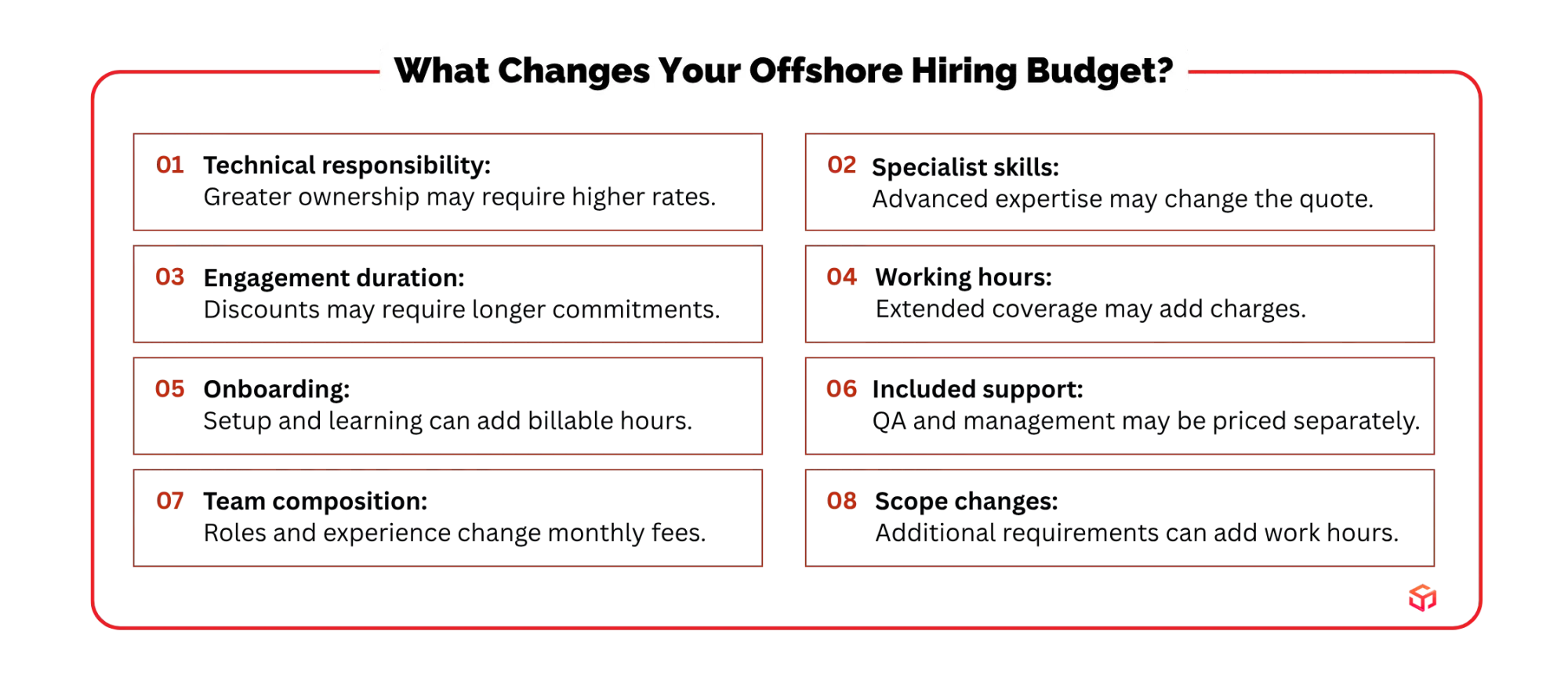
Let’s look at how these factors change the cost and what you can do to plan for them.
There are some more minor factors that will also affect the pricing, but in our 14+ years of experience, we found these factors to be the most important.
Technical responsibility: A developer responsible for architecture, technical decisions, or production releases may need more experience and command a higher rate than someone implementing defined tasks.
Best practice: Specify what the developer must own independently and which decisions your team will oversee.
Specialist skills: Roles requiring expertise in AI, data engineering, security, or specialist platforms may carry higher rates. The required skills matter alongside years of experience.
Best practice: Separate essential skills from preferences, and evaluate relevant work before paying for specialist expertise.
Security requirements: Work involving sensitive data may require extra access controls, security reviews, or specialist support. These requirements can add billable hours or separately charged services.
Best practice: Explain your security and data-handling requirements before requesting a quote, and confirm which responsibilities and costs each team will cover.
Engagement duration: Some vendors offer lower rates for longer commitments, but minimum terms can leave you paying for capacity you no longer need.
Best practice: Compare the total commitment, notice period, and cancellation charges alongside any discount.
Working-hour expectations: Extended time-zone overlap, overnight coverage, or weekend work may involve additional fees or different rates. More hours can also increase the monthly bill without changing the standard rate.
Best practice: Agree on the working schedule, overtime rates, and approval process before work begins.
Codebase and onboarding needs: An unfamiliar or poorly documented system can require additional time for setup, investigation, and knowledge transfer. This mainly affects billed hours rather than automatically increasing the hourly rate.
Best practice: Prepare access, documentation, and a technical contact, then agree on how onboarding time will be billed.
Included services and management: A quote covering development alone differs from one that includes technical oversight, QA, or delivery management. Bundled support may raise the quoted price while reducing separately purchased services.
Best practice: Request an itemized list of inclusions and compare quotes covering the same responsibilities.
Team size and experience mix: Adding developers increases monthly fees, while choosing more senior roles changes the team’s combined cost. This affects the total budget even when individual rates stay unchanged.
Best practice: Match each role to a defined need and use the experience mix your workload requires.
Scope clarity and changes: Unclear requirements, repeated revisions, and additional tasks can increase billable hours. Your monthly spending may rise even if the agreed hourly rate remains the same.
Best practice: Define priorities and acceptance criteria, and approve changes with an estimate of their cost before work starts.
These factors help explain why offshore developer quotes vary. Two other major considerations are the engagement model and billing method. They shape who manages the work, what the quote includes, and how you pay, so let’s look at both in more detail.
How Engagement Models and Billing Affect Costs
Your hiring arrangement determines who manages the work and which services the quote covers. The billing method determines how you pay for those services. Checking both helps you understand the support, responsibilities, and developer availability behind the price.
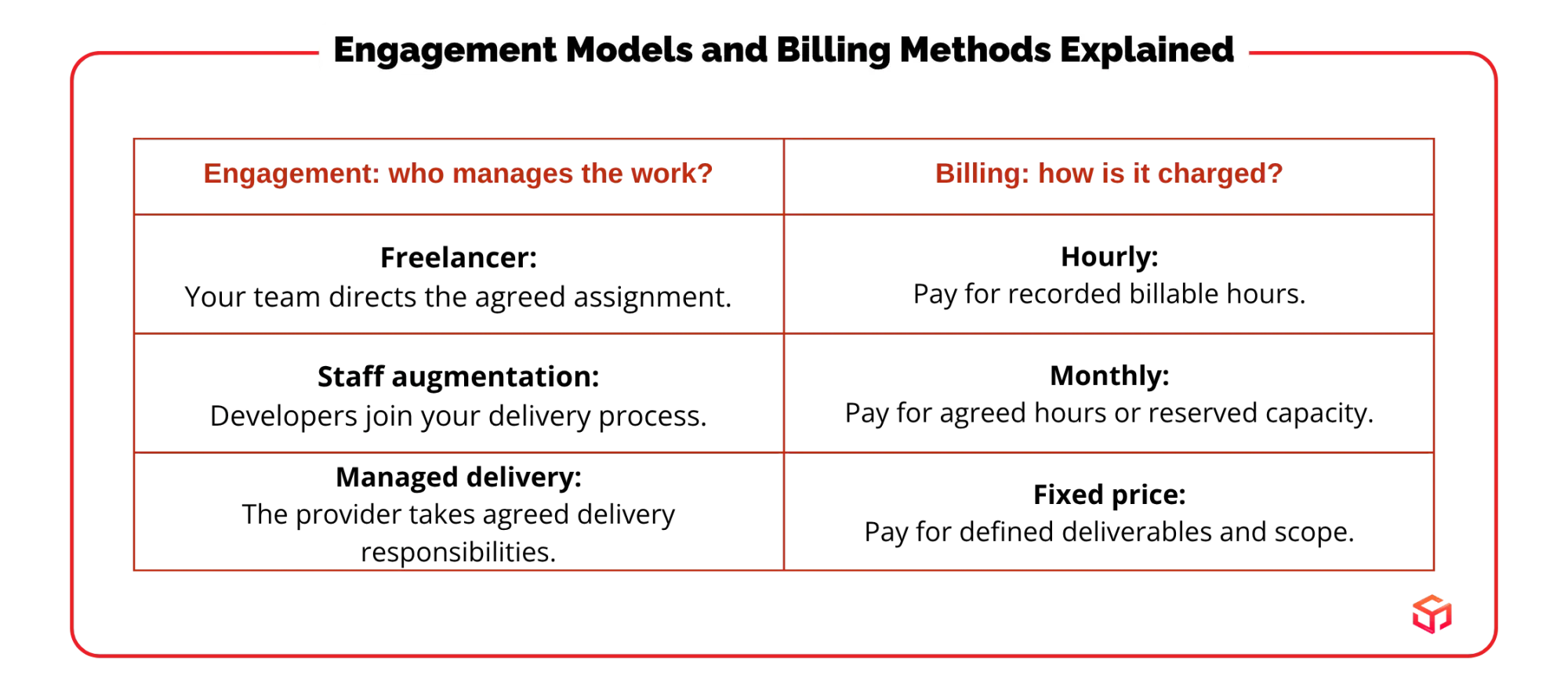
Engagement Models Define Responsibilities
Start by deciding how much of the work your team will manage.
A freelancer can suit a clearly defined task when your team can provide technical direction and review the output. When comparing costs, factor in the management and coordination your team will handle.
With IT staff augmentation services, developers join your existing team and delivery process. You typically retain control over priorities and technical decisions. Confirm whether the quote includes additional technical oversight or covers only the developer’s time.
In a managed offshore software development outsourcing arrangement, the provider may also handle planning, QA, delivery management, and release support. These responsibilities can affect the quoted price, so check exactly which services are included.
Billing Models Define the Charges
Once the responsibilities are clear, check how the vendor calculates your bill.
Hourly billing: You pay for agreed, recorded billable hours. Monthly spending changes with the hours used, so establish a budget and an approval process for additional work.
Monthly billing: You pay an agreed monthly fee for reserved capacity or a specified number of hours. Confirm the allocation and how leave, unused hours, and additional work are treated.
Fixed-price billing: You pay an agreed amount for defined deliverables. The quote depends on the scope and assumptions, so confirm how changes will be priced.
A dedicated developer or team can be billed hourly or monthly. “Dedicated” describes the staffing arrangement; it does not establish the billing method.
When comparing offshore developer hourly rates, check that the quotes cover similar responsibilities, included services, and billable capacity.
What Is Included in Offshore Developer Pricing?
Once you understand the billing method, check what the quoted price covers. It may include the developer’s time, equipment, and some support, while other services are charged separately. Getting this breakdown in writing helps you build a more complete hiring budget.
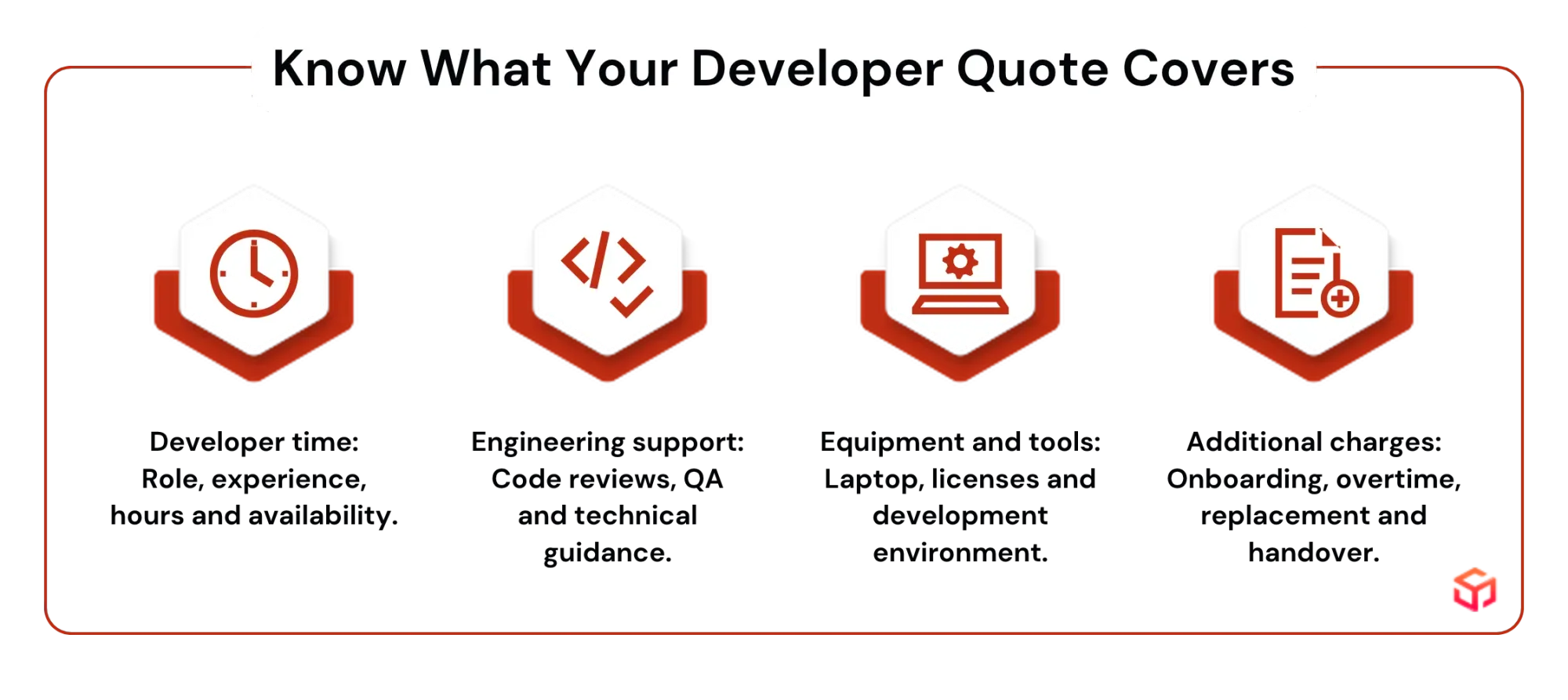
Services to Confirm in the Quoted Rate
Ask the vendor to explain which services are included and what your team will need to provide.
Developer allocation: Confirm the developer’s role, experience, available hours, and working schedule. Ask whether they will work exclusively with your team or divide their time across assignments.
Engineering support: Establish who will handle code reviews, testing, technical questions, and release coordination. Check whether this support is included or requires additional people and fees.
Equipment and tools: Confirm who provides the laptop, development environment, software licenses, and secure access. If the work requires cloud hosting or paid APIs, ask who pays for them and whether usage charges are included in the quote. Identify anything your team must arrange before development begins.
Additional Charges to Check Before Hiring
After confirming the inclusions, ask about costs that could arise when starting, changing, or ending the engagement.
Onboarding and replacement: Check whether onboarding is billable and how replacements are handled. Agree who covers knowledge transfer, training, and any period when two developers work together.
Extra hours and schedule changes: Confirm the charges for overtime, holiday work, urgent support, or extended availability. Agree that additional hours require approval before they are worked.
Notice periods and handover: Understand the minimum commitment and any charges for reducing or ending the engagement. Confirm what documentation, knowledge transfer, and access removal the handover includes.
Taxes and payment fees: Ask whether taxes, currency conversion, or payment-processing fees apply. Check whether these are included in the quote or added to the invoice.
You can then separate the developer’s fee from other expected charges and see how much the engagement could cost each month.
Know Your Hiring Costs Before Committing
Additional services can change your hiring budget. Share your role, hours, and support needs with Soft Suave to request a quote tailored to your requirements.
Request a QuoteHow to Compare Offshore Developer Quotes Fairly
When you hire dedicated developers, a fair comparison starts with giving vendors the same requirements. Their proposals should cover similar responsibilities, hours, and support so you can understand what accounts for any price difference.
Use these checks to evaluate each proposal:
Match the role and experience: Share the same responsibilities, technology requirements, and expected level of ownership. Evaluate relevant skills and previous work alongside the developer’s title and years of experience.
Compare the same hours: Calculate costs using the same monthly allocation. Check how each vendor treats meetings, required time-zone overlap, overtime, leave, and unused hours.
Compare the complete monthly cost: Add separately quoted management, QA, onboarding, tools, and other services to the developer’s fee. Ask vendors to clarify missing items before comparing the totals.
Evaluate technical fit: Review relevant work and use an agreed assessment task where appropriate. If a vendor offers a 40-hour free trial, confirm its terms and choose a small task with clear acceptance criteria. Review the code, testing, communication, and explanation of technical decisions with your engineering team.
Check continuity and contract terms: Compare replacement arrangements, notice periods, confidentiality, code ownership, and handover responsibilities. Establish who will address delivery concerns and how changes to the team will be managed.
The comparison should show both what you will pay and what your team will receive. That gives you a clearer basis for choosing an engagement that fits your requirements and budget.
How to Control Offshore Developer Hiring Costs
Now, let’s look at a question every hiring decision-maker faces: how can you keep offshore developer costs under control?
Keeping costs under control continues after you choose a developer. Clear assignments, prepared onboarding, and regular reviews help you identify unnecessary spending and adjust the engagement as your needs change.
Match experience to the assignment: Use senior expertise where technical ownership is needed. Assign clearly defined work to other experience levels when appropriate, allowing time for guidance and review.
Prepare before the developer starts: Arrange repository access, documentation, test environments, and a prioritized backlog. Assign a contact who can answer questions and resolve blockers.
Review spending alongside progress: Compare billed hours with completed work, defects, and outstanding issues. Discuss unexpected changes early to understand whether they come from additional scope, delays, or support needs.
Adjust capacity to the workload: Review the team’s roles and hours at agreed intervals. Follow notice terms when making changes, and maintain documentation so knowledge stays accessible.
These practices make the cost of hiring offshore developers easier to track. Use them to keep your spending aligned with the work being delivered throughout the engagement.
Conclusion
Knowing how much an offshore developer costs means looking beyond the hourly rate. Experience, monthly hours, included support, and contract terms all shape the budget you need.
Use the rate tables and monthly examples to compare vendors on the same basis. Match the developer’s capabilities to your project, confirm additional charges, and check how the engagement can adapt as your workload changes.
To plan your next hire, share your role requirements, technology stack, and expected hours with Soft Suave. Request a quote that clearly explains the developer’s experience, billing terms, and included services so you can make an informed hiring decision.
Frequently Asked Questions About Offshore Developer Costs
Is an Offshore Developer’s Hourly Rate the Same as Their Salary?
No. The hourly rate is what your business pays for the developer’s services. Salary is the compensation a developer receives as an employee. When hiring through a vendor, the quoted rate may also cover equipment, administration, and agreed support.
Does a Monthly Developer Fee Include a Fixed Number of Hours?
Not always. Some monthly fees cover a set number of hours, while others reserve a developer’s availability. Your agreement should explain the working schedule and what happens to unused hours or additional work.
Can I Hire an Offshore Developer Part-Time?
You may be able to, depending on the provider’s availability. Part-time hiring can suit a smaller workload, but minimum hours, response times, and the hourly rate may differ from a full-time engagement.
Does a Senior Developer Always Cost More Overall?
Not necessarily. A senior developer has a higher hourly rate in these examples, but the total depends on the hours and support required. Consider the work involved and the developer’s relevant capabilities when comparing overall costs.
Are QA and Project Management Included in Developer Rates?
Only if they are listed in the quote, a developer-only engagement may leave testing and delivery coordination with your team. If you need separate QA or project management support, include those fees in your budget.
What Should I Confirm About Replacement and Notice-Period Charges?
The key is knowing what you would need to pay if the developer changes or the engagement ends. Get written terms for replacement onboarding, knowledge transfer, notice periods, early termination, and any overlapping developer fees.

Ramesh Vayavuru is the Founder & CEO of Soft Suave Technologies, with 15+ years of experience delivering innovative IT solutions.
Related Blogs